
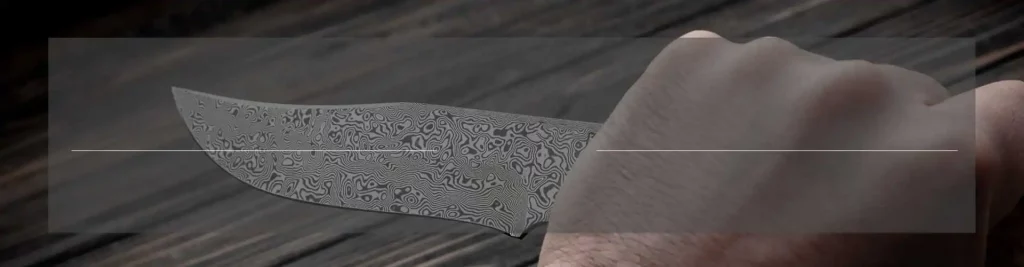
Bowie Knives: Anatomy, Balance and Which One Suits Your Work
This collection holds 11 hand-forged bowie and large field knives, from $185 to $370, running 13 to 14 inches overall. Every one is finished at HRC 58–60, guarded, and supplied with a full-grain leather sheath. Construction is split roughly evenly between full tang and hidden tang, and each listing says which.
A bowie is a big knife and that is the whole point of it. Before buying, the two things worth understanding are what the clip point and false edge actually do, and why balance decides how the knife feels far more than weight does.
Which Bowie for Which Work
| What you want it for | What to look for | From this collection |
|---|---|---|
| A first bowie, without overspending | Full tang, guard, working finish | 13 in Damascus, bone and bull horn at $185 14 in J2, full tang at $190 |
| Camp and field work | Brass guard, robust handle, plain finish | 13 in Damascus with brass guard at $235 |
| Grip that holds up when wet | Resin or dense wood rather than polished bone | J2 bowie, bull horn and resin at $240 Wenge wood bowie, J2 steel at $245 |
| Something with presence on a wall | Engraved sheath, decorative finish | Damascus bowie, hand engraved sheath at $235 Acid etched skull design, J2 at $290 |
| A piece to hand down | Stag crown, fancy handle, Damascus pattern | Damascus hunter, stag crown handle at $370 |
The Collection
All 11 knives, with prices.
-
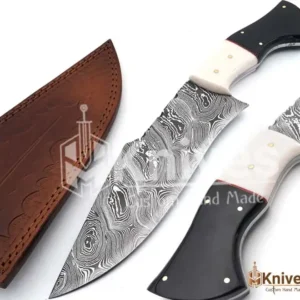
13 Inch Bowie Knife — Damascus Steel, Bone and Bull Horn Handle
$185.00 -
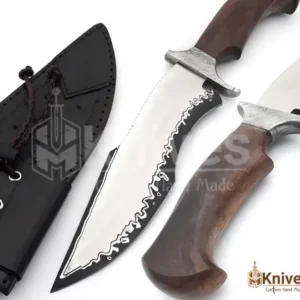
14 Inch Bowie Knife — J2 Steel, Full Tang
$190.00 -
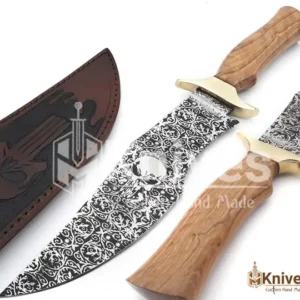
Acid Etching Hunting Knife — Skull Design, J2 Steel
$290.00 -
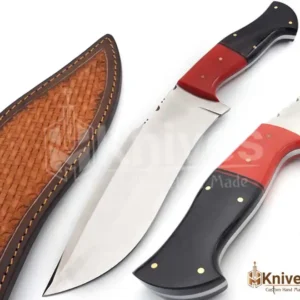
Bowie Knife — J2 Steel, Bull Horn and Resin Handle
$240.00 -
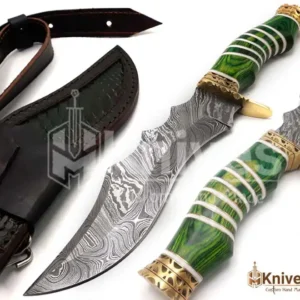
Custom Hand Made Damascus Hunting Bowie Knife with Brass Guards & Shoulder Belt Leather Sheath
$235.00 -
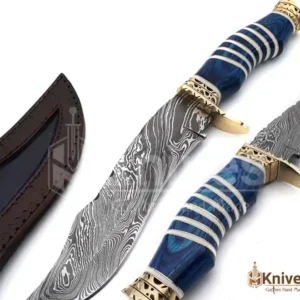
Damascus Bowie Knife with Brass Guard — 13 Inch Handmade Bowie
$235.00 -
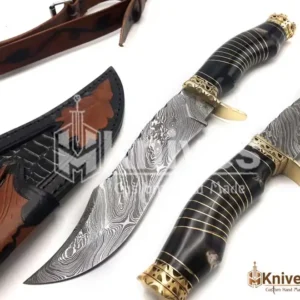
Damascus Steel Hand Made Bowie Hunting Knife with Hand Engraved Leather Sheath & Shoulder Belt
$235.00 -
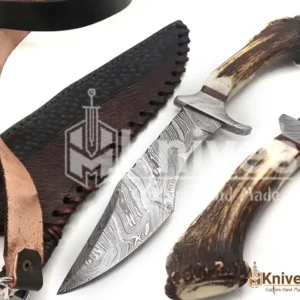
Damascus Steel Hand Made Hunter Knife with Stag Crown Handle & Fancy Hand Engraved Leather Sheath
$370.00 -
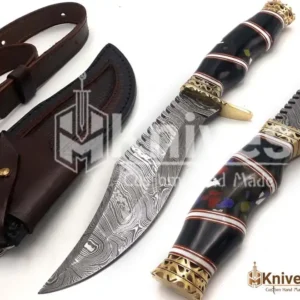
Damascus Steel Hand Made Hunting Outdoor Knife with Resin Sheet & Brass Guards Leather Sheath
$235.00 -
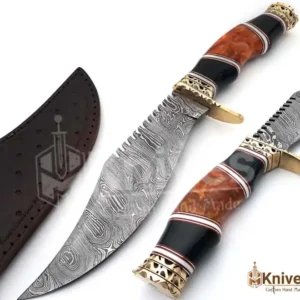
Hand Made Damascus 13 inch Bowie Knife with Brass Guard Bone Handle
$235.00 -
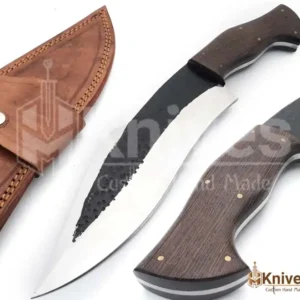
Wenge Wood Bowie Knife — J2 Steel, Full Tang
$245.00
Anatomy: The Parts That Make It a Bowie
Most of the terms attached to bowie knives describe real features that do real things. Worth knowing what you are looking at.
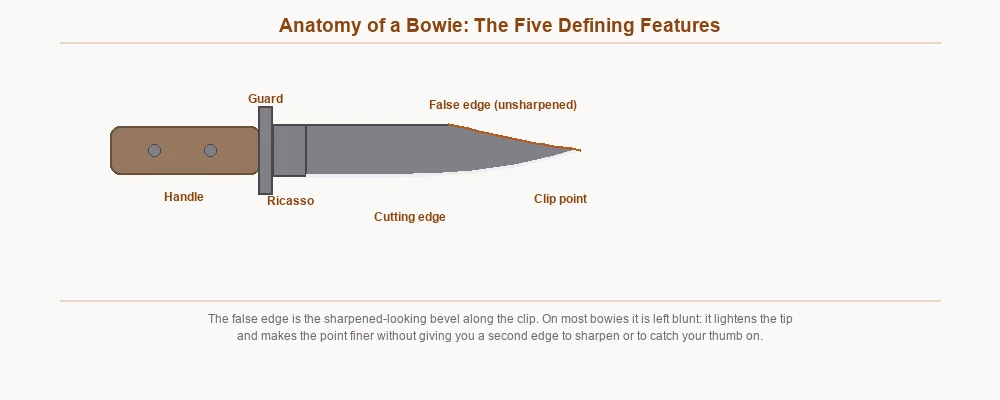
| Part | What it is | What it does |
|---|---|---|
| Clip point | A concave scoop taken out of the spine near the tip | Drops the point closer to the centreline and makes it finer, so the knife pierces well for its size |
| False edge | The bevel along that clip, usually left unsharpened | Removes metal from behind the tip, lightening the point. Sharpening it gives you a second edge to maintain and something to catch your thumb on |
| Guard | A crossbar of steel or brass between handle and blade | Stops your hand running forward onto the edge. On a knife this size that is a safety feature, not decoration |
| Ricasso | The unsharpened flat between guard and edge | Somewhere to choke up with a finger for control, and where the tang transitions into blade |
| Full tang | One piece of steel running the whole length of the handle, as opposed to a hidden tang anchored inside it | No joint where the leverage is highest. About half of these are full tang and half hidden tang — on a blade this long it is worth checking the listing |
Balance Decides How It Feels
Two bowies of identical length and near-identical weight can feel completely different in the hand, and the reason is where the mass sits relative to your grip.
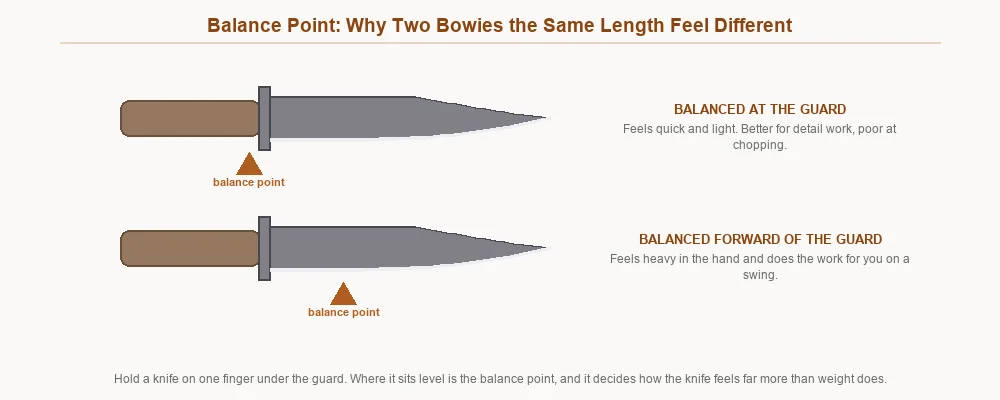
Balanced forward of the guard, the knife carries its own momentum through a swing — it chops well and feels substantial, and it tires your wrist on fine work. Balanced at or behind the guard it feels quick and lively and responds to small movements, and it will bounce off wood rather than bite. Neither is better; they are different tools. Our bowie buyer’s guide goes through this in detail.
Damascus or J2
Both steels in this collection finish at HRC 58–60 and both are carbon steels. Neither is stainless and neither has an edge-retention advantage over the other.
Damascus
1095 and 15N20 forge-welded together, folded, drawn and etched so the two alloys read as light and dark bands. On a blade this large the pattern has room to show, which is much of why bowies are the shape people most often want in Damascus. The layers are a pattern, not a performance feature — our Damascus vs high carbon guide sets out what they do and do not change.
J2
A plain high-carbon steel at the same hardness. It takes a keen edge, comes back quickly on a stone, and rusts on exactly the same schedule as the Damascus. On a large knife that will actually be used, it is the sensible buy.
Handles and Grip
A big knife amplifies whatever the handle is doing, well or badly. Materials here are bone, bull horn, sheep horn, stag, resin and wenge wood.
- Resin and wenge wood — the most secure when wet, and the most stable over years.
- Stag and stag crown — naturally textured, so the grip comes from the material itself. Every piece is different.
- Bull horn and sheep horn — warm in the hand and take a deep polish.
- Bone — handsome, and slippery once polished and wet. Ideal on a knife that will be handled and admired.
Care
- Wipe it dry after use, before anything else.
- Keep a film of oil on the blade. Mineral or camellia oil, wiped on.
- Never store it in the sheath. Leather holds moisture against steel and is tanned with salts. Carry in it, store out of it.
- Let a patina form. The grey film carbon steel develops is a stable oxide that slows further corrosion. Orange rust is the one to act on.
- Sharpen the edge, leave the false edge alone unless you have a reason to want it sharp.
Full routine in our maintenance guide; the whetstone sequence is in the sharpening guide.
Frequently Asked Questions
What actually makes a knife a bowie?
A large single-edged fixed blade with a clip point, a guard, and enough mass to chop. The clip – a concave scoop out of the spine near the tip – is the defining feature. Beyond that the name covers a wide range of shapes, and always has.
What is the false edge for?
It is the bevel ground along the clip. On most bowies it is left unsharpened. Grinding it removes metal from behind the tip, which makes the point finer and lighter without giving you a second edge to maintain or to catch your thumb on.
What size bowie should I buy?
The knives here run 13 to 14 inches overall. That is a working size: enough reach and mass to chop and to handle camp tasks, still controllable for detail work. Photographs never convey how substantial a knife this size feels in the hand.
Why do two bowies of the same length feel so different?
Balance point. Hold a knife on one finger under the guard – where it sits level is the balance point. Forward of the guard and the knife does the work for you on a swing but feels heavy. At or behind the guard and it feels quick and light but will not chop.
Do Damascus bowie knives rust?
Yes. Our Damascus is 1095 and 15N20, both carbon steels. Wipe the blade dry after use, keep a light film of oil on it, and store it out of the leather sheath – leather holds moisture and is tanned with salts that corrode carbon steel.
Is Damascus better than J2 for a bowie?
Not in how it performs. Both run at HRC 58 to 60 and behave the same on an edge and in the rain. Damascus costs more because forge-welding and folding a billet takes hours of work, and what that buys is the pattern. On a blade this size the pattern is a large part of the appeal, which is a perfectly good reason to choose it.
Can a bowie be used as a hunting knife?
For field dressing, a 13 inch bowie is more knife than the job wants – a shorter blade gives better control against hide. For camp work alongside a smaller knife, it is excellent. Several knives in this collection are listed as hunting knives for exactly that reason.
Does it come with a sheath?
Yes, every bowie here ships with a full-grain leather sheath, and several have hand engraved sheaths. Custom engraving on blade or sheath is available on request.
Guides for Choosing a Bowie Knife
These go deeper on the parts that apply across the whole workshop — steel, geometry, materials and upkeep.
- Best Bowie Knife to Buy: A Complete Buyer’s Guide — what defines a bowie, which size suits which work, and why the balance point decides whether it chops.
- Blade Profiles and When to Use Them — the clip point and the false edge explained alongside every other profile.
- Damascus vs High Carbon Steel — Damascus construction on a large blade, and its honest limits.
- Knife Materials Compared — stag, bone, micarta and wood compared on grip when wet.
- How to Sharpen a Knife: Step-by-Step — sharpening a long edge without rounding the tip.