

Viking Axes: Head Shapes, Hafts and Which One to Buy
Last updated: September 16, 2026
This collection holds 11 hand-forged axes, from $180 to $235, covering bearded axes, battle axes, camp and bushcraft axes, a throwing axe and a double-headed axe. Every head is forged from high-carbon steel at HRC 58–60 and hung on a wooden haft, and each ships with a leather sheath.
These are made to the Viking pattern rather than being reproductions of specific finds. They are newly forged, individually, and they are built to be used — which mostly comes down to matching the head shape to what you actually intend to do with it.
Forged by Our Team
These axes are hand-forged by the same team that makes our knives, at our own workshop — nothing here is outsourced or dropshipped. The work is divided by stage, the same way it is for our knives: one craftsman handles forge welding, another forges each billet to its final axe shape, and heat treatment is done individually rather than in batches. More on how our knives and axes are made.
Which Axe for What
| What you want it for | What to look for | From this collection |
|---|---|---|
| Camp work — kindling, limbing, general use | One-handed size, compact head | Viking Camping Axe, rosewood at $200 Viking Bushcraft Axe, ashwood at $200 |
| Carving and controlled cutting | A bearded head, so you can choke up on it | Bearded Viking Axe, ashwood and leather at $190 |
| Throwing | Lighter, plainer head that rotates predictably | Viking Throwing Axe, acid etched at $180 |
| Display with real construction underneath | Decorative handle work, etched or carved | Hand-carved handle design at $190 Etched axe, leather-wrapped handle at $190 |
| A grip that stays put | Rope or leather wrapping over the haft | Engraved ashwood with rope wrapping at $190 Textured ashwood handle at $190 |
| The most substantial piece here | Two bits, most mass | Double Headed Viking Axe, rosewood at $235 |
| A named piece | Heavier build, rosewood or ashwood | Ragnar Viking Axe at $190 Viking Tactical Axe, rosewood at $200 |
The Collection
All 11 axes, with prices.
-
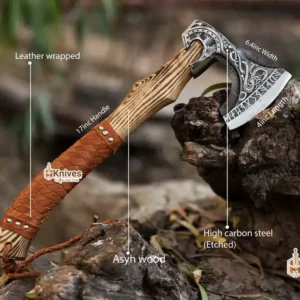
Bearded Viking Axe — Forged Carbon Steel with Ashwood Handle & Brown Leather Wrap
$190.00 -
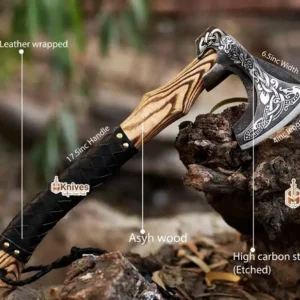
Carbon Steel Viking Axe — Hand Forged with Textured Ashwood Handle
$190.00 -
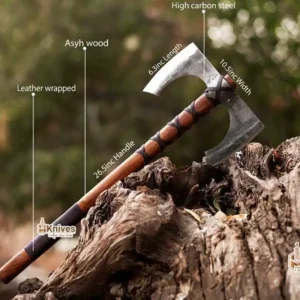
Double Headed Viking Axe — Forged Carbon Steel with Rosewood Handle
$235.00 -
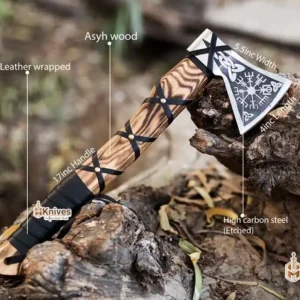
Etched Viking Axe — Forged Carbon Steel with Black Leather-Wrapped Handle
$190.00 -
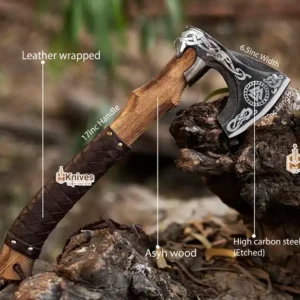
Ragnar Viking Axe — Forged Carbon Steel with Ashwood Handle
$190.00 -
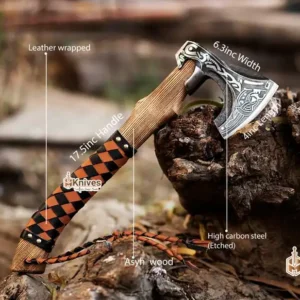
Viking Axe with Hand-Carved Handle Design — Forged Carbon Steel
$190.00 -
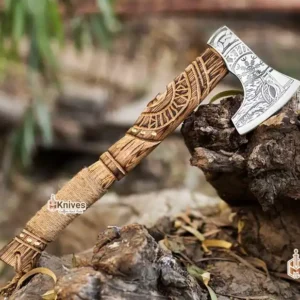
Viking Axe, Engraved Ashwood Handle & Rope Wrapping
$190.00 -
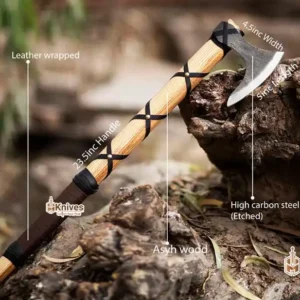
Viking Bushcraft Axe — Forged Carbon Steel with Ashwood Handle
$200.00 -
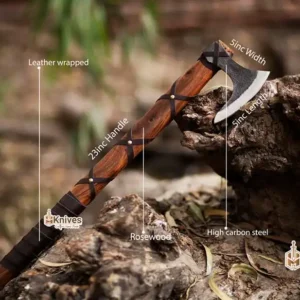
Viking Camping Axe — Forged Carbon Steel with a Rosewood Shaft
$200.00 -
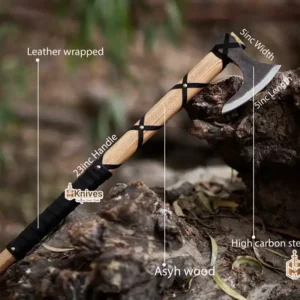
Viking Tactical Axe — Forged Carbon Steel with Rosewood Handle
$200.00 -
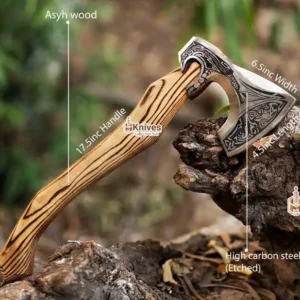
Viking Throwing Axe — Forged Carbon Steel with Acid-Etched Blade
$180.00
Anatomy of a Bearded Axe
The bearded axe is the shape most people picture, and the beard is a real piece of engineering rather than decoration.
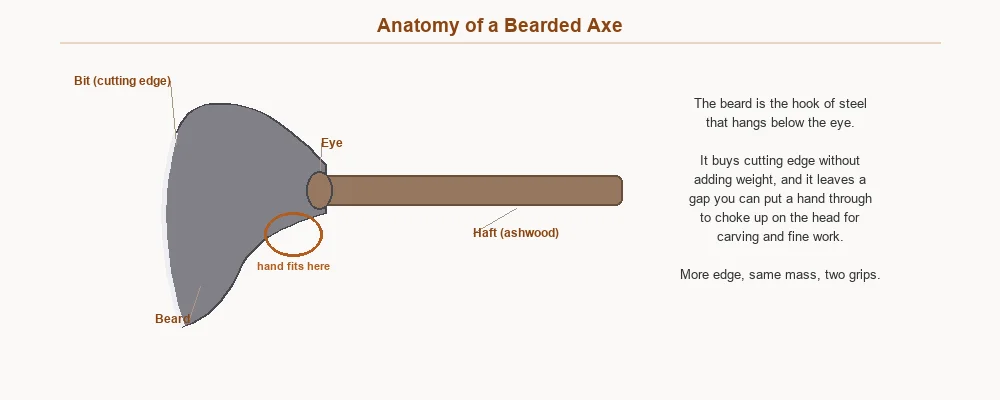
Steel hung below the eye buys cutting edge without buying weight — a longer bit for the same mass in your hand. The gap it leaves between the beard and the haft is big enough to put a hand through, so you can slide your grip right up under the head and use the axe like a heavy knife for carving. One tool, two grips, and that is why the shape survived.
Head Shapes and What Each Is Weighted For
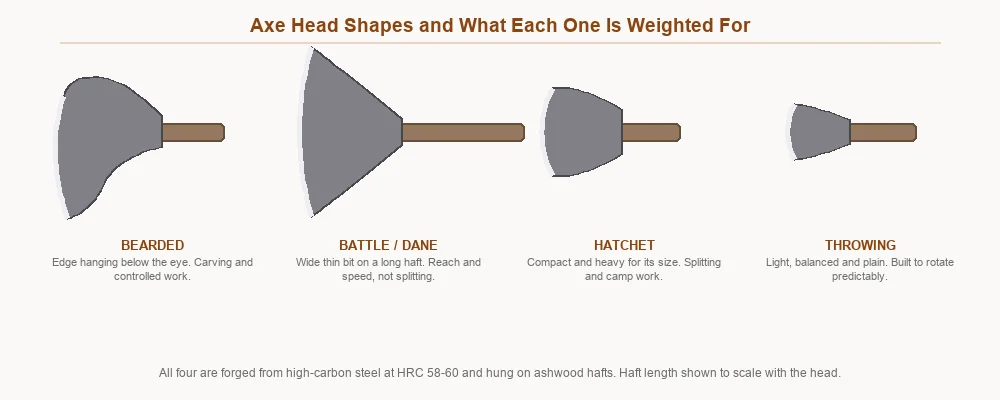
The four patterns in this collection are genuinely different tools, not one tool at four sizes.
| Pattern | The shape | What it does well | What it does badly |
|---|---|---|---|
| Bearded | Lower bit hangs below the eye, leaving a gap at the haft | Carving, controlled cutting, choking up for fine work | Heavy splitting — the thin bit is not a wedge |
| Battle / Dane | Wide, thin, sweeping crescent on a longer haft | Reach and speed. Almost all edge and very little mass | Splitting wood. It is not built to wedge anything apart |
| Hatchet | Compact and deep, mass concentrated near the haft | Splitting kindling and general camp work one-handed | Reach, and any fine work |
| Throwing | Small, light, plain, balanced | Rotating predictably at a consistent distance | Actual woodwork — too light to do much |
Hafts
Handle material changes how an axe feels more than most buyers expect.
- Ashwood — the traditional choice, and still the best one. It is springy and absorbs the shock of impact rather than transmitting it into your wrist.
- Rosewood — denser and heavier, with a darker figure. More mass in the hand and a harder feel on impact.
- Leather or rope wrapping — adds grip, particularly with cold or wet hands, and takes the sting out of a mis-hit.
Whichever you choose, the haft is the part that needs looking after. Oil it once or twice a year, keep it dry, and never keep using an axe whose head feels loose on the eye.
Care and Sharpening
An axe is not a knife and should not be treated like one. The edge survives impact rather than slicing, so it wants a more obtuse bevel, and it is maintained with different tools.
- Sharpen with a file or a puck, not a bench stone, following the existing bevel from the middle of the bit outward.
- Wipe the head dry and oil it. High-carbon steel rusts; this is not stainless.
- Do not store it in the leather sheath. Leather holds moisture against the steel.
- Oil the haft once or twice a year with boiled linseed oil.
- Check the head is tight before every session. A dry haft shrinks, and a loose head is genuinely dangerous.
Our maintenance guide covers rust prevention on carbon steel in general, and the axe care page goes further on hafts and heads.
Frequently Asked Questions
What makes an axe a Viking axe?
A single-bit head with a relatively thin, wide bit and a shape that flares forward from the eye, hung on a straight wooden haft. The bearded form – where the lower part of the bit hangs below the eye – is the most recognisable. It is a shape, not a period: these are newly forged axes made to that pattern.
What is the beard for?
It is the hook of steel hanging below the eye. It adds cutting edge without adding much weight, and it leaves a gap you can put a hand through so you can choke up on the head for carving and fine work. More edge, the same mass, and two ways to hold it.
How hard are the axe heads?
HRC 58 to 60, forged from high-carbon steel. That is hard enough to hold an edge through real use and tough enough not to chip on impact.
What are the handles made from?
Most are ashwood, which is the traditional choice because it is springy and absorbs shock well. Several are rosewood, which is denser and heavier. Some have leather wrapping or rope wrapping over the grip. Check the individual listing.
Which axe should I buy for camping?
The Camping Axe or the Bushcraft Axe. Both are sized for one-handed use around a camp – splitting kindling, limbing, general work – rather than for felling or for display.
Is the throwing axe balanced for throwing?
It is built to the lighter, plainer pattern that throwing asks for, so it rotates more predictably than a heavy bearded axe would. Throwing is a skill that depends far more on consistent distance and release than on the axe.
Do the axe heads rust?
Yes. These are high-carbon steel, not stainless. Wipe the head dry after use, keep a film of oil on it, and do not leave it in a damp shed or in its leather sheath.
How do I look after the handle?
Keep it dry, and oil it once or twice a year with boiled linseed oil. A dry handle shrinks and the head loosens on the eye, which is the usual reason an axe head comes off. If it ever feels loose, stop using it until it is re-hung.
How do I sharpen an axe?
Differently from a knife. Use a file or a puck rather than a bench stone, follow the existing bevel, and work from the middle of the bit out towards each end. An axe wants a more obtuse edge than a knife because it survives impact rather than slicing.
Guides Worth Reading
These go deeper on the parts that apply across the whole workshop — steel, geometry, materials and upkeep.
- How to Choose the Right Viking Axe: A Buyer’s Guide — budget, head shape, handle material and a use-case table matched to the exact listings in this collection.
- The History and Mythology of the Viking Axe — named axes in the sagas, the Dane axe at Hastings, and what Viking graves actually show.
- Viking Axe vs. Battle Axe vs. Bearded Axe vs. Tomahawk — what actually separates these terms, and why a bearded axe is not a different product from a Viking axe.
- Knife Steel Types and How They Perform — what hardness means on an impact tool rather than a slicing edge.
- Complete Knife Maintenance & Care Guide — oiling a head, drying a haft, and keeping a carbon steel edge honed.
- How Damascus Steel Is Actually Made — how a billet is forged, folded and etched in the same workshop.
- Knife Materials Compared — wood, leather and steel, and how each behaves over years.
- Is Handmade Really Better Than Production? — what hand forging genuinely buys you, and where it does not.