
Daggers, Trekkers & Karambits: Three Shapes, Three Different Jobs
This is the specialist end of the workshop: six hand-forged knives from $110 to $315, covering three geometries that have almost nothing in common with each other. All are finished at HRC 58–60. Four are full tang and two are hidden or half tang — each listing says which.
None of these is a general-purpose knife, and that is the point of them. A dagger is built to thrust, a tanto is built around an unbreakable tip, and a karambit cuts on the pull. If you want one knife that does most things, buy a drop point instead — this collection is for people who want a specific thing.
Which One and Why
| What draws you to it | What you are getting | From this collection |
|---|---|---|
| A working outdoor dagger, least maintenance | D2 tool steel, better rust resistance | D2 Hunting Dagger, sheep horn at $110 |
| A dagger built for outdoor use | Damascus pattern, full tang, field ready | Damascus Dagger, hunting and survival at $155 |
| The strongest tip shape here | Tanto geometry, genuine stag handle | Damascus Tanto, stag handle at $160 |
| A pulling cut and a reverse grip | Karambit curve with a finger ring | Karambit for outdoor use, J2 at $195 Bone Karambit, horn and bone at $195 |
| A presentation piece | High polish finish, Damascus handle | High Polish Trekker Dagger at $315 |
The Collection
All six knives, with prices.
-
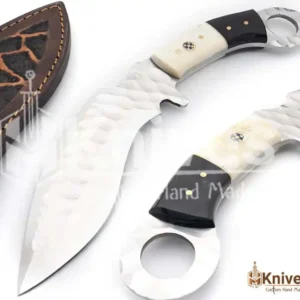
Bone Karambit Knife — Full Tang, Genuine Horn and Bone Handle
$195.00 -
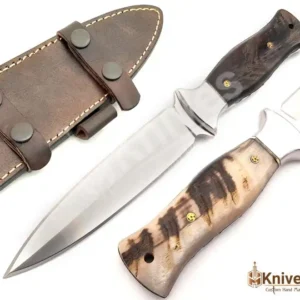
D2 Steel Hunting Dagger Knife with Sheep Horn Handle
$110.00 -
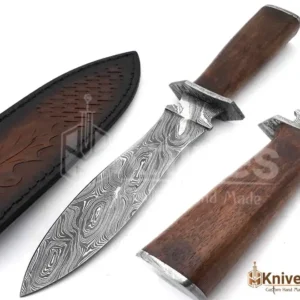
Damascus Dagger Knife — Built for Hunting and Outdoor Survival
$155.00 -
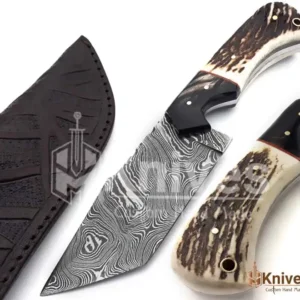
Damascus Tanto Knife — Genuine Stag Handle
$160.00 -
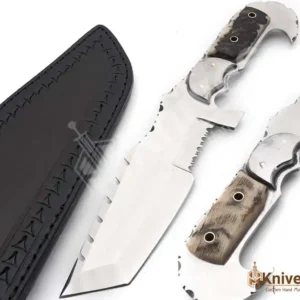
High Polish Trekker Dagger — Sheep Horn and Damascus Handle
$315.00 -
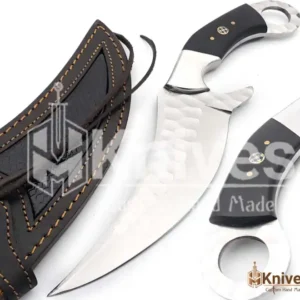
Karambit Knife for Outdoor Use — J2 Steel, Full Tang
$195.00
Three Geometries
Drawn to shape, so the differences are visible rather than described.
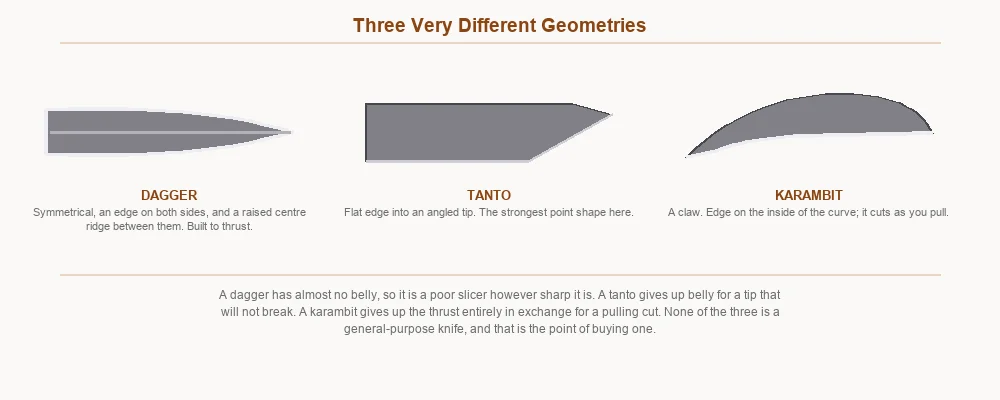
| Shape | Defining feature | Good at | Poor at |
|---|---|---|---|
| Dagger | Symmetrical, edged both sides, raised centre ridge, centred point | Thrusting. Also the shape people most want on a wall | Slicing — almost no belly. And two edges to sharpen |
| Tanto | Flat primary edge meeting a short angled tip in a distinct corner | A tip that will not break, and a straight edge that is easy to sharpen | Skinning or any sweeping cut — no belly at all |
| Karambit | Curved blade with the edge on the inside of the curve, ring at the butt | Pulling cuts, and keeping the edge engaged through a stroke | Everything a normal knife does. It is not a utility blade |
Which Direction the Blade Cuts
The least obvious difference between these shapes, and the most important one in the hand.
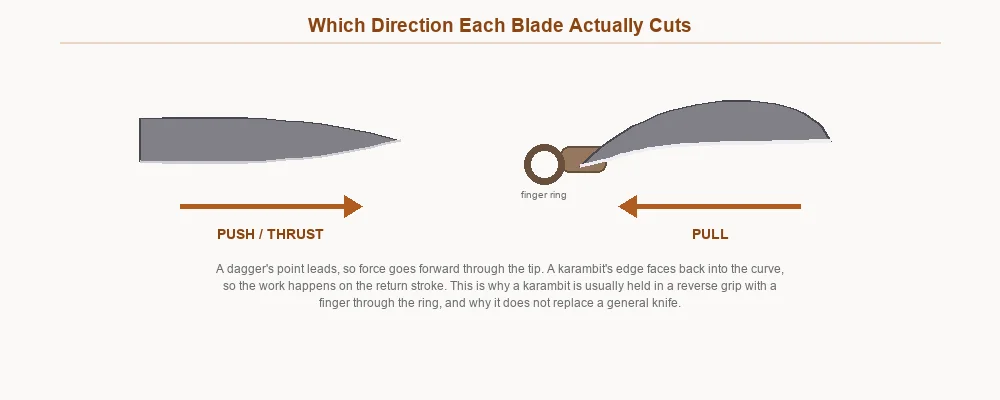
A dagger’s point leads, so force travels forward through the tip — it is a thrusting tool and everything about the symmetry serves that. A karambit’s edge faces back into the curve, so the work happens as you draw the knife toward you. That is why it is held in a reverse grip with a finger through the ring, and why it will feel wrong to anyone expecting a normal knife.
The Trekker
The High Polish Trekker Dagger sits apart from the rest. It is finished as a presentation piece — mirror polish, Damascus handle, sheep horn — rather than as a field tool, and it is the most expensive knife in this collection at $315. Underneath the finish it is built like the others: full tang, HRC 58–60, hand forged. You are paying for the finishing work, which is where a large share of the hours on any knife go.
Steel
Damascus, J2 and D2 appear here, all finished at HRC 58–60.
Our Damascus is 1095 and 15N20 forge-welded together, folded, drawn and etched — both carbon steels, so it rusts like plain carbon and is bought for the pattern rather than for performance. J2 is a plain carbon steel that does the same job for less. D2 is a high-chromium tool steel that resists rust noticeably better without being stainless, and is harder to sharpen in exchange. Our steel types guide compares them properly.
One practical note specific to this collection: a double-edged blade is twice the sharpening work, and a karambit’s inside curve needs a rod or a narrow stone rather than a flat bench stone. Factor that in if you intend to use rather than display them.
Care
- Wipe dry after handling, especially the polished pieces — fingerprints etch a mirror finish.
- Keep a film of oil on the blade.
- Store out of the leather sheath. Leather holds moisture and is tanned with salts.
- Sharpen both bevels evenly on a dagger, or the point drifts off centre over time.
- Use a rod or narrow stone for a karambit’s inside curve.
Frequently Asked Questions
What makes a knife a dagger rather than a knife?
Two things: an edge on both sides, and a symmetrical taper to a centred point, usually with a raised ridge running down the middle. That geometry is built to thrust. It is also why a dagger is a poor slicer – there is almost no belly to it.
What is a karambit actually for?
It is a curved blade with the edge on the inside of the curve, so it cuts on the pull rather than the push. It comes from Southeast Asian agricultural tools and is normally held in a reverse grip with a finger through the ring at the butt. It is a specialist shape, not a general utility knife.
Why does a tanto have that angled tip?
Because the corner where the flat edge meets the angled tip puts a lot of steel directly behind the point. That makes it the strongest tip shape here and very hard to break. The trade is that a tanto has essentially no belly, so it is poor at skinning or any sweeping cut.
Are these practical knives or display pieces?
Both, depending which. The D2 hunting dagger and the Damascus dagger are built as working outdoor knives. The High Polish Trekker is finished as a presentation piece. All of them are functional rather than ornamental. They differ in finish and in tang construction, which each listing states.
Can I use a dagger for hunting?
For piercing, yes. For skinning, not well – a dagger has almost no belly, and belly is what does the work when you separate hide. If you want one knife for field work, a drop point from our hunting collection is a better tool.
Do double-edged blades take twice as long to sharpen?
In practice, yes, roughly. You have two bevels to raise a burr on and remove it from rather than one. It is not difficult, it is simply twice the work, and it is worth knowing before you buy one as an everyday user.
Are these legal to own and carry?
Ownership and carry rules for double-edged blades and karambits vary widely by country and often within a country, and double-edged knives are restricted in more places than single-edged ones. Check your local law before ordering. That is your responsibility, not ours.
Will they rust?
The Damascus and J2 pieces will if neglected – both are carbon steels. The D2 dagger resists rust noticeably better but is not stainless. Wipe dry, keep a film of oil on the blade, and store out of the leather sheath.
Guides for Choosing a Specialist Blade
These go deeper on the parts that apply across the whole workshop — steel, geometry, materials and upkeep.
- Blade Profiles and When to Use Them — symmetrical, recurve and tanto profiles, and what each geometry is for.
- Knife Steel Types and How They Perform — steel choice for a blade that is mostly point.
- Folding vs Fixed Blade Knives — fixed blade strength versus folding carry.
- Knife Materials Compared — handle and pin materials on a knife held in reverse grip.
- How to Sharpen a Knife: Step-by-Step — raising and removing a burr, which you do twice on a double-edged blade.