

Folding Knives: How the Lock Works and Which One to Carry
This collection holds five hand-forged Damascus folding knives, from $110 to $135. They are everyday carry knives: small enough to live in a pocket, built to be opened one-handed and to lock open while you use them.
Two things worth knowing before you buy. First, the Damascus here is 1095 and 15N20 — both carbon steels, so these blades rust if neglected, and the pivot needs attention as well as the edge. Second, a folder is not a fixed blade. Everything it can carry runs through one pin and one small piece of sprung metal.
Which Folder to Carry
| What you want | From this collection |
|---|---|
| A proven, robust lock you can feel engage | Back Lock Damascus Folder at $110 |
| The simplest thing that works, at the lowest price here | Easy Knife Damascus Folder at $110 |
| A traditional two-blade pattern | Trapper Folding Knife at $125 |
| Something less common in the pocket | Dasori Folding Knife at $130 |
| The largest and most finished of the five | Saab Folding Knife at $135 |
The Collection
All five folders, with prices.
-
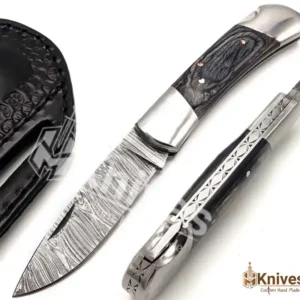
Back Lock Knife Hand Made Damascus Folding EDC Knife
$110.00 -
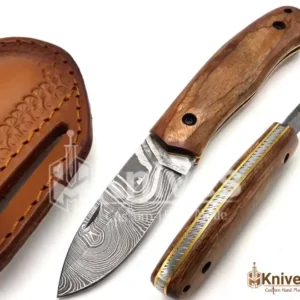
Dasori Folding Knife Hand Made Damascus Steel EDC Folding Knife
$130.00 -
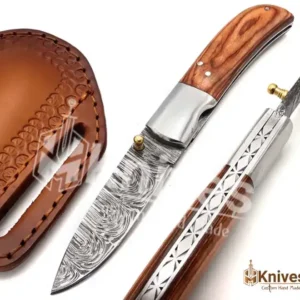
Easy Knife Hand Made Damascus Folding EDC Knife
$110.00 -
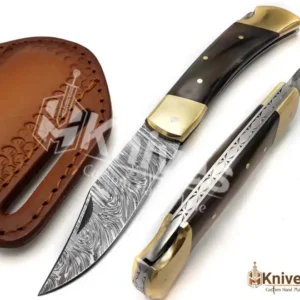
Saab Folding Knife Hand Made Damascus Steel EDC Folding Knife
$135.00 -
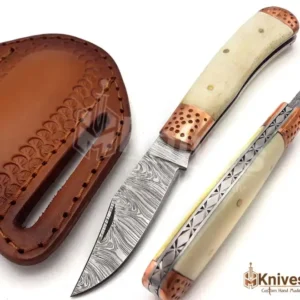
Trapper Folding Knife Hand Made Damascus EDC Folding Knife
$125.00
What Actually Holds the Blade Open
This is the part of a folding knife that matters and the part nobody looks at. When you cut with a folder, the force you apply tries to rotate the blade shut. Something has to stop that, and in every design it is one small sprung component bearing on the blade’s tang.
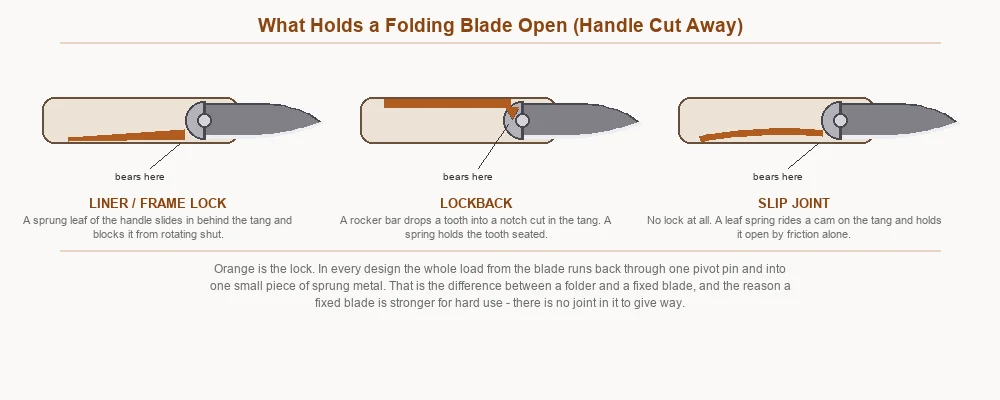
| Lock | How it holds | In practice |
|---|---|---|
| Liner or frame lock | A sprung leaf of the handle slides in behind the tang and blocks it rotating shut | Easy to close one-handed, since your thumb pushes the leaf aside. The leaf is doing all the work |
| Lockback | A rocker bar drops a tooth into a notch cut in the tang, held down by a spring | Very positive engagement and an audible click. Needs two hands to close. This is what the Back Lock in this collection uses |
| Slip joint | No lock at all — a leaf spring rides a cam on the tang and holds the blade open by friction | Legal in more places precisely because it does not lock. Fine for light cutting, and it will fold on your fingers if you push it |
The important point is the one the diagram makes: whichever design you choose, the load path runs blade → tang → pivot pin → lock. A full tang fixed blade has no joint anywhere in that path, which is why it is the right tool the moment the work gets hard.
Why Pocket Knives Are the Size They Are
There is a hard geometric limit on a folding knife that people rarely state plainly: the blade has to fit inside the handle.
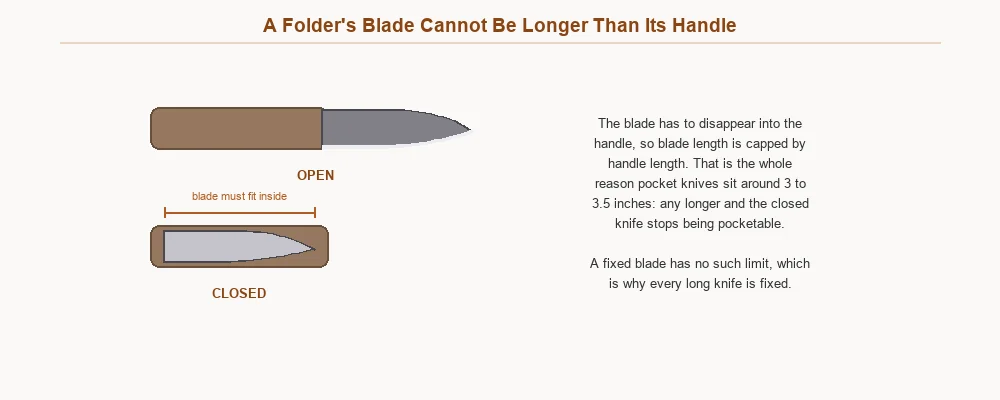
A four inch blade needs a handle over four inches long, which gives you a closed knife the size of a small torch. That is why everyday carry folders cluster around three to three and a half inches of blade, and why every genuinely long knife ever made is a fixed blade. It is not a fashion, it is arithmetic.
Damascus in a Folder
Every folder in this collection is Damascus — 1095 and 15N20 forge-welded, folded, drawn out and etched so the two alloys show as light and dark bands. Both are carbon steels, finished at HRC 58–60.
What that means in a pocket: the blade takes a fine edge and comes back easily on a stone, and it will spot if you close it wet or carry it against a damp pocket lining. The pattern is what the extra labour buys you. It is not an edge-retention feature, and our Damascus vs high carbon guide explains exactly why.
Looking After a Folder
- Dry the blade before you close it. A closed folder holds moisture against the steel with nowhere for it to go.
- Clean the pivot, not just the edge. Lint and grit collect there and are the usual cause of a stiff or gritty action.
- One drop of light oil on the pivot, worked in by opening and closing. More than a drop just attracts dust.
- Keep a film of oil on the blade, as with any carbon steel.
- Do not pry with it. Lateral load is exactly what a pivot is worst at resisting.
The general routine is in our knife maintenance guide.
Frequently Asked Questions
Are these folding knives legal to carry?
That depends entirely on where you are, and it is your responsibility to check. Blade length limits, locking mechanisms and ‘good reason’ requirements all vary by country and often by region within a country. A locking knife that is unremarkable in one place is restricted in another.
Is a folding knife as strong as a fixed blade?
No, and nothing will make it so. A folder routes every bit of load through a pivot pin and a small sprung lock. A full tang fixed blade is one piece of steel with no joint in it. For prying, batoning or any hard use, take a fixed blade.
Do Damascus folding knives rust?
Yes. Our Damascus is 1095 and 15N20, both carbon steels, so a folder needs the same care as a fixed blade plus a little more: the pivot traps moisture and lint. Wipe the blade, put a drop of oil on the pivot occasionally, and do not put it away wet.
What is a back lock?
A rocker bar running down the spine of the handle drops a tooth into a notch cut in the blade tang, and a spring holds it seated. You release it by pressing the exposed part of the bar. It is one of the older and more robust folding lock designs.
Why are pocket knife blades usually around three inches?
Because the blade has to disappear inside the handle when closed, so blade length is capped by handle length. Much beyond three and a half inches and the closed knife stops being comfortable in a pocket. That geometric limit, not fashion, is why the category clusters where it does.
How do I clean a folding knife?
Rinse and dry the blade as usual, then deal with the pivot: warm water flushed through, dried thoroughly, and a single drop of light oil worked in by opening and closing the knife. Pocket lint and dust in the pivot cause far more stiff actions than corrosion does.
Can I have a folding knife engraved?
Yes, custom engraving is available on request. Engraved orders take longer to ship than stock items.
Guides for Choosing a Folding Knife
These go deeper on the parts that apply across the whole workshop — steel, geometry, materials and upkeep.
- Folding vs Fixed Blade Knives — how a lock carries load, which lock types exist, and the geometry that caps blade length.
- Best Knife Type for Every Use Case — what everyday carry actually asks of a knife.
- Complete Knife Maintenance & Care Guide — why a folder needs the pivot cleaned, not just the edge honed.
- Where to Spend Your Money on Knives — where the money helps on a folder and where it stops helping.
- Damascus vs High Carbon Steel — what the layers genuinely change, and what they do not.