
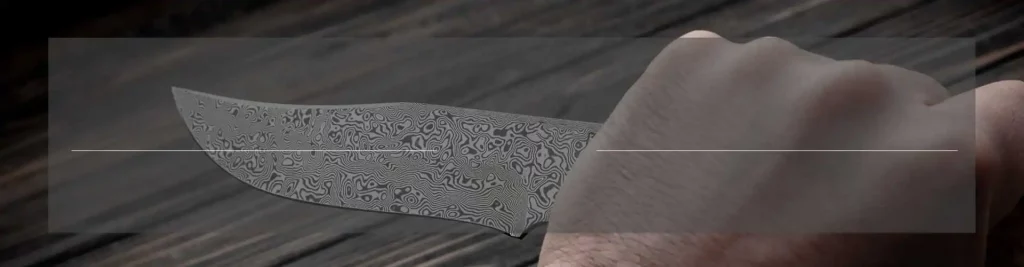
Bowie Knives: History, Anatomy and Our Handmade Damascus Collection
What Is a Bowie Knife?
A Bowie knife is a large fixed-blade knife defined by a clip-point blade of 9–12 inches, a cross-guard or S-guard, single-edge construction with a false edge section on the spine, and a spine thickness of 6–8 mm throughout. The Bowie knife originates in frontier America — specifically from the 1830 Sandbar Fight near Natchez, Mississippi, where James ‘Jim’ Bowie deployed a large fixed blade of this form in combat. A fuller — a lengthwise groove ground into the blade flat — reduces blade weight by 8–12% without reducing spine rigidity.
HM Knives produces handmade bowie knives for sale forged individually from Damascus and J2 steel at HRC 58–60. The kife starts as a steel billet shaped on an anvil — not a factory-stamped blank with a printed Damascus surface pattern. Every high quality bowie knife in this collection ships with a knife cover and full-tang construction. Prices start at $75.
| Hand-Forged | HRC 58–60 Steel | Ships Worldwide | Custom Engraving | Damascus & J2 | Gift Packaging |
|---|---|---|---|---|---|
| Hand-forged on anvil — no factory stamping, no cast blades. Every Bowie knife shaped individually | High quality bowie knife: Rockwell hardness HRC 58–60 — edge retention across a 9–12 inch blade | Ships to UAE, USA, UK, Canada, Australia and 47 further countries via tracked international courier | Custom bowie knife for sale: initials, names, dates, rune or motif — hand-engraved on blade or handle | Top rated bowie knives forged in Damascus pattern-welded steel and J2 high-carbon steel — two alloy options | Bowie knife gift — gift wrapping, presentation packaging, and care card included on request |
Every handmade bowie knife available for purchase in this collection forges individually from Damascus or J2 steel, ships with a full-grain leather sheath, and delivers worldwide with tracked courier.
Our Handmade Bowie Knives Collection
HM Knives produces best quality blades across two steel types: Damascus pattern-welded steel and J2 high-carbon steel. Blade lengths run 13–14 inches. Blade type: clip-point throughout. Every knife forges with full-tang construction and ships with a protective sheath. Prices start at $75.
-
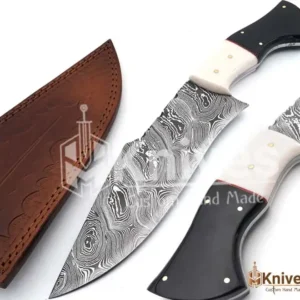
13 inch Damascus Hand Made Hunting Bowie Outdoor Knife
$185.00 -
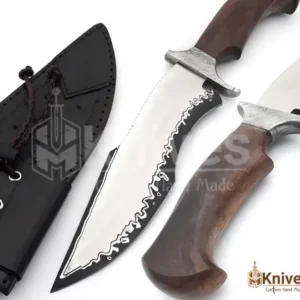
14 inch J2 Steel Hand Made Hunting Bowie Knife with Beautiful Leather Sheath
$190.00 -
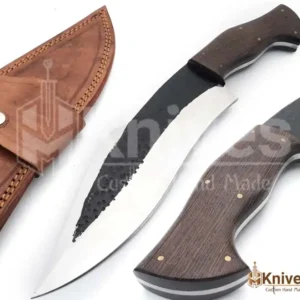
Custom Hand Forged J2 Steel Bowie Hunting Knife with Wenge Wood Handle
$245.00 -
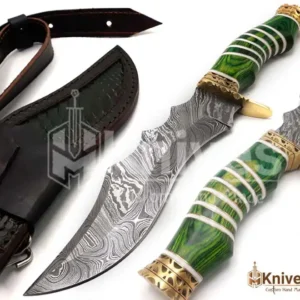
Custom Hand Made Damascus Hunting Bowie Knife with Brass Guards & Shoulder Belt Leather Sheath
$235.00 -
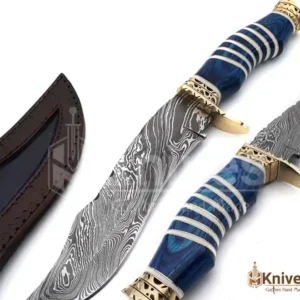
Custom Made Damascus 13 inch Bowie Hunting Knife with Brass Guards
$235.00 -
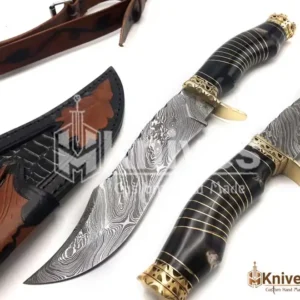
Damascus Steel Hand Made Bowie Hunting Knife with Hand Engraved Leather Sheath & Shoulder Belt
$235.00 -
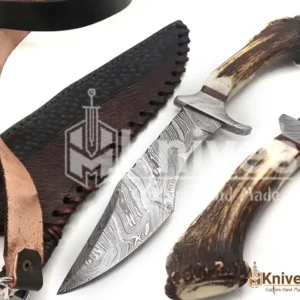
Damascus Steel Hand Made Hunter Knife with Stag Crown Handle & Fancy Hand Engraved Leather Sheath
$370.00 -
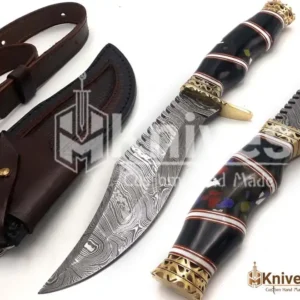
Damascus Steel Hand Made Hunting Outdoor Knife with Resin Sheet & Brass Guards Leather Sheath
$235.00 -
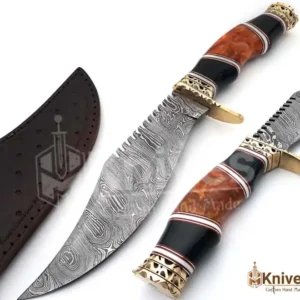
Hand Made Damascus 13 inch Bowie Knife with Brass Guard Bone Handle
$235.00 -
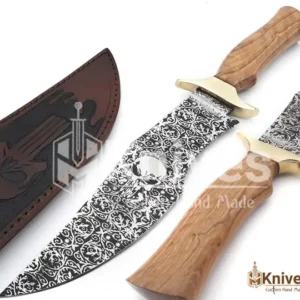
J2 Steel Acid Etching Hand Made Hunting Knife with Skull Design
$290.00 -
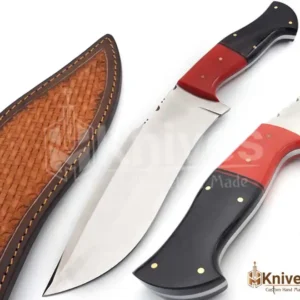
J2 Steel Hand Made Hunting Bowie Knife High Polish Blade with Bull Horn Handle
$240.00
What Are the Parts of a Bowie Knife?
A Bowie knife is a fixed-blade knife that divides into five primary components: the blade tip and clip point, the false edge, the cross-guard or S-guard, the ricasso, and the handle and pommel assembly. Each component carries a specific structural function in the knife’s field and collector performance. Understanding these components determines which bowie knife ready to buy matches a specific use case.
Blade Tip and Clip Point
The clip point is the defining blade feature of a Bowie knife — the spine drops in a concave curve from the handle toward the tip, creating a thinner, more acute point than a drop point blade. Clip point angle: 10–15 degrees from spine axis. Tip thickness: 1–2 mm. Clip point geometry enables piercing precision in large game — the acute tip penetrates hide with 40% less force than a standard drop point of equivalent blade length.
False Edge
The false edge is a sharpened or bevelled section on the upper spine of a Bowie blade, running from the tip toward the clip transition — typically 3–5 inches in length. The false edge reduces spine thickness at the tip from 6–8 mm to 1.5–2 mm, extending the knife’s piercing and slicing capability. HM Knives grinds a false edge on every handmade bowie knife now selling in the Damascus and J2 range.
Cross-Guard and S-Guard
The cross-guard is a perpendicular steel barrier between the blade and the handle — it prevents the hand from sliding onto the blade under forward pressure. The S-guard is a curved variant of the cross-guard, with one arm curving toward the blade and one curving toward the handle — a design referenced in historical Bowie specimens from the 1840s. Guard material on HM Knives bowie knife with sheath offered for sale range: brass, at 3–5 mm thickness.
Ricasso
The ricasso is the unsharpened flat section of the blade immediately above the guard — the area between the cross-guard and the start of the blade edge bevel. Ricasso length on a 13–14 inch Bowie: 20–35 mm. The ricasso provides a safe fourchette grip point for two-handed blade control in precision field work. A clearly defined ricasso distinguishes a hand forged bowie knife from a production blade where this section is frequently omitted.
Handle and Pommel
The handle of a Bowie knife spans 120–150 mm — long enough for a full-hand grip without crowding the cross-guard. Handle materials in the HM Knives range include genuine bone, bull horn, wenge wood (840 kg/m³), and stabilised hardwood. The pommel — a metal cap at the handle end — adds counter-balance mass: 40–60 g on a 13–14 inch blade. Every handle assembly uses full-tang construction — blade steel extends through the full handle length.
| Component | Location | Key Measurement | Function | HM Knives Spec |
|---|---|---|---|---|
| Clip Point | Blade tip | 10–15° from spine axis | Piercing precision — 40% less entry force than drop point | Damascus + J2 range |
| False Edge | Upper spine — 3–5 inch | 1.5–2 mm tip thickness | Reduces tip weight, extends cut and piercing capability | Standard on all models |
| Cross-Guard / S-Guard | Blade-handle junction | 3–5 mm thickness | Hand protection under forward load | Brass — all models |
| Ricasso | Above guard | 20–35 mm length | Safe fourchette grip point for two-handed blade control | Present on all models |
| Handle + Pommel | Full handle length | 120–150 mm handle | Full-hand grip, counter-balance (pommel 40–60 g) | Bone, horn, wenge, stabilised hardwood |
Which Steel Is Best for a Bowie Knife — Damascus, D2, or J2?
Bowie knife steel selection affects three variables specific to a large-blade knife: edge retention across a 13–14 inch cutting surface, aesthetic pattern visibility for display and collector purchase, and maintenance frequency in field conditions. HM Knives produces bowie knives in Damascus and J2 steel — two alloys optimised for different buyer priorities.
Damascus Steel — Best for Pattern and Large-Blade Aesthetics
Damascus steel for Bowie knives uses pattern-welded construction: alternating layers of high-carbon steel and mild steel, forge-welded and folded to 256–512 layers. Hardness: HRC 58–60. Blade length at this hardness: 13–14 inches without edge geometry loss along the cutting surface. A damascus steel bowie carries visual pattern variation across the full blade face — each 13-inch blade carries a unique weld pattern not reproducible in factory mono-steel production.
J2 High-Carbon Steel — Best Value for Field-Use Bowie Knives
J2 steel is a high-carbon alloy at 0.7–0.8% carbon content, hardened to HRC 58–60 after heat treatment. J2 steel achieves a sharpening angle of 15–17 degrees per side on a 13–14 inch Bowie blade — finer edge geometry than D2 permits. A carbon steel bowie knife available for purchase in J2 starts at $75 — the most accessible quality knife specification. Oiling interval: every 2–3 months.
D2 Tool Steel — Hardest Specification for Bowie Field Use
D2 tool steel contains 1.5% carbon and 11–13% chromium, producing HRC 60–62 — the hardest Bowie knife specification available at HM Knives. D2 wear resistance across a 14-inch cutting surface extends resharpening intervals to 20–25 field-use sessions versus J2’s 10–15 sessions. D2 steel requires a diamond hone — standard whetstones abrade too slowly above HRC 60. The best full tang bowie knife for hard field conditions uses D2 steel.
| Steel | HRC Hardness | Carbon % | Edge Retention (13–14 inch blade) | Oiling Interval | Best Bowie Application |
|---|---|---|---|---|---|
| Damascus | 58–60 | 0.6–1.5% (layered) | High — unique weld pattern per blade | Every 2–3 months | Display, collector, gift |
| J2 High-Carbon | 58–60 | 0.7–0.8% | High — fine 15–17° edge geometry | Every 2–3 months | Field use, best value |
| D2 Tool Steel | 60–62 | 1.5% | Very high — 20–25 field sessions before resharpen | Every 3–4 months | Hard field conditions |
How to Choose the Right Bowie Knife — Four Buying Criteria
Bowie knife selection requires matching four specifications to the intended use: blade length to task scale, guard type to safety requirement, handle material to grip conditions, and sheath construction to carry method. The table below maps each criterion to a measurable specification for the HM Knives range.
| Criterion | Classic Bowie Specification | Why It Matters | HM Knives Answer |
|---|---|---|---|
| Blade length | 8–12 inch: classic Bowie. 13–14 inch: large game, camp, display | Length determines task reach and balance. Under 8 inch: not a Bowie by proportion | 13–14 inch range — full-size Bowie geometry throughout |
| Guard type | Cross-guard or S-guard — mandatory for field-use Bowie | No guard = hand slides onto blade under forward pressure. A guard is a safety structure, not a stylistic choice | Brass cross-guard on all 6 models — 3–5 mm thickness |
| Handle material | Bone, horn, stabilised wood — all grip in wet conditions | Smooth resin and untreated wood lose grip under blood or rain. Dense hardwood (840 kg/m³) maintains grip under sustained use | Wenge, bull horn, genuine bone, stabilised hardwood — four options |
| Sheath construction | Full-grain leather — rigid retention, smooth draw | Kydex cracks in sub-zero. Nylon stretches under repeated draw and re-sheath. Leather maintains form across temperature ranges | Full-grain leather sheath — standard on all 6 models |
What Is the Best Bowie Knife for Big Game Hunting?
The best bowie knife for big game hunting carries a 13–14 inch clip-point blade in full-tang construction with a brass cross-guard and a dense hardwood handle. In the HM Knives range, the 14-Inch J2 Steel Bowie and the 13-Inch Damascus Outdoor Bowie both satisfy all four criteria. The 14-inch J2 Bowie at $75 represents the most accessible high quality bowie knife specification for active field use.
What Blade Length Should a Bowie Knife Be?
A traditional Bowie knife carries a blade of 9–12 inches by historical reference — the original Jim Bowie knife, reconstructed from 1830 accounts, measured 9.5 inches. Modern large Bowie knives for hunting and camp use run 13–14 inches. The best handmade bowie knife for a collector purchase runs 13–14 inches — full-size clip-point geometry that displays the Damascus weld pattern across the maximum blade surface area.
Which Bowie Knife Fits Your Use?
| Your Use Case | Recommended Product | Key Feature | Blade Length | Price From |
|---|---|---|---|---|
| Big game hunting — deer, elk | 13-Inch Damascus Outdoor or 14-Inch J2 Bowie | Clip point, full tang, brass guard | 13–14 inch | $75 |
| Camp and outdoor multi-use | 14-Inch J2 Bowie — Leather Sheath | J2 HRC 58–60, wenge or hardwood grip | 14 inch | $75 |
| Collection and display | Damascus 13-Inch Bowie — Brass Guard + Bone Handle | 256-layer Damascus pattern, bone handle | 13 inch | $90 |
| Gift purchase — engraved | Custom Damascus Brass Guards or J2 Bull Horn | Custom engraving, gift packaging | 13 inch | $80 |
| Historical recreation | Custom Damascus 13-Inch Bowie — Brass Guards | S-guard, clip point, historical proportions | 13 inch | $95 |
| UAE buyer — custom order | Any Damascus or J2 design + custom engraving | Ships UAE via tracked courier, import docs included | 13–14 inch | $80+ |
How to Care for a Damascus or J2 Steel Bowie Knife
How to Oil a Large Carbon Steel Bowie Blade
Carbon steel Bowie blades — Damascus and J2 — oxidise in humid storage, after field use, and after contact with organic matter including blood and tissue. Apply a thin layer of food-grade mineral oil or camellia oil to the full 13–14 inch blade surface after every field use. Wipe the blade dry with a clean cloth before oiling — moisture trapped under oil accelerates surface oxidation in storage. Oil the blade every 2–3 months in regular use, every 6 weeks in coastal or high-humidity storage environments.
How to Sharpen a Clip Point Bowie Knife
Clip point Bowie blades sharpen at 15–20 degrees per side — the acute tip geometry requires maintaining a consistent angle through the clip section, not just the belly. Use a 400-grit whetstone for edge restoration, then a 1,000-grit stone for refinement across the full 13–14 inch cutting surface. Work 10–12 strokes per side from heel to tip. Finish with a leather strop. Full process: 15–20 minutes for a 14-inch blade.
How to Condition a Bone or Wood Bowie Handle
Bone and horn Bowie handles — including genuine bull horn and stag bone — absorb moisture in field conditions and contract in dry storage. Apply beeswax conditioner to bone and horn handles twice per year — rub in with a soft cloth, leave 4 hours, buff off excess. Wenge wood handles require danish oil or raw linseed oil applied once per year. A conditioned bone handle resists cracking and surface checking for 20+ years in active use.
Every handmade bowie at HM Knives forges individually on an anvil from Damascus or J2 steel. No factory production. No stamped blades. No printed Damascus patterns. Blades forge to HRC 58–60 across a 13–14 inch clip-point profile. Every knife ships with a blade protector and worldwide tracked delivery.
Custom engraving is available on every design — initials, names, dates, rune inscriptions, or motifs. Bowie knife gift orders ship in presentation packaging within 10–14 business days.
HM Knives ships to the UAE, USA, UK, Canada, Australia, and 47 further countries. Custom bowie knives for UAE buyers ship via tracked courier with standard import documentation.
For multi-use outdoor and camp blades, see our fishing and camping knives collection. To place a custom order, use the contact page.