
Hunting Knives: Blade Shapes, Steel and Which One Fits Your Hunt
This collection holds 19 hand-forged hunting and field knives, from $110 to $370. Ten are full tang and nine are hidden tang — each listing says which. All are finished at HRC 58–60 and ship with a full-grain leather sheath. The three decisions that actually separate them are blade shape, overall length and steel — and of those, shape and length matter more than steel for almost everyone.
The short version: for general hunting and field dressing, take an 11–13 inch drop point or dagger in whichever steel you like the look of. Everything above 15 inches is a chopper, not a skinner. Steel choice changes how often you sharpen, not whether the knife works.
Which Knife for Which Job
Every knife below is in stock.
| What you are doing | What to look for | From this collection |
|---|---|---|
| Field dressing and general hunting | 11–13 in overall, drop point or dagger, grippy handle | D2 Steel Hunting Dagger at $110 Damascus outdoor knife, resin and brass at $235 |
| Skinning and caping | Belly in the blade, a point you can control | Damascus hunter, stag crown handle at $370 D2 Steel Hunting Dagger at $110 |
| Wet hands, boat or riverbank | Micarta rather than polished bone or stag | J2 11-inch with green micarta at $140 |
| Camp work with reach | 13–15 in bowie, full tang, guard | 13-inch Damascus Bowie at $185 14-inch J2 Bowie at $190 |
| Chopping, clearing, heavy camp | 18–19 in, weight forward of the hand | 19-inch Damascus Kukri at $265 18-inch Damascus with stag handle at $355 |
| A knife to hand down | Stag crown, engraved sheath, Damascus pattern | Damascus hunter, stag crown handle at $370 |
The Collection
All 19 knives, sorted by name. Every one is hand forged and supplied with a leather sheath. Tang construction is stated on each listing.
-
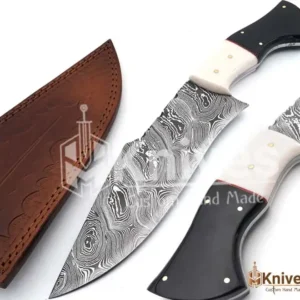
13 Inch Bowie Knife — Damascus Steel, Bone and Bull Horn Handle
$185.00 -
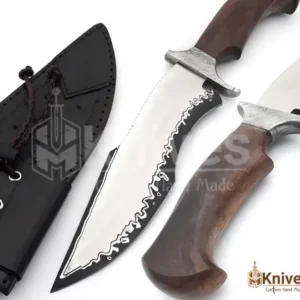
14 Inch Bowie Knife — J2 Steel, Full Tang
$190.00 -
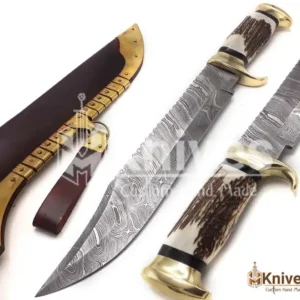
18 Inch Hunting Knife — Damascus Steel, Genuine Stag Handle
$355.00 -
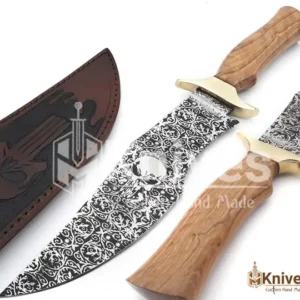
Acid Etching Hunting Knife — Skull Design, J2 Steel
$290.00 -
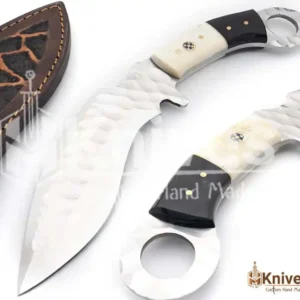
Bone Karambit Knife — Full Tang, Genuine Horn and Bone Handle
$195.00 -
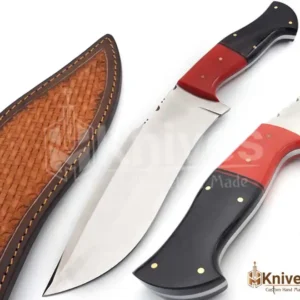
Bowie Knife — J2 Steel, Bull Horn and Resin Handle
$240.00 -
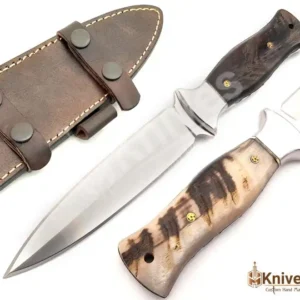
D2 Steel Hunting Dagger Knife with Sheep Horn Handle
$110.00 -
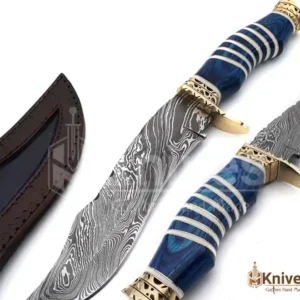
Damascus Bowie Knife with Brass Guard — 13 Inch Handmade Bowie
$235.00 -
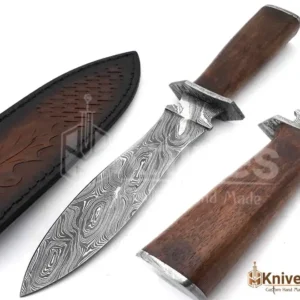
Damascus Dagger Knife — Built for Hunting and Outdoor Survival
$155.00 -
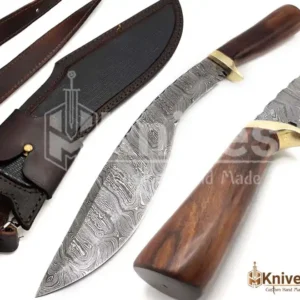
Damascus Kukri Knife — 19 Inches, Shoulder Belt Carry
$265.00 -
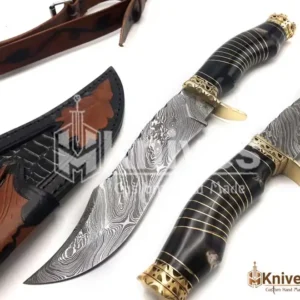
Damascus Steel Hand Made Bowie Hunting Knife with Hand Engraved Leather Sheath & Shoulder Belt
$235.00 -
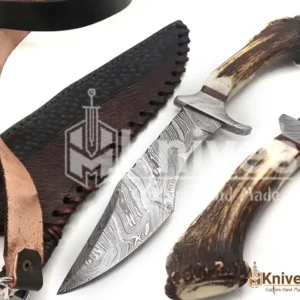
Damascus Steel Hand Made Hunter Knife with Stag Crown Handle & Fancy Hand Engraved Leather Sheath
$370.00 -
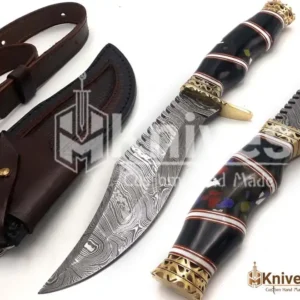
Damascus Steel Hand Made Hunting Outdoor Knife with Resin Sheet & Brass Guards Leather Sheath
$235.00 -
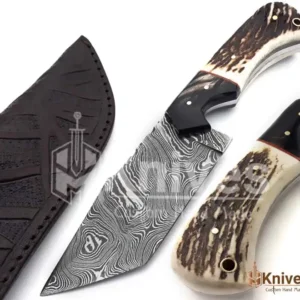
Damascus Tanto Knife — Genuine Stag Handle
$160.00 -
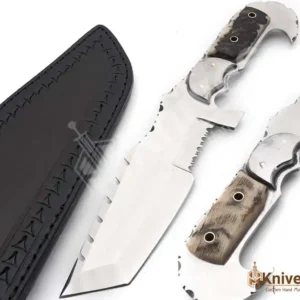
High Polish Trekker Dagger — Sheep Horn and Damascus Handle
$315.00 -
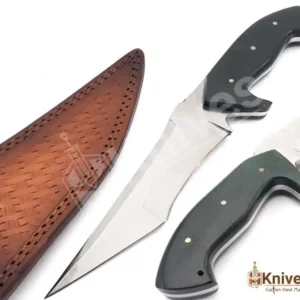
J2 Steel 11 inch Hand Made Fishing Camping Knife with Green Micarta Handle
$140.00 -
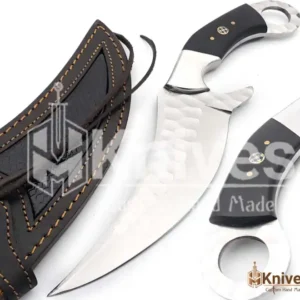
Karambit Knife for Outdoor Use — J2 Steel, Full Tang
$195.00 -
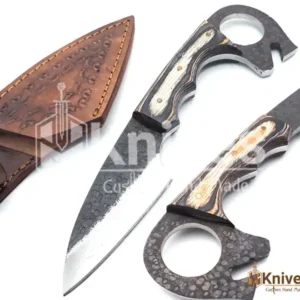
Rail Steel Knife — Hand Forged, Full Tang
$145.00 -
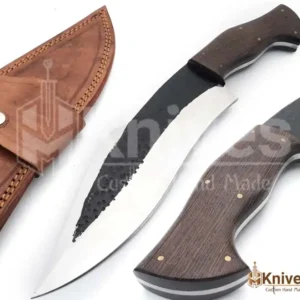
Wenge Wood Bowie Knife — J2 Steel, Full Tang
$245.00
What Makes a Knife a Hunting Knife
A hunting knife is a fixed-blade knife built for work on an animal in the field: opening, skinning, separating joints, and the camp jobs either side of that. The features that matter are unglamorous. It needs a full tang, because a hidden or partial tang puts a joint exactly where the leverage is highest. It needs a point you can control, because a fine needle tip punctures what you are trying not to puncture. It needs a handle that still grips when wet, because it will be wet. And it needs a sheath that holds it closed on a belt.
Everything else — pattern, engraving, handle material, the steel name on the listing — is preference. Real preference, worth paying for if you want it, but not performance.
The Blade Shapes in This Collection
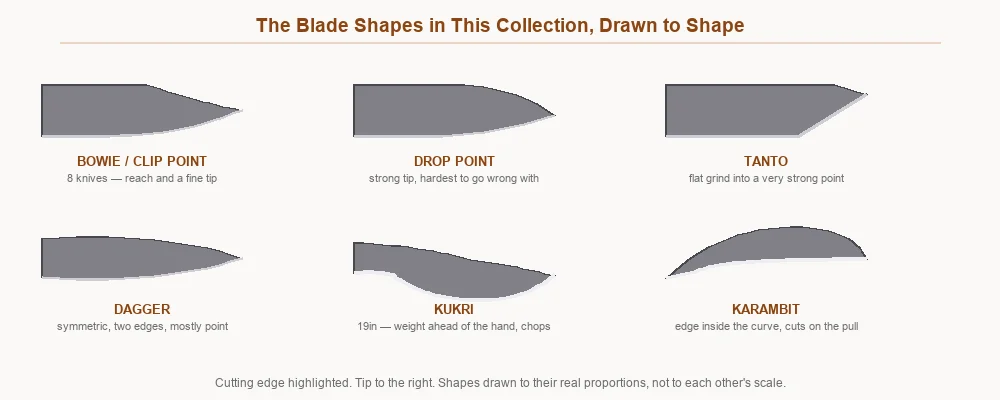
Six shapes appear across these 19 knives. They are drawn below at their real proportions, so you can see what each one is doing rather than read an adjective about it.
| Shape | What the geometry does | Where it helps | Where it does not |
|---|---|---|---|
| Clip point (bowie) | A concave scoop out of the spine near the tip makes the point finer and drops it closer to the centreline | Reach, piercing, general camp work. Eight knives here use it | The thinner tip is easier to snap on bone, or if you pry with it |
| Drop point | The spine curves gently down to the tip, keeping steel behind the point | The hardest shape to go wrong with for field dressing | Less acute than a clip point for fine piercing |
| Tanto | A flat primary edge meeting a short angled tip in a distinct corner | A very strong tip, and a straight edge section that is easy to sharpen | No belly to speak of, so it is poor at skinning |
| Dagger | Symmetrical, tapering to a centred point, often edged both sides | Piercing, and it looks the part on a wall | Almost no belly, and two edges means twice the sharpening |
| Kukri | The spine angles forward and down so the mass sits ahead of your hand, with the belly swelling behind the tip | Chopping and clearing — it swings like a light axe | Too much knife for anything delicate |
| Karambit | A claw, with the edge on the inside of the curve | Cuts on the pull, and the curve keeps the edge in contact through a stroke | A specialist shape; it is not a field dressing knife |
Size: Nothing Here Is Under 11 Inches
Worth saying plainly, because photographs never convey size. These are overall lengths including the handle, and the collection runs from 11 to 19 inches. If you are looking for a compact 7-inch skinner, this is not the collection for it.
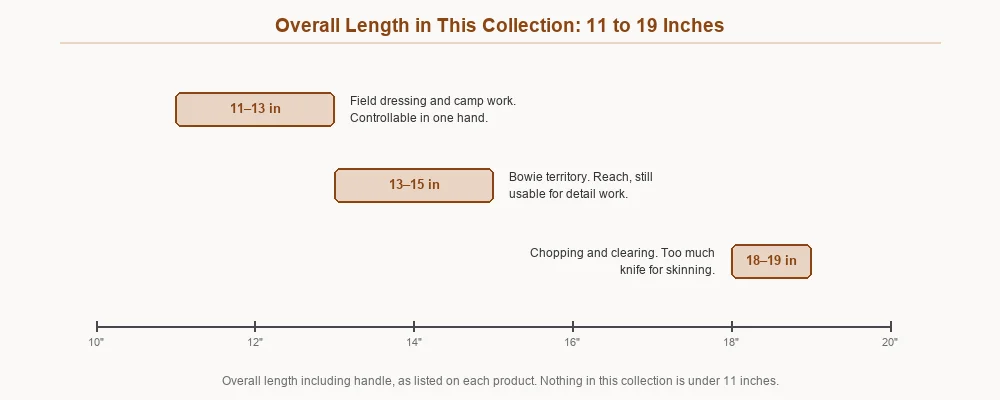
The practical effect: an 18 or 19 inch knife is a chopping tool. It will clear a trail and split a ribcage, and it will be clumsy for caping. An 11 to 13 inch knife handles the fine work and most of the camp work too. If you are buying one knife rather than three, buy in that lower band. For heavier chopping and camp wood work specifically, a dedicated axe from our handmade Viking axe collection will outperform any knife in this size range.
Damascus, J2 or D2
Three steels appear in this collection, and there is more honest daylight between them than the marketing usually admits — but less than you might expect, and not in the direction most people assume.
Damascus is a construction method, not a steel
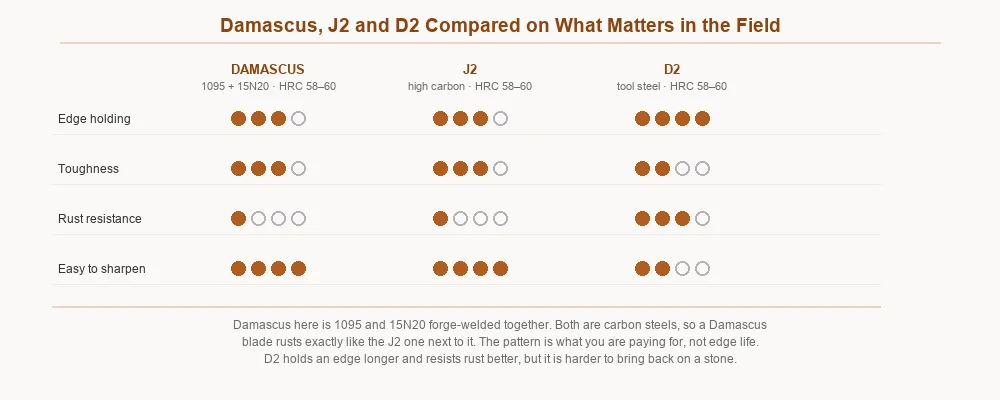
Our Damascus is 1095 and 15N20 forge-welded together, folded and drawn out, then etched so the two alloys show as light and dark bands. Both are carbon steels. That has one consequence people are routinely surprised by: a Damascus blade rusts, exactly like the plain carbon one beside it. Wipe it dry, keep a film of oil on it, and it will outlive you. Leave it wet overnight and it will spot.
The layers do not make it cut better. At HRC 58–60 the pattern is a pattern — it is the reason to buy one, and it is a good reason, but it is not an edge-retention feature. Our Damascus vs high carbon guide goes through what the layers do and do not change.
J2 does the same job for less
J2 is a plain high-carbon steel run to the same HRC 58–60. It takes a fine edge, comes back quickly on a stone, and rusts on the same schedule as the Damascus. If you want a working knife rather than a pattern, this is the sensible buy.
D2 holds longer and fights you on the stone
D2 is a high-chromium tool steel. The chromium is largely bound up in carbides rather than free in solution, so it is not stainless — but it does resist rust noticeably better than the two carbon steels, and it holds an edge longer. The trade is that those same carbides make it slower to sharpen. A worn D2 edge wants a diamond plate; an ordinary aluminium oxide stone will struggle.
| Damascus (1095 + 15N20) | J2 | D2 | |
|---|---|---|---|
| Hardness | HRC 58–60 | HRC 58–60 | HRC 58–60 |
| Rusts? | Yes — oil it | Yes — oil it | Resists, but not stainless |
| Edge holding | Good | Good | Better |
| Sharpening | Easy on any stone | Easy on any stone | Wants a diamond plate |
| Why you would pick it | The pattern | Best value for working use | Least maintenance |
Handle Materials and Grip
Handle choice is mostly aesthetic until your hands are wet, at which point it stops being aesthetic. Handles here are fitted over either a full tang or a hidden tang, and pinned or secured into the handle.
| Material | Grip when wet | Notes |
|---|---|---|
| Micarta | Best here | Resin-bonded fabric. Gets grippier as it gets wet. The least beautiful and the most practical |
| Stag and stag crown | Good | Naturally textured, and every piece is different — which is the point |
| Bull horn and sheep horn | Fair | Warm to hold, takes a deep polish. Can dry out over years in a heated house |
| Bone | Fair to poor when polished | Handsome. Polished bone gets slippery wet |
| Wenge and stabilised wood | Fair | Stable and dense. Stabilised wood tolerates damp better than raw |
| Resin | Fair | Colour and pattern, fully waterproof, no movement with humidity |
If the knife is going to be used hard in wet conditions, take micarta. If it is going to be used and admired, take stag or horn and accept that you will be a little more careful with it. Our knife materials guide covers this in more depth.
Looking After a Carbon Steel Hunting Knife
Two of the three steels here are carbon steels, which makes rust a maintenance question rather than a defect. The routine is genuinely simple:
- Wipe it dry before you put it away. Blood and stomach contents are acidic and will etch a carbon blade if left on it.
- Keep a film of oil on the blade. Food-grade mineral oil or camellia oil. A wiped-on film is enough; it does not need to be wet.
- Do not store it in the leather sheath. Leather holds moisture against steel and is tanned with salts. The sheath is for carrying, not for storage.
- Hone before you sharpen. Most blades that feel dull are not blunt, they are misaligned.
- Oil horn and bone handles occasionally. They are organic and will dry out in a heated house over years.
A patina — the grey-blue film carbon steel develops with use — is not rust, and is worth keeping. It is a stable oxide layer that slows further corrosion. Red or orange rust is the one to act on. The full routine, including grits and angles, is in our knife maintenance guide, and the sharpening sequence itself is in the step-by-step sharpening guide.
What Every Knife Here Has in Common
- Stated tang construction. Ten of these nineteen are full tang, the rest hidden tang. Every listing tells you which, rather than leaving you to guess.
- HRC 58–60. Hard enough to hold an edge, soft enough not to chip.
- Hand forged. Shaped on an anvil from a billet rather than stamped from sheet.
- A full-grain leather sheath with every knife.
- Worldwide tracked shipping, and custom engraving on request.
Frequently Asked Questions
What is the best hunting knife for deer?
An 11 to 13 inch knife with a drop point or a controllable dagger point, full tang, and a handle that grips wet. In this collection the D2 Steel Hunting Dagger at $110 and the Damascus outdoor knife at $235 both fit. You do not need a large knife for deer, and a large one makes caping harder.
Does a Damascus hunting knife rust?
Yes. Our Damascus is 1095 and 15N20, both carbon steels, so it rusts like any carbon blade. Wipe it dry after use, keep a light film of oil on it, and store it outside the leather sheath. Damascus is not stainless, and anyone telling you otherwise is describing a different product.
Is Damascus steel better than J2 for hunting?
Not in performance. Both run at HRC 58 to 60 and behave the same on an edge and in the rain. Damascus costs more because of the labour in forge-welding and the pattern it produces. Buy it because you want the pattern, not because you expect it to cut longer.
What size hunting knife should I buy?
For one knife that does most things, 11 to 13 inches overall. Between 13 and 15 inches you get bowie reach and can still do detail work. Above 18 inches you have a chopping tool, which is excellent for clearing and poor for skinning.
Why does a full tang matter?
A hidden tang anchors the blade inside the handle rather than running the full width of it, so under heavy lateral load it is the weaker of the two. On a long chopping knife that matters and full tang is worth seeking out; on a shorter knife used for cutting rather than prying, it rarely does. Ten of the nineteen knives here are full tang and the listings say which.
What is the hardest steel you offer?
All three finish at HRC 58 to 60. D2 wears longest of the three because of its chromium carbides, not because it is run harder. It is also the most awkward to sharpen, and generally wants a diamond plate.
Do these come with a sheath?
Yes, every knife ships with a full-grain leather sheath. Carry it in the sheath, but store the knife out of it – leather holds moisture and is tanned with salts that will corrode a carbon blade over time.
Can I have a knife engraved?
Yes, custom engraving is available on any design in this collection, on the blade or the sheath. Engraved orders take longer to ship than stock items.
Guides for Choosing a Hunting Knife
These go deeper on the parts that apply across the whole workshop — steel, geometry, materials and upkeep.
- How to Choose the Right Hunting Knife — blade length by game size, why the guard is a safety feature, and the HRC range worth paying for.
- Blade Profiles and When to Use Them — drop point, clip point and gut hook compared on tip strength and belly.
- Knife Steel Types and How They Perform — what 1095, D2 and J2 actually do differently in the field.
- Complete Knife Maintenance & Care Guide — field cleaning, oiling and why a leather sheath is the worst place to store a blade.
- Damascus vs High Carbon Steel — what the Damascus layers genuinely change, and what they do not.