
Table of Contents
- How to Read a Steel Specification
- What Blade Steel Actually Is
- What Each Alloying Element Does
- The Four Properties That Matter
- Understanding HRC, the Number That Matters Most
- The Carbon Steels
- 1095 in Detail
- 15N20 in Detail
- Damascus: A Construction, Not a Grade
- Tool Steels: D2 and the Semi-Stainless Middle
- The Stainless Steels
- The Steels Compared Side by Side
- Why Heat Treatment Outranks the Grade
- Choosing a Steel for Your Use
- Frequently Asked Questions
- Reading Steel Like a Buyer, Not a Collector
How to Read a Steel Specification
Steel names look like specifications and mostly are not. 1095, D2, VG-10, 440C: these tell you roughly what is in the alloy, and nothing at all about how the blade in front of you was treated. Two knives in the same steel can behave completely differently, and buyers who compare on grade alone are comparing the least variable part of the equation.
This is a reference guide, so it does what a reference should: sets out what each family does, what the alloying elements contribute, what the hardness number means, and which steel suits which work. It also says plainly where steel choice stops mattering and something else takes over.
The Short Version
Ask three questions of any knife: which steel, what hardness, and is it stainless. Those three answers predict how it will cut, how often you will sharpen it, and whether it will rust. Everything below is the detail behind them.
What Blade Steel Actually Is
Iron Plus Carbon, Plus Intent
Steel is iron with carbon dissolved in it, typically between 0.5 and 1.5 percent for blades. Carbon is what allows steel to be hardened at all: without it you have iron, which cannot hold an edge.
What Hardening Does
Heating steel above a critical temperature changes its crystal structure. Cooling it fast enough traps that structure in a hard, strained form. Everything a blade steel does follows from how well that process can be controlled.
Why Other Elements Are Added
To adjust the trade-offs. Chromium buys corrosion resistance. Vanadium buys wear resistance. Molybdenum helps the steel harden evenly through thicker sections. None of them are free, and each takes something back.
What Each Alloying Element Does
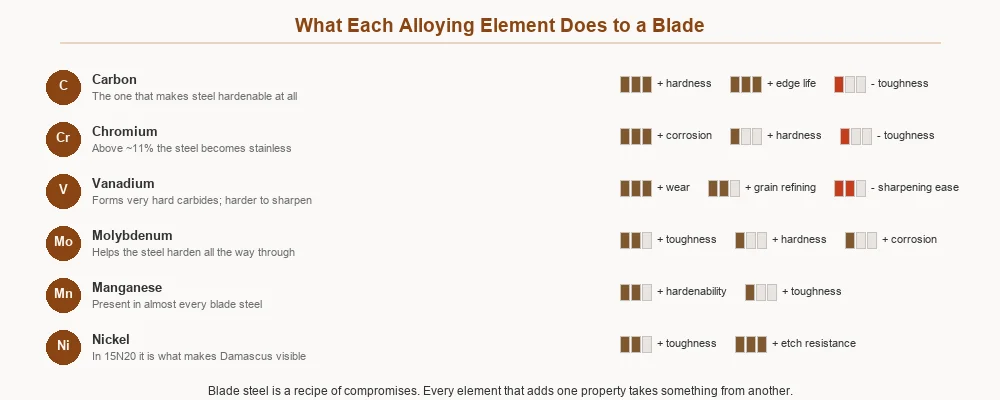
Carbon: The Essential One
Sets how hard the steel can get and forms the carbides that resist abrasion. More carbon means more potential hardness and edge retention, at some cost in toughness.
Chromium: The Stainless Threshold
Above roughly 11 percent, chromium forms a dense oxide film that reseals when scratched, which is what stainless means. Below that it contributes hardness and a little corrosion resistance without conferring the label.
Vanadium: Wear Resistance at a Price
Forms extremely hard carbides that dramatically extend edge life. Those same carbides make the steel considerably harder to sharpen, which is the trade nobody mentions when selling super steels.
Molybdenum, Manganese and Nickel
Molybdenum improves hardenability and toughness. Manganese is in almost every blade steel and helps it harden reliably. Nickel adds toughness and, in 15N20, resists acid etching, which is what makes a Damascus pattern visible.
| Element | Adds | Costs | Where you meet it |
|---|---|---|---|
| Carbon (C) | Hardness, edge retention | Toughness, corrosion resistance | Every blade steel |
| Chromium (Cr) | Corrosion resistance, hardness | Toughness, some keenness | All stainless grades |
| Vanadium (V) | Wear resistance, fine grain | Ease of sharpening | D2 and premium stainless |
| Molybdenum (Mo) | Hardenability, toughness | Cost | D2, 154CM, VG-10 |
| Manganese (Mn) | Hardenability | Little | Almost universal |
| Nickel (Ni) | Toughness, etch resistance | Little | 15N20, Damascus layers |
| Cobalt (Co) | Hardness at high temperature | Cost | Premium stainless |
Why Steel Names Are Not Standardised
Part of the confusion around steel comes from the naming itself, which follows several unrelated conventions at once. The 10xx series is an American SAE designation where the numbers encode composition. D2 comes from a tool steel classification where D means cold-work die steel. VG-10 and AUS-8 are Japanese proprietary names with no compositional meaning at all. 440C belongs to a stainless series where the letter grades carbon content within the family.
The practical consequence is that you cannot compare steels by reading their names, because the names are not measuring the same thing. Two steels with similar-looking designations may have nothing in common, and two with entirely different names may be near-identical in composition and behaviour.
The Four Properties That Matter
Edge Retention
How long the blade cuts well before needing attention. Driven by hardness and carbide content. It is the property most advertised and the one that matters least to casual users, whose sharpening interval is already months.
Toughness
Resistance to chipping and breaking under impact or lateral load. It pulls directly against hardness: you cannot maximise both.
Corrosion Resistance
Whether the blade rusts. Almost entirely a function of chromium content. This is the property with the clearest right answer for a given environment.
Ease of Sharpening
How readily the edge comes back on a stone. Inversely related to wear resistance, which is why super steels are a mixed blessing for anyone who sharpens freehand.
The Rule That Governs All Four
They trade against one another. Any steel that claims to lead in all four is being described by marketing rather than metallurgy.
Understanding HRC, the Number That Matters Most
What the Number Means
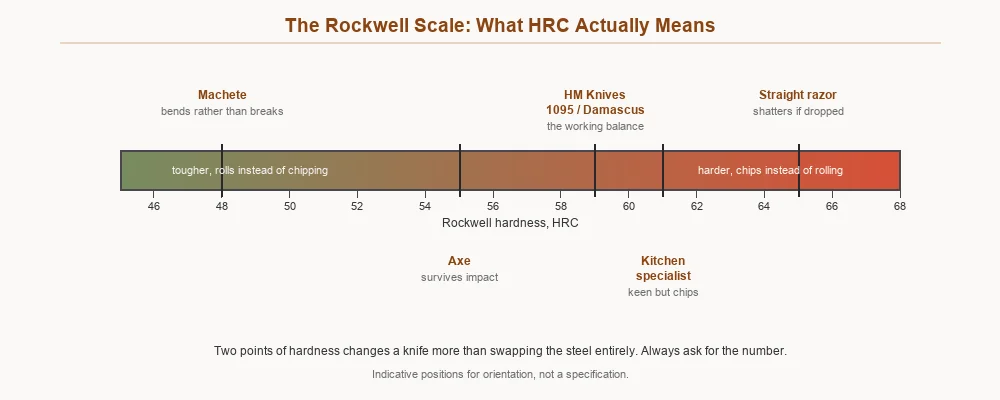
Rockwell C measures resistance to indentation. For knives the useful range runs from about 54 to 64, and small differences matter enormously.
What Different Ranges Feel Like
Below 55, the edge rolls rather than chips and needs frequent honing. Between 56 and 58, tough and forgiving, suited to impact. Between 58 and 61, the working balance most quality knives target. Above 62, exceptional edge holding with real chipping risk.
Where Our Blades Sit
HM Knives blades finish at HRC 58 to 60, which is the range that holds a working edge while surviving field use. It is a deliberate choice rather than an accident of process.
Why Two Points Matters More Than the Grade
The same 1095 at HRC 54 and HRC 61 are effectively different knives. Changing hardness by two points changes behaviour more than swapping to a different steel at the same hardness. Always ask for the number.
How Hardness Is Actually Measured
The test itself is worth knowing, because it explains why the figure is trustworthy when someone quotes it. A diamond cone is pressed into the steel under a defined load, and the depth of the permanent indentation is converted directly to a hardness number. It takes seconds, costs almost nothing once you own the tester, and leaves a tiny mark usually placed on the tang where it will be hidden by the handle.
This is why a maker who cannot state a hardness is telling you something meaningful. The equipment is not exotic and the test is not difficult. A workshop that hardens steel without ever verifying the result is working by hope, and the variation shows up in the finished knives.
The Carbon Steels
What Defines the Family
Iron and carbon with minimal alloying, and no meaningful chromium. The 10-series naming is genuinely useful: the last two digits give carbon content in hundredths of a percent, so 1075 is 0.75 percent and 1095 is 0.95.
Why Makers Keep Choosing Them
Predictable heat treatment, excellent keenness, easy sharpening, low cost. A well treated carbon blade will out-cut a badly treated premium alloy at a fraction of the price.
The Cost
They rust. Quickly, if left wet. This single property determines whether carbon steel suits you, and our comparison of stainless and carbon steel works through the decision.
Patina
Carbon steels develop a stable grey-blue oxide with use that is mildly protective and not a fault. Learning to distinguish patina from red rust removes most of the anxiety about owning one.
1095 in Detail
Composition and Character
Roughly 0.95 percent carbon, 0.4 percent manganese, little else. Simple, well understood, and forgiving to work with.
Performance
Takes an extremely keen edge, holds it well at HRC 58 to 60, and returns to sharp quickly on a basic stone. Toughness is good rather than exceptional, so it dislikes prying.
Who It Suits
Hunters, bushcrafters, kitchen users willing to dry the blade, and anyone who wants to learn to sharpen. It is the steel we forge most, and it appears throughout the hunting knives range.
Its Weakness
Corrosion. Leave it wet and it will show surface rust within hours.
15N20 in Detail
Composition and Character
Around 0.75 percent carbon with roughly two percent nickel. Originally a bandsaw steel, valued for toughness.
Its Role in Damascus
The nickel resists ferric chloride etching, so 15N20 layers stay bright while 1095 darkens. That contrast is the entire visible pattern. It also contributes toughness to the laminate.
What the Nickel Does Not Do
Two percent nickel does not approach the chromium threshold for stainlessness. A 15N20 blade rusts like any carbon steel.
Damascus: A Construction, Not a Grade
Worth stating plainly: Damascus is not a steel type and has no composition of its own. It describes two or more steels forge welded and etched. Ours is 1095 and 1043/15N20, both carbon steels with no meaningful chromium, so it rusts and needs oiling. Anyone listing Damascus as a grade alongside 440C is confusing a process with a material.
How It Performs
Like its constituent steels. At HRC 58 to 60 from 1095 and 15N20, expect performance in the same band as good single carbon steel, with a small toughness benefit from the layer boundaries.
Where to Read More
Our guide to how Damascus steel is actually made covers the forging sequence, and the Damascus versus high carbon comparison covers what the layers do and do not change.
Where Damascus Sits in a Steel Guide
Damascus causes trouble in reference tables precisely because it does not belong in one. Listing it beside 440C invites the reader to compare them as though they were alternatives of the same kind, when one is a composition and the other is a manufacturing method that could in principle be applied to any compatible pair of steels.
The honest way to place it is to ask what it is made from. Carbon Damascus of the kind we forge behaves as carbon steel and belongs in that family. Stainless Damascus, made elsewhere from stainless constituent steels, belongs in the stainless family. The word Damascus tells you about appearance and labour; the constituent steels tell you about performance.
Tool Steels: D2 and the Semi-Stainless Middle
What Makes a Tool Steel
High carbon plus substantial carbide-forming elements, developed for industrial cutting tools rather than knives. They bring exceptional wear resistance.
D2 Specifically
Around 1.5 percent carbon and 11 to 13 percent chromium, which puts it right on the stainless boundary. It is usually called semi-stainless: far more corrosion resistant than 1095, not immune like 440C.
The Trade
Outstanding edge retention, meaningfully reduced toughness, and genuinely difficult to sharpen by hand. D2 rewards owners with good sharpening equipment and frustrates those without.
Stainless Does Not Mean Rustproof
The term is a description of resistance rather than immunity, and it misleads a great many buyers. A stainless blade left in salt water, stored wet in a sheath, or exposed to acidic food residue for long enough will pit. The chromium film reseals itself when scratched, but it can be overwhelmed by sustained attack, and chlorides are particularly effective at breaking it down.
What stainless genuinely buys is forgiveness. A carbon blade shows rust within hours of neglect; a stainless one tolerates days. For anyone whose knife will occasionally be forgotten in a wet pack, that difference is decisive, and it matters far more than the edge retention figures that dominate the marketing.
The Stainless Steels
440C
The traditional workhorse. Around 1 percent carbon, 17 percent chromium. Sharpens easily, resists rust well, moderate edge retention. Still a sensible choice.
AUS-8
Softer and very forgiving. Sharpens with almost no effort, dulls sooner. Excellent for anyone learning to sharpen or for a knife that gets abused.
VG-10
Around 1 percent carbon, 15 percent chromium, with vanadium and cobalt. Holds an edge notably longer than 440C and takes more work to sharpen. Common in quality kitchen knives.
154CM
Similar territory to VG-10 with slightly higher wear resistance. A solid everyday carry steel.
When Stainless Is Simply Correct
Fishing, boats, coastal air, or any blade that will be stored damp. See the fishing and camping knives range for where we use it.
Powder Metallurgy and the Modern Premium Grades
Beyond the grades listed here sits a category worth knowing about even if you never buy one. Powder metallurgy steels such as S30V, M390 and CPM-3V are produced by atomising molten steel into powder and consolidating it under pressure, which distributes the carbides far more evenly than conventional casting allows. The result is steel that achieves high wear resistance without the brittleness that usually accompanies it.
They are genuinely excellent and genuinely expensive, and they demand diamond abrasives to sharpen. For someone cutting abrasive material daily they repay the cost. For a knife used a few times a week, the longer sharpening interval is invisible and the harder sharpening is not. This is the clearest case in knives of a real technical advance that most buyers do not need.
The Steels Compared Side by Side
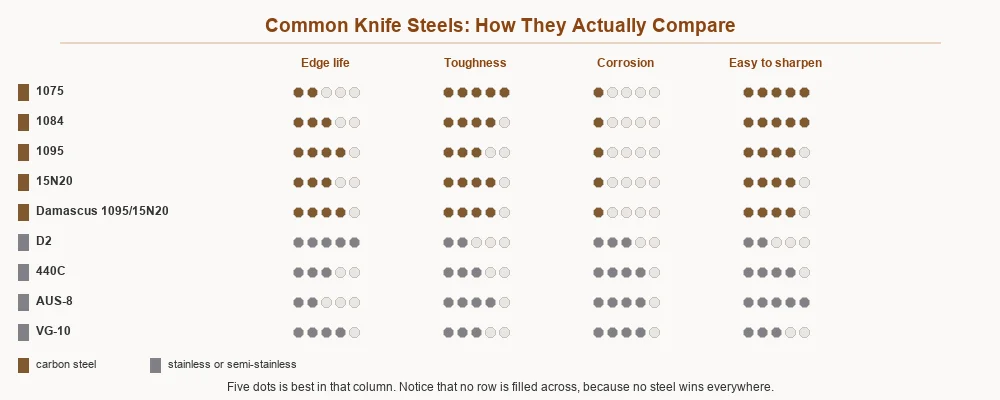
Reading the Matrix
No row fills across, because no steel leads in every column. The carbon steels cluster high on keenness and sharpening ease and bottom out on corrosion. The stainless grades do the reverse.
| Steel | Family | Carbon | Chromium | Typical HRC | Edge life | Sharpening | Rusts? |
|---|---|---|---|---|---|---|---|
| 1075 | Carbon | 0.75% | None | 56-58 | Fair | Very easy | Yes |
| 1084 | Carbon | 0.84% | None | 57-60 | Good | Very easy | Yes |
| 1095 | Carbon | 0.95% | None | 58-62 | Good | Easy | Yes |
| 15N20 | Carbon | 0.75% | None | 56-60 | Good | Easy | Yes |
| Damascus 1095/15N20 | Carbon laminate | ~0.85% avg | None | 58-60 | Good | Easy | Yes |
| D2 | Semi-stainless | 1.5% | 11-13% | 58-62 | Excellent | Difficult | Rarely |
| 440C | Stainless | 1.0% | 16-18% | 56-59 | Moderate | Easy | Very rarely |
| AUS-8 | Stainless | 0.75% | 13-14.5% | 56-58 | Fair | Very easy | Very rarely |
| VG-10 | Stainless | 1.0% | 14-16% | 59-61 | Very good | Moderate | Very rarely |
Where Steel Stops Mattering
It is worth marking the boundary of this subject clearly, because steel receives attention out of all proportion to its influence. Three things sit above it. Blade geometry decides whether the edge can reach the material at all, and a thick grind in premium steel loses to a thin grind in ordinary steel every time. Format decides whether the knife is even present when needed, which our comparison of folding and fixed blade knives sets out. Profile decides whether the shape suits the cut, covered in our guide to blade profiles and when to use them.
Steel matters after all three are settled. It determines how often you sharpen and whether the blade rusts, both real considerations, neither of which rescues a knife that is the wrong shape or left at home.
Why Heat Treatment Outranks the Grade
The Same Steel, Two Knives
1095 at HRC 54 rolls under normal use. The same 1095 at HRC 60 holds an edge for months. Nothing about the composition changed.
What Good Heat Treatment Involves
Normalising cycles to refine grain, accurate austenitising temperature and soak time, a quench fast enough to harden but controlled enough not to crack, and tempering to the target hardness. Each stage has a right answer and several wrong ones.
Why It Is Invisible
Nothing about heat treatment shows in a photograph, which is exactly why grade and layer count get advertised instead. Our guide on where to spend your money on knives sets out how much this matters relative to everything else you pay for.
The Question to Ask
What hardness is the blade finished to, and how is that verified? A stated range and an explanation means someone is measuring.
Matching Your Abrasives to Your Steel
One practical consequence of steel choice is rarely mentioned at the point of sale: the stones you own may not cut the steel you are buying. Standard aluminium oxide and natural stones handle carbon steels and softer stainless comfortably. They struggle badly with D2 and are effectively useless against powder metallurgy grades, whose carbides are harder than the abrasive itself.
If you already own a sharpening setup, check it before choosing a steel. Buying a knife that your stones cannot maintain leads to one of two outcomes, and both are bad: either you spend more on diamond plates than you saved, or the knife quietly goes dull and stays that way. Our maintenance guide sets out which abrasives suit which steels.
Choosing a Steel for Your Use
| Your situation | Steel to choose | Why |
|---|---|---|
| Learning to sharpen | 1084, 1095 or AUS-8 | Forgiving and quick to bring back |
| Hunting, dry conditions | 1095 or Damascus | Keen edge, easy field touch-ups |
| Fishing or marine | 440C or VG-10 | Carbon will rust regardless of care |
| Kitchen, daily use | VG-10 or 1095 | Keenness matters; environment is dry |
| Camp and bushcraft | 1084 or 1095 | Toughness over outright edge life |
| Cutting cardboard all day | D2 or VG-10 | Abrasive work rewards wear resistance |
| A knife you will neglect | 440C or AUS-8 | Only stainless survives inattention |
| Buying for appearance | Damascus | Bought for the pattern, cared for as carbon |
The Order to Decide In
Environment first, since that settles carbon against stainless. Then sharpening willingness, which settles how much wear resistance you actually want. Grade comes last, and matters least. Our use case guide covers the decisions that sit above this one, and the materials guide covers handles and sheaths.
Steel Myths Worth Retiring
A few claims circulate widely enough to be worth naming. That Damascus is a steel: it is a construction, and its performance is that of its constituent grades. That a higher layer count improves cutting: layers are visual, and the point is covered in our comparison of handmade and production knives. That premium steel makes a knife sharper: sharpness is geometry and sharpening, and any steel can be brought to the same keenness on day one.
Two more are worth adding. That stainless steel cannot take a good edge, which was arguable decades ago and is simply false now. And that carbon steel is obsolete, which ignores that it sharpens faster, costs less and reaches a keener edge than most stainless grades, all of which is why working makers still reach for it. Every blade in the HM Knives collection is carbon steel for exactly those reasons.
Frequently Asked Questions
What is the best knife steel?
There is no single answer, because the four properties that matter trade against each other. For dry use with regular care, 1095 offers excellent keenness cheaply. For wet environments, VG-10 or 440C. For abrasive work, D2. Any steel claimed to lead in every category is being sold rather than described.
What does HRC mean on a knife?
Rockwell C hardness, a measure of resistance to indentation. Knives generally fall between 54 and 64. Below 56 the edge rolls and needs frequent honing; above 62 it holds very well but chips more readily. Most quality working knives target 58 to 60.
Is Damascus a type of steel?
No. Damascus describes a construction in which two or more steels are forge welded, folded and etched. It has no composition of its own, and its performance comes entirely from the steels used. HM Knives Damascus is 1095 and 1043/15N20, both carbon steels that rust.
Is a higher carbon content always better?
No. More carbon allows greater hardness and edge retention but reduces toughness, so a very high carbon blade chips more readily under impact. For chopping and batoning a slightly lower carbon steel at moderate hardness is the better tool.
Why are super steels harder to sharpen?
Because the vanadium and chromium carbides that give them wear resistance are harder than common sharpening abrasives. Ordinary aluminium oxide stones struggle to cut them, so diamond or ceramic abrasives are usually needed.
What steel are HM Knives blades made from?
Our Damascus blades are forged from 1095 and 1043/15N20 and finished at HRC 58 to 60. Both are high carbon steels with no meaningful chromium, so they take a keen edge, sharpen easily, and need drying after use with occasional light oiling.
Reading Steel Like a Buyer, Not a Collector
Steel grades are worth understanding and easy to overweight. They set the envelope of what a blade can do; heat treatment decides where inside that envelope the particular knife lands, and geometry decides whether the edge can reach the material at all. A buyer who understands all three asks better questions than one who has memorised alloy compositions.
So use this page as a reference rather than a ranking. Work out what your environment demands, decide how much sharpening you are willing to do, and let those two answers narrow the field. Then ask the seller for a hardness figure, and judge them by whether they have one.
Everything we forge is carbon steel, hardened to HRC 58 to 60, and built to be sharpened rather than replaced. If you want to know exactly what is in a particular knife, contact us and we will tell you, and our maintenance guide covers keeping any of these steels performing.
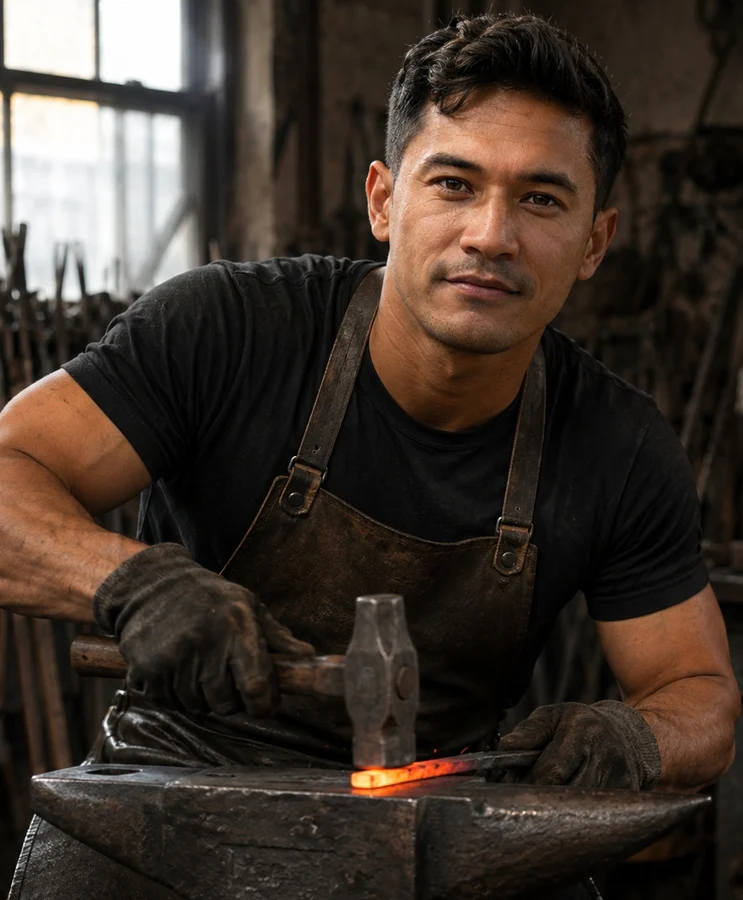
From Our Workshop
Each steel in this guide, in something you can buy. Prices are on each listing.
- 13 Inch Bowie Knife — Damascus Steel, Bone and Bull Horn Handle — Damascus — 1095 and 15N20 forge welded.
- Full Tang Skinner Knife — J2 Steel with Sheep Horn Handle — J2 — plain high carbon at the same hardness.
- D2 Steel Hunting Dagger Knife with Sheep Horn Handle — D2 — high chromium tool steel, longer edge life, harder to sharpen.
- Rail Steel Knife — Hand Forged, Full Tang — rail steel — reclaimed high carbon, forged the same way.
Browse the full range.