Table of Contents
- Why Blade Profile Matters More Than Most Realize
- The History of Blade Profiles: Evolution Through Function
- Understanding Blade Anatomy and Performance
- Drop Point: The Most Versatile Profile
- Clip Point: The Refined Blade for Precision
- Tanto: The Modern Tactical Profile
- Sheepsfoot: The Safe, Controlled Cutter
- Leaf Shape: Beauty Meets Function
- Gut Hook: The Specialized Tool
- Trailing Point: The Slicing Specialist
- Spear Point: The Balanced Design
- Debunking Blade Profile Myths
- Choosing Your Profile: Decision Framework
- Frequently Asked Questions
- The Verdict: Finding Your Perfect Profile
Why Blade Profile Matters More Than Most Realize
Walk into any knife store or browse online cutlery, and you’ll quickly notice knives look wildly different from each other. The differences aren’t just aesthetic—they’re fundamentally functional. The shape of the blade, from tip to spine, determines what a knife can do well, what it struggles with, and how it feels in your hand.
This is blade profile, and it’s arguably the most important decision you make when choosing a knife. Material matters. Handle ergonomics matter. But the profile—the overall shape—determines whether you’re holding a tool optimized for precise dicing, aggressive slicing, or controlled utility work.
Here at HM Knives we have spent years understanding how profile affects performance, and the use case usually decides the profile before personal taste gets a say. We’ve tested profiles in kitchens, in the field, in professional settings, and in the hands of serious users. This comprehensive guide exists because profile choice is deeply personal—and deeply important.
What You’ll Learn
This guide covers the major blade profiles used by professionals and serious knife users worldwide. We’ll explore what defines each profile, when it excels, where it falls short, and who should choose it.
The History of Blade Profiles: Evolution Through Function
Blade profiles didn’t emerge randomly. Each major profile was developed by people solving specific problems with specific tools. Understanding this history explains why certain profiles excel in certain situations.
Drop Point: Born from Hunting
The drop point emerged in American hunting culture in the 19th century. Hunters needed a blade that could handle the full range of field dressing tasks: precise cuts for detailed work, enough belly for slicing, and enough strength for occasional heavy tasks. The drop point solved this by maintaining a high spine that gradually curved down to the tip, creating controlled strength with precision capability.
Clip Point: Refined in Kitchens and Law Enforcement
Clip points evolved separately, emerging from kitchen traditions (particularly European culinary design) and later being adopted by military and law enforcement for their refined, controlled cutting capability. The clipped spine reduces tip mass while maintaining control, making this profile ideal for detailed work and slicing.
Tanto and Spear Point: Modern Adaptations
The tanto emerged in the 1980s from tactical knife communities seeking maximum edge retention and control. The spear point, adapted from traditional Japanese designs, represents a balanced approach that performs well across multiple disciplines.
Understanding Blade Anatomy and Performance
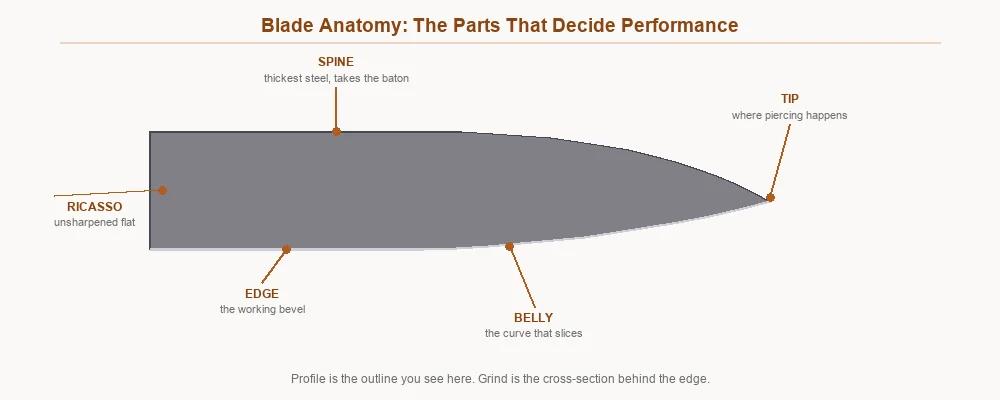
Before diving into specific profiles, you need to understand the parts of a blade and how they function.
The Tip: Precision and Penetration
The tip is where the edge meets the spine. A sharp tip excels at detail work and piercing. A more blunt or rounded tip is safer and more controlled but less precise. Tip design is one of the primary differentiators between profiles and directly impacts how you can use the blade.
The Edge: The Cutting Surface
The edge is the cutting surface. The majority of edge comes from the belly—the curved or straight section that runs most of the blade’s length. A pronounced belly is excellent for slicing motions. A straight edge is better for push-cutting and detail work. This distinction fundamentally affects your cutting technique.
The Spine: Support and Control
The spine (or back) is the unsharpened top edge. A high spine (far from the handle) creates a tall profile that’s strong but potentially awkward for some cuts. A low spine (close to the handle) creates a more aggressive profile. The spine’s curve or straightness significantly affects how the blade cuts and how your hand naturally moves through motions.
The Heel: Leverage and Cutting Surface
The heel is the section of blade closest to the handle. A large heel gives you leverage for tough cuts and more cutting surface near the handle. A small heel creates a more refined, precision-focused tool. Professional chefs often choose profiles based on heel size and shape for specific cutting tasks.
Drop Point: The Most Versatile Profile
If you had to choose one blade profile that works adequately for most tasks, the drop point would be it. This is why it’s the most popular profile globally among knife users of all experience levels.
What Defines a Drop Point
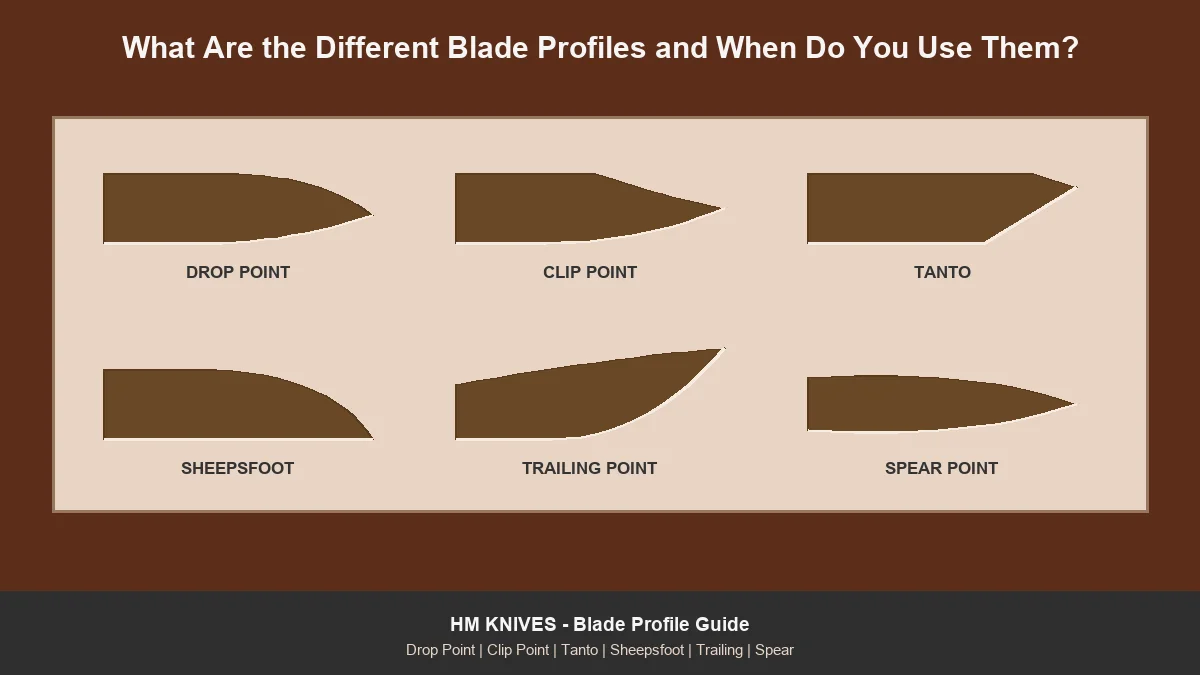
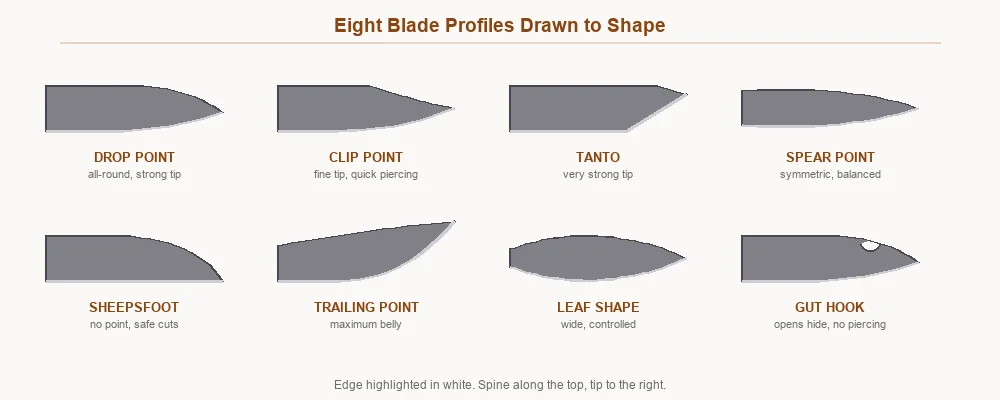
A drop point is defined by a convex (curved) spine that arcs down to meet the edge before reaching the tip. This creates a blade that’s taller near the handle and gradually tapers to a sharp point. The spine curve can range from gentle to aggressive depending on the specific design and intended use.
Strengths of the Drop Point
Versatility is the drop point’s defining characteristic. The high spine near the handle provides control and strength for tougher cuts. The curved spine guides your hand naturally through slicing motions. The sharp tip excels at precision work. For these reasons, drop points are found in hunting knives, chef’s knives, bushcraft blades, and pocket knives worldwide.
The drop point is forgiving. If you’re not entirely sure what cuts you’ll need to make, a drop point will handle them. This is why it’s the default choice for people buying their first serious knife.
Weaknesses of the Drop Point
The drop point is a generalist, which means it’s not a specialist at any particular task. If you need maximum slicing capability, a blade with more belly would be better. If you need maximum tip control and precision, a clip point would be superior. The drop point’s strength is versatility, not dominance in any single dimension.
Best Use Cases
Hunting (field dressing, processing game), bushcraft and camping, general kitchen work, pocket knives, survival knives, woodworking. Essentially, if you’re not sure what specific tasks you’ll encounter, drop point is your answer.
Drop Point Examples from HM Knives
Our drop point and dagger-point hunting knives includes options in both damascus and high carbon steel, allowing you to choose the perfect material for your intended use and skill level.
Clip Point: The Refined Blade for Precision
If the drop point is the generalist, the clip point is the specialist in precision and control. This profile sacrifices some strength and versatility for exceptional refinement and finger control.
What Defines a Clip Point
A clip point is defined by a straight (or slightly curved) spine that runs most of the blade’s length, then “clips” inward before reaching the tip. This creates a notch along the spine, reducing tip mass while keeping the tip sharp and precise. The edge typically has a straight section near the heel and curves into a belly as it approaches the tip.
Strengths of the Clip Point
The clip point’s primary strength is precision and control. The reduced tip mass makes the blade feel lighter in your fingertips, giving you exceptional control for detailed cuts. The straight spine portion provides good strength for general cutting. The design is inherently refined—clip points are attractive and feel premium in your hand.
Clip points are popular in kitchen knives and tactical folders precisely because of this control. If you need to make precise, deliberate cuts, a clip point excels at every level of expertise.
Weaknesses of the Clip Point
The clip reduces the blade’s strength at the tip. A clip point isn’t ideal for heavy-duty work or any task where you’ll be using the tip as a pry or applying lateral stress. The reduced blade height near the handle (compared to a drop point) means less knuckle clearance and less cutting surface in that area. For general kitchen work, this is fine. For field processing, it’s a limitation.
Best Use Cases
Kitchen knives (slicing, precision vegetable work), tactical folders, pocket knives, any application where refined control matters more than raw capability. Professional chefs often prefer clip points for their precision.
Kitchen Performance: Clip Point Advantage
In precision cutting tasks—julienne vegetables, detailed plating work, precise herb mincing—clip points significantly outperform drop points. The reduced tip mass and refined geometry give the user better feedback and control. Many premium HM Knives kitchen designs feature clip point profiles for exactly this reason.
The clip point is the defining shape of a bowie, and every knife in our bowie knives collection uses one.
Tanto: The Modern Tactical Profile
The tanto emerged in the 1980s from tactical knife designers seeking maximum edge retention and control. It’s a modern design that broke from historical traditions and offered genuine performance advantages.
What Defines a Tanto
A tanto is defined by a sharp angle where the spine meets the edge. Instead of a gradual curve, the spine and edge meet at roughly 90 degrees (or close to it), creating a flat-topped profile. This creates two distinct cutting surfaces: a flat edge section near the heel and a second, angled edge section toward the tip.
Strengths of the Tanto
The tanto’s primary strength is edge retention. The angular geometry creates edge geometry that holds up exceptionally well under stress. The flat edge section is excellent for slicing, while the angled section handles cutting tasks effectively. Tantos are tough—the angular spine design doesn’t trap stress the way rounded profiles do, distributing force differently.
Tantos feel aggressive. The angular geometry conveys strength and capability. Many tactical and EDC users prefer tantos because they feel purposeful and perform reliably in demanding conditions.
Weaknesses of the Tanto
The tanto’s angular geometry is less intuitive than more traditional profiles. The transition between flat and angled edge sections can create an awkward cutting motion for some users. The flat spine doesn’t guide your hand the way a curved spine does, making the cutting motion more deliberate and less automatic. The profile can feel less versatile because it’s optimized for specific cutting angles rather than a range of angles.
Best Use Cases
Tactical knives, EDC (everyday carry) folders, bushcraft when maximum reliability matters, any situation where edge retention and toughness are priorities. Less ideal for kitchen work unless you have experience with the cutting geometry.
Tactical Advantage
In demanding conditions—survival situations, tactical use, extended field operations—the tanto’s durability and edge retention often outperform more refined profiles. This is why military and law enforcement favor tantos despite their unconventional geometry.
We make this shape in Damascus with a stag handle; it sits in the daggers, trekkers and karambits collection.
Sheepsfoot: The Safe, Controlled Cutter
The sheepsfoot profile prioritizes safety and controlled cutting above all else. It’s named for its resemblance to a sheep’s foot (a blunt, curved shape) and represents a deliberately non-aggressive design philosophy.
What Defines a Sheepsfoot
A sheepsfoot is defined by a blunt (non-pointed) tip. The spine curves downward as it approaches the tip, but instead of meeting in a point, it curves back up to meet the edge at a much wider angle, creating a rounded or squared-off tip. The edge is typically quite straight, running parallel to the handle for most of the blade’s length.
Strengths of the Sheepsfoot
The sheepsfoot’s primary strength is control and safety. The blunt tip means you cannot accidentally puncture or pierce. This makes sheepsfoot invaluable in situations where precision cutting matters but the risk of accidental injury needs to be minimized. The straight edge is excellent for controlled slicing and cutting.
Sheepsfoot blades feel comfortable and secure in hand. The wide tip provides a sense of control, and the blunt end means you can use significant pressure without fear of the tip suddenly penetrating something it shouldn’t.
Weaknesses of the Sheepsfoot
The sheepsfoot excels at slicing but struggles at detail work. The blunt tip cannot pierce or access tight spaces. If you need to make precise tip-centered cuts, the sheepsfoot isn’t ideal. The design is specialized—it’s not versatile for general-purpose use.
Best Use Cases
Kitchen knives (especially for inexperienced users), cutting tasks where safety is paramount, professional settings where liability is a concern, any situation where you need a sharp blade but controlled cutting is more important than versatility.
Kitchen Safety Standard
Many professional culinary schools teach with sheepsfoot profiles precisely because they combine capability with control. The blunt tip prevents accidental punctures during high-volume kitchen work, making sheepsfoot particularly popular in commercial kitchens.
A blunt, safe tip belongs in a kitchen more than a field — our kitchen and chef knives cover that work.
Leaf Shape: Beauty Meets Function
The leaf shape is perhaps the most aesthetically beautiful blade profile. It’s also remarkably functional, though often misunderstood by users unfamiliar with its design philosophy.
What Defines a Leaf Shape
A leaf shape is defined by symmetry. The spine and edge both curve in a similar manner, meeting at both the tip and the heel in balanced curves. When viewed from above, the profile resembles an actual leaf—hence the name. The blade is typically widest near the middle and tapers to a point at the tip.
Strengths of the Leaf Shape
The leaf shape is beautifully balanced. The symmetrical geometry distributes stress evenly and feels natural in hand. The pointed tip excels at both slicing and detail work. The curved edge provides excellent slicing capability. The profile is strong because stress is distributed through the centerline without concentrating at any single point.
Leaf shapes are found in premium collector knives and traditional designs because they’re inherently attractive. The aesthetics aren’t accidental—they reflect functional optimization.
Weaknesses of the Leaf Shape
The leaf shape’s symmetry, while beautiful, makes it less practical for some tasks. The profile doesn’t guide your hand the way an asymmetrical profile does, requiring more conscious technique to use effectively. The blade height is often limited compared to drop points, providing less knuckle clearance in kitchen settings.
Best Use Cases
Collector knives, traditional designs, bushcraft and field knives where versatility and balance matter, kitchen knives in experienced hands, any situation where beauty and function should combine equally.
Aesthetic Excellence
Leaf-shaped blades are popular in premium handmade knives precisely because of their visual appeal. Many of our premium Damascus pieces feature leaf-shaped profiles, combining the visual drama of the steel’s pattern with the elegant geometry of the profile.
Gut Hook: The Specialized Tool
The gut hook is a specialized profile designed for one specific task: field dressing game. It’s controversial in knife communities—some consider it essential, others view it as unnecessary.
What Defines a Gut Hook
A gut hook is a small, sharp hook integrated into the spine of the blade, typically positioned near the tip. It’s usually found on drop point or clip point blades and creates an additional cutting edge perpendicular to the main blade edge.
Strengths of the Gut Hook
For its intended purpose—opening a game animal’s abdomen without puncturing the organs inside—the gut hook excels. The small hook allows you to create a controlled cut that separates hide and muscle from abdominal organs with minimal risk of puncturing the digestive system.
Weaknesses of the Gut Hook
The gut hook is a specialist tool that adds complexity to a blade without providing general benefits. For hunters who use their knife for 99% other tasks and only occasionally field dress, the gut hook is rarely used. Many hunters argue that proper technique with a standard blade can accomplish the same result.
Best Use Cases
Hunting knives, specifically for hunters who regularly field dress game and want to maximize safety and efficiency. Not recommended for general-purpose knives or kitchen use.
Hunting Optimization
For serious hunters, our hunting knife guide discusses gut hooks in depth and shows which profiles work best for specific game processing tasks.
Trailing Point: The Slicing Specialist
The trailing point is an uncommon but highly effective profile for tasks requiring exceptional slicing capability and aggressive cutting motion.
What Defines a Trailing Point
A trailing point is defined by a spine that curves upward (the opposite of a drop point) and an edge that curves downward throughout the blade’s length. The result is a blade that’s lowest near the handle and highest at the tip. The edge is highly curved, creating maximum belly.
Strengths of the Trailing Point
The trailing point’s primary strength is slicing capability. The aggressive curve of the edge and the increasing blade height toward the tip create exceptional slicing performance. For tasks requiring the blade to move through material smoothly—slicing meat, processing vegetables, detailed culinary work—the trailing point excels.
The high tip creates excellent piercing capability despite being optimized for slicing. The profile feels natural during slicing motions and encourages the user’s hand into proper cutting technique.
Weaknesses of the Trailing Point
The trailing point sacrifices strength at the heel for capability at the tip. Push-cuts and tougher tasks are less comfortable because the blade height at the heel is low. The design is specialized—it’s not versatile for general-purpose use.
Best Use Cases
Culinary knives (slicing meat, processing seafood), professional kitchen work, any situation where slicing motion dominates the work. Excellent for boning and filleting work in professional settings.
The deep upswept belly of a trailing point is what a skinner is built around — see the skinner knives collection.
Spear Point: The Balanced Design
The spear point is an uncommon profile that represents a middle ground between drop and clip points, offering balanced capability across multiple dimensions.
What Defines a Spear Point
A spear point is defined by symmetry around the spine. Both the edge and the false edge (the spine side) curve similarly, meeting at a sharp point. The result resembles a spear head, hence the name. The spine runs straight down the center.
Strengths of the Spear Point
The spear point’s primary strength is elegance and versatility. The symmetrical design provides exceptional balance. The pointed tip excels at both slicing and detail work. The curved edge provides excellent slicing capability. The profile is strong because stress is distributed evenly through the centerline.
Weaknesses of the Spear Point
The spear point is less common, making it harder to find. The symmetrical design doesn’t guide your hand the way asymmetrical designs do, requiring more conscious technique. If not properly executed, the narrow blade height can limit knuckle clearance.
Best Use Cases
Traditional knives, premium collector pieces, professional applications where balanced versatility matters, users who appreciate refined aesthetics alongside functionality.
Debunking Blade Profile Myths
Myth #1: “Drop Point is Always the Best All-Around Choice”
Reality: Drop point is versatile, but “best” depends on what you’ll actually do. If you primarily slice, a trailing point is better. If you need precision, a clip point excels. Drop point is the safest choice when you’re unsure, but specialists will beat it in their domains.
Myth #2: “Pointed Tips Are Always Better for Detail Work”
Reality: A sharp point helps, but tip geometry is only part of the equation. A clip point’s refined geometry often outperforms drop points for detail work, despite both having pointed tips. The overall profile matters more than the tip alone.
Myth #3: “Sheepsfoot Knives Can’t Cut Effectively”
Reality: Sheepsfoot knives are excellent cutters within their design parameters. They excel at slicing and controlled cutting. They’re just not suited for piercing or tip-centric detail work. They’re specialized, not inferior.
Myth #4: “Blade Profile Matters Less Than Steel Type”
Reality: Profile and material are equally important. Great steel in a poor profile underperforms. A well-optimized profile in good-quality steel outperforms great steel in a sub-optimal profile. They’re interdependent factors.
Myth #5: “Tantos Are Only for Tactical Users”
Reality: Tantos offer genuine performance advantages (edge retention, durability) that benefit any user. They require different technique, but experienced users in any domain can benefit from a tanto’s toughness and reliability.
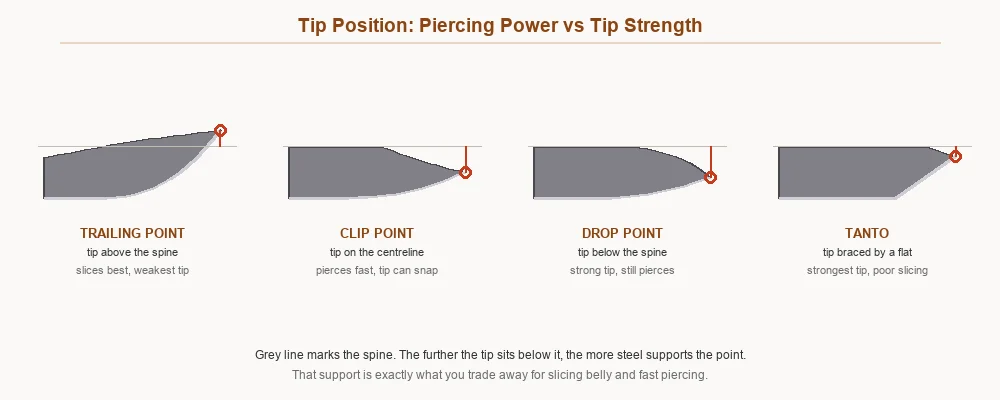
| Profile | Tip Strength | Belly for Slicing | Piercing | Choose It For |
|---|---|---|---|---|
| Drop point | High | Generous | Good | General field and utility work |
| Clip point | Low to moderate | Moderate | Excellent | Detail work and fast piercing |
| Tanto | Highest | Minimal | Strong but blunt entry | Hard materials and tip abuse |
| Spear point | High | Moderate | Excellent | Balanced thrusting and cutting |
| Sheepsfoot | None (no point) | None — straight edge | None | Controlled cuts where a point is a hazard |
| Trailing point | Lowest | Maximum | Poor | Skinning and long slicing strokes |
| Leaf shape | Moderate to high | Generous | Good | Everyday carry and food prep |
| Gut hook | n/a (specialist) | n/a | None | Opening hide without cutting through |
Choosing Your Profile: Decision Framework
If You Primarily Slice (Kitchen, Butchery)
Best choice: Trailing Point or Clip Point
Trailing point offers maximum slicing capability. Clip point adds precision to your slicing motions. Both will outperform drop points for this specific task. Consider your secondary needs when choosing between these two specialists.
If You Need All-Purpose Capability
Best choice: Drop Point
The drop point handles slicing adequately, precision work adequately, and tougher tasks adequately. It won’t beat specialists, but it won’t disappoint. This is why it’s the default for people buying their first serious knife.
If Precision and Control Are Paramount
Best choice: Clip Point
The clip point’s refined geometry provides exceptional control and feedback. Perfect for culinary work, detail-oriented tasks, and situations where precision matters more than raw capability. Experienced users particularly appreciate this profile.
If You Need Maximum Toughness and Reliability
Best choice: Tanto or Drop Point
Both profiles distribute stress favorably. Tanto offers slightly better edge retention under stress. Drop point offers slightly better overall versatility. Choose based on your secondary needs and expected use.
If Safety is a Priority
Best choice: Sheepsfoot
The blunt tip eliminates accidental puncture risk while maintaining excellent cutting capability. Perfect for professional environments where liability concerns exist or for users prioritizing safety.
If You Want Refined Aesthetics and Performance
Best choice: Clip Point, Spear Point, or Leaf Shape
These profiles are inherently elegant. If visual appeal matters as much as function, these three will satisfy both requirements while delivering excellent performance.
Frequently Asked Questions
Profile Selection Questions
Q: Which blade profile is best for beginners?
A: Drop point is ideal for beginners. It handles most tasks adequately and is forgiving of technique variations. As you develop preferences, you can explore more specialized profiles.
Q: Can I use a clip point for hunting?
A: Yes, but drop point is more practical. Clip point’s refined geometry is excellent for precise field dressing, but its reduced tip strength makes it less ideal for general hunting tasks than a drop point.
Q: Why would I choose a specialized profile over a drop point?
A: Specialists consistently outperform generalists in their specific domains. If you know 80% of your cuts will be slicing, a trailing point will be noticeably superior. If you know precision is paramount, a clip point excels. Choose when you understand your actual needs.
Performance and Comparison Questions
Q: Is a tanto harder to learn than other profiles?
A: Yes, slightly. The angular geometry requires more conscious technique than curved profiles like drop point. But with practice, many users find tantos intuitive and rewarding. Consider your willingness to invest in learning technique.
Q: Can different materials affect how a profile performs?
A: Absolutely. A clip point in brittle high-carbon steel will feel different (sharper, but more prone to chipping) than the same profile in flexible stainless steel. Profile and material interact, so consider both together.
Q: Which profiles are best for different steel types?
A: Our complete steel type guide discusses profile-material interactions in depth, showing which profiles work best with specific steel types.
Selection and Usage Questions
Q: Should I own multiple profiles?
A: Many serious knife users own 3-4 profiles, each optimized for specific tasks. If budget is limited, start with drop point, then add specialists as your needs clarify. Our collection offers options across all profiles.
Q: How do I know which profile will feel right in my hand?
A: Feel matters tremendously. If possible, handle different profiles before buying. Read reviews from users with similar use cases. Watch videos of people using each profile. Your specific hand size, strength, and technique matter.
Q: Can I sharpen any profile myself?
A: Yes. All profiles sharpen using the same basic techniques. Some require slightly different sharpening angles, but the methods are identical. Our sharpening guide covers profile-specific sharpening techniques.
The Verdict: Finding Your Perfect Profile
Blade profile is personal. What works beautifully for one person might feel awkward for another. The correct profile is the one that matches how your hand naturally works and what tasks you’ll primarily perform.
The data is clear: specialists beat generalists in their domains. But generalists beat specialists if you need flexibility. Choose accordingly based on how you’ll actually use the blade.
Here at HM Knives, we offer multiple profiles in both damascus and high carbon steel, because we believe the perfect blade should match your specific needs, not compromise based on limited options.
Not sure which profile is right for you? Contact our team—tell us what you’ll primarily use the blade for, and we’ll recommend profiles that match your work. Or explore our complete guide to choosing by use case to understand how profile fits into your broader knife selection strategy.
The perfect blade is the one you’ll actually reach for and use confidently. That perfect profile exists—we can help you find it.

From Our Workshop
One knife per profile, so you can see the geometry in the metal. Prices are on each listing.
- 13 Inch Bowie Knife — Damascus Steel, Bone and Bull Horn Handle — clip point — the concave scoop out of the spine.
- D2 Steel Hunting Dagger Knife with Sheep Horn Handle — dagger point — symmetrical, built to thrust.
- Damascus Tanto Knife — Genuine Stag Handle — tanto — a flat edge into an angled tip, the strongest point here.
- Damascus Skinner Knife — Heavier 4mm Blade, Bone Handle — skinner belly — a deep continuous curve, for sweeping cuts.
- Karambit Knife for Outdoor Use — J2 Steel, Full Tang — karambit — edge on the inside of the curve, cuts on the pull.
Browse the full range.