
Table of Contents
- Why This Choice Matters More Than Steel or Brand
- What Actually Separates the Two
- Strength: Where the Load Actually Goes
- How Folding Knife Locks Work
- The Geometry Limit on Blade Length
- Carrying Each Type Day to Day
- Getting the Blade Into Action
- Cleaning and Maintenance Differences
- Legal and Workplace Considerations
- Matching the Knife to the Work
- Which One Lasts Longer
- What Your Money Buys in Each
- How to Actually Decide
- Frequently Asked Questions
- Making the Call
Why This Choice Matters More Than Steel or Brand
Most buyers agonise over steel. They compare D2 against 1095, read about carbide volume and Rockwell hardness, and spend weeks deciding between two alloys that will both outperform their actual needs. Then they pick a knife that folds when they needed one that does not, or buy a fixed blade they cannot legally carry to work.
The folding-versus-fixed decision shapes your experience of a knife far more than the steel inside it. It determines whether the knife is in your pocket when you need it. It determines how much force you can apply without thinking. It determines how long cleaning takes, whether you can carry it into an office, and how the knife ages over twenty years.
Steel is a specification. Format is a relationship. Get the format wrong and the best steel in the world sits in a drawer.
What This Guide Covers
We will work through the mechanical differences first, because they explain everything downstream: why folders fail where they fail, why a folder’s blade can never be as long as its handle, and why a fixed blade cleans in seconds. Then we cover carry, law, maintenance, cost, and the specific tasks where each format clearly wins. By the end you should be able to make the call in about a minute.
What Actually Separates the Two
The distinction sounds obvious and mostly is, but the edges of the category matter more than people expect.
The Folding Knife Defined
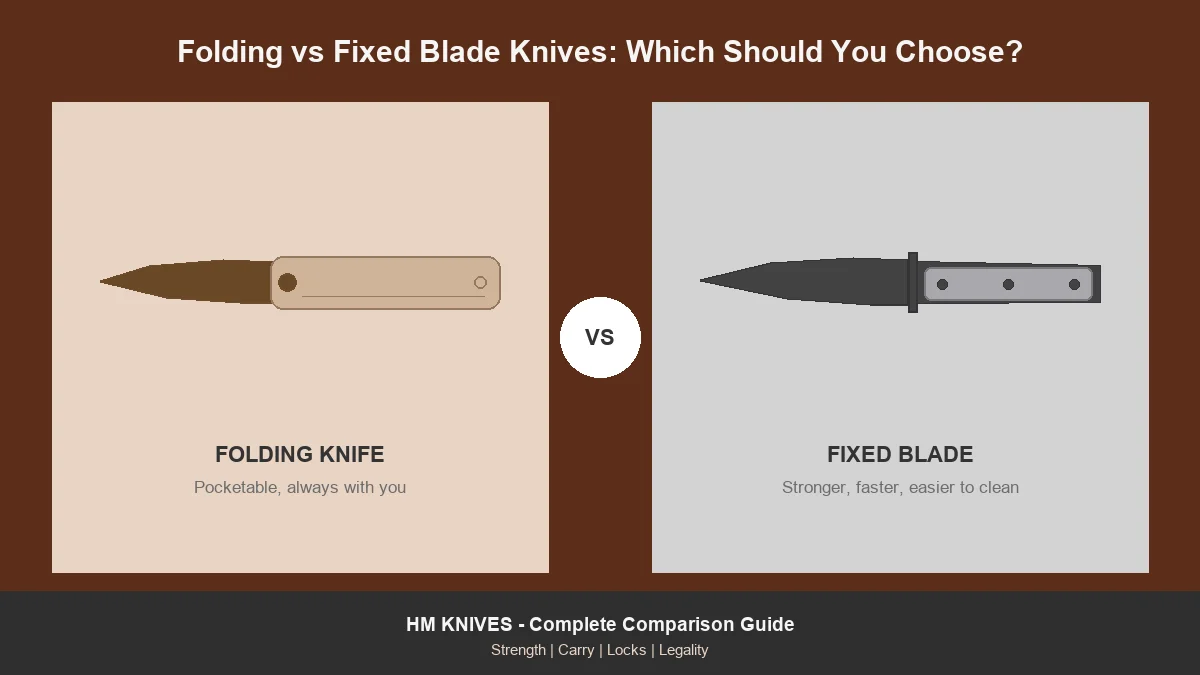
A folding knife has a blade that rotates around a pivot pin into a channel in the handle. The handle must therefore be at least as long as the blade, and it must be hollow enough to receive it. Almost every other characteristic of a folder follows from those two facts.
The Fixed Blade Defined
A fixed blade has no moving parts. The blade and the tang are one continuous piece of steel, and the handle material is attached to that tang rather than housing it. There is nothing to deploy, nothing to lock, and nothing to fail mechanically.
Full Tang, Partial Tang and Rat-Tail
Not all fixed blades are equal. A full tang runs the entire length and width of the handle, with scales pinned either side. A partial tang stops short. A rat-tail tang narrows to a thin rod that threads into the handle. Full tang is the strongest and the one worth paying for in a working knife; rat-tail construction is where most cheap fixed blades break, usually at the shoulder where the blade meets the tang.
The Grey Areas: Slipjoints, Balisongs and Friction Folders
A slipjoint folder, such as a traditional pocket knife, has no lock at all. A spring holds the blade open against light pressure, and it will close if you push hard on the spine. Friction folders rely on an extended tang trapped by your own grip. Balisongs pivot on two handles. All of these are folders in law and in practice, but they behave very differently under load, and the lockless designs deserve real caution on anything more demanding than opening post.
| Characteristic | Folding Knife | Fixed Blade |
|---|---|---|
| Moving parts | Pivot, lock, often a detent and spring | None |
| Blade length available | Capped by handle length | Unrestricted by the handle |
| Carry method | Pocket clip, pocket, pouch | Belt sheath, pack, neck |
| Time to deploy | Half a second to two seconds | Immediate |
| Cleaning | Awkward; the pivot traps debris | Wipe the whole blade in seconds |
| Lateral strength | Limited by the lock face | Limited only by the steel |
| Typical legal status | More widely permitted | More often restricted |
| Failure mode | Lock slips or pivot loosens | Steel chips or snaps |
Strength: Where the Load Actually Goes
This is the heart of the comparison, and it is worth understanding properly rather than accepting the folk wisdom that fixed blades are simply stronger.
The Full Tang Advantage
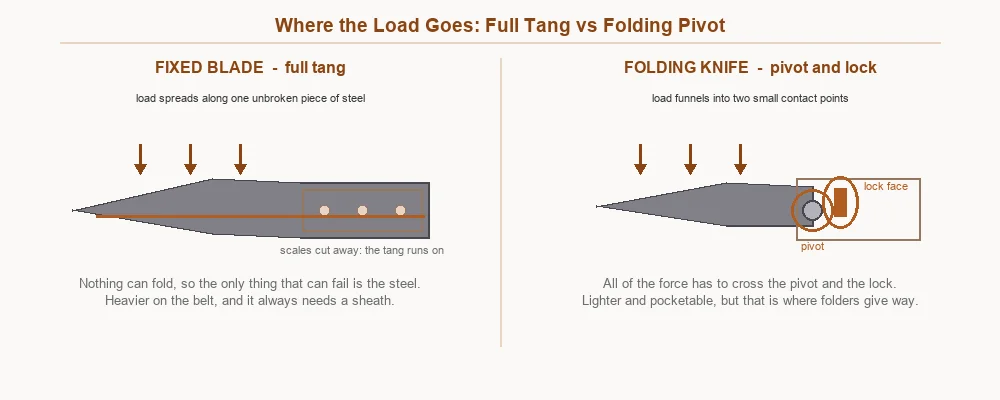
When you press down on a full tang fixed blade, the force travels from the edge, up through the blade, and out along a continuous piece of steel that runs the whole length of your grip. There is no joint, no interface, no component that can shift. The load is distributed across a large cross-section of metal. For the blade to fail, the steel itself has to fail.
What a Pivot Can and Cannot Take
A folder routes that same force through two small contact points: the pivot pin and the lock face. Both are engineered to handle far more than most people ever apply, and a well-made modern lock will take a surprising amount of abuse. But the load is concentrated rather than distributed, and concentrated load is what finds manufacturing tolerances.
Straight-down cutting pressure is the easy case. The lock face is loaded in compression and folders handle it comfortably.
Lateral Stress: The Real Killer
Twisting is what breaks folders. When you use a blade to pry, lever a lid, or wiggle a stuck point free, you apply torque across the pivot, and the pivot is the one axis a folder cannot brace against. The lock resists the blade closing; it does not meaningfully resist the blade twisting. Repeated lateral loading develops play in the pivot, and once a folder has developed play it never fully goes away.
A full tang fixed blade shrugs this off, which is precisely why every batoning, prying and field-dressing recommendation points at fixed steel.
How Much Strength Do You Actually Need?
Honestly, less than the internet suggests. If your knife opens packages, breaks down boxes, cuts cord, prepares food and handles the occasional stubborn task, a quality folder will serve for decades without ever approaching its limits. The strength argument only becomes decisive when the work involves sustained force, leverage, or conditions where a mechanical failure would be dangerous rather than annoying. The steel type you choose matters here too, since a tough steel forgives lateral load far better than a hard, brittle one.
How Folding Knife Locks Work
If you are buying a folder, the lock matters more than the blade shape and arguably more than the steel. Here is what each common type actually does.
The Lockback
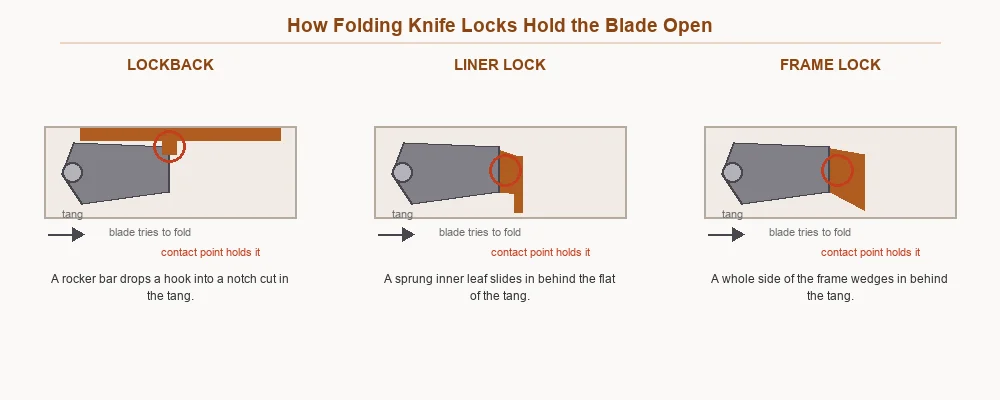
A rocker bar runs along the spine of the handle, pivoting in the middle. When the blade opens, a hook on the front of that bar drops into a notch cut into the tang. To close it, you press the exposed rear of the bar, which lifts the hook clear. Lockbacks are strong, ambidextrous, and mechanically simple. The trade-off is that closing them usually needs two hands, and the notch can collect grit.
The Liner Lock
One of the thin inner liners of the handle is cut so that a leaf of it springs inward. When the blade swings open, that leaf snaps across behind the flat rear face of the tang, physically blocking it from rotating back. Pushing the leaf sideways releases it. Liner locks allow genuinely one-handed opening and closing, which is why they dominate everyday carry. Quality varies enormously: the leaf must contact the tang at the correct angle, and a poorly cut lock can slip under pressure or stick fast.
The Frame Lock
The same principle as a liner lock, but instead of a thin internal liner it is an entire side of the handle frame that springs in behind the tang. Far more metal is doing the work, so frame locks are typically the strongest of the common folding locks. Your grip also tends to press the lock bar further into engagement. The cost is weight and, on some designs, a lock bar that is stiff to disengage until it wears in.
Slipjoints and Non-Locking Folders
A slipjoint has no lock. A backspring holds the blade in the open position through friction and geometry alone. Push hard enough on the spine and it will fold. These are legal in places where locking knives are not, and a well-made slipjoint is a pleasure to use for light tasks, but treat the blade as though it could close, because it can.
Lock Failure and What Causes It
Locks rarely fail catastrophically out of nowhere. They fail because grit has packed the engagement surfaces, because the lock face has worn past its intended contact angle, because a pivot has loosened, or because the knife was used for prying. Check your lock periodically: open the blade, press firmly on the spine, and feel for any movement or slip. If it budges, stop using it until it is serviced.
| Lock Type | Relative Strength | One-Handed Close | Grit Tolerance | Best Suited To |
|---|---|---|---|---|
| Lockback | High | No | Moderate | Hard-use folders, traditional patterns |
| Liner lock | Moderate to high | Yes | Good | Everyday carry, light utility |
| Frame lock | Highest | Yes | Good | Heavier duty folding work |
| Slipjoint | None (friction only) | n/a | Excellent | Light tasks, restricted jurisdictions |
The Geometry Limit on Blade Length
Here is the constraint most buyers never think about until they are holding both knives.
Why a Folder’s Blade Is Capped
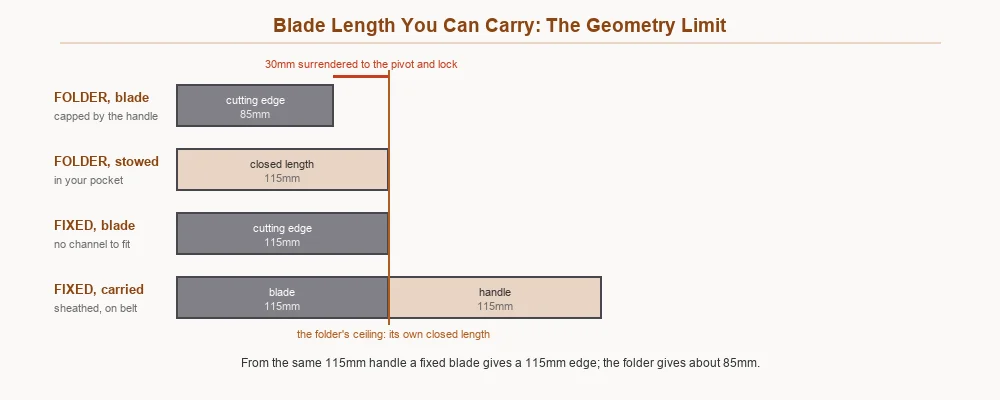
A folding blade has to fit inside its own handle. That means the blade can never be longer than the closed knife, and in practice it is always meaningfully shorter, because the pivot assembly, the lock and the blade channel all consume length. A folder with a 115mm closed length typically carries a blade around 85mm. A fixed blade with a 115mm handle can carry a 115mm blade, or a 200mm blade, or whatever the design calls for.
Closed Length vs Carry Comfort
You could simply build a longer folder, and manufacturers do. But closed length is exactly what determines whether the knife is comfortable in a pocket. Past roughly 120mm closed, a folder starts to feel like a tool you are carrying rather than something you have forgotten about. This is the ceiling that keeps most everyday folders in the 75mm to 95mm blade range.
When You Genuinely Need More Blade
Breaking down a carcass, processing firewood, clearing vegetation, or preparing food all benefit from length that folders structurally cannot provide. If the task needs 150mm of edge, no folding design will serve you well, and this is often the point at which the whole debate resolves itself. Our guide to blade profiles and when to use them covers how shape interacts with length once you have settled the format.
Carrying Each Type Day to Day
The best knife is the one you actually have. Carry method decides that more than any other factor.
Pocket Carry and Clips
A modern folder with a pocket clip rides in the corner of a trouser pocket, takes up almost no space, and disappears from your awareness within a week. This is the single strongest argument for folders and it is a very good argument. A knife you carry every day beats a superior knife you leave at home.
Belt Carry and Sheaths
Fixed blades need a sheath, and the sheath needs a belt. A good leather or moulded sheath holds the knife securely, allows a clean draw, and protects the edge. It also announces itself. Sitting down in a car, working at a desk, or moving through a crowd all become slightly more considered activities.
Weight Over a Full Day
A typical everyday folder weighs 60 to 120 grams. A comparable fixed blade with a sheath runs 200 to 400 grams. That difference is trivial for an hour and noticeable across a twelve-hour day on your feet.
Discretion and Social Context
A folder in a pocket is invisible. A sheathed fixed blade on a belt is not, and context decides whether that is fine or a problem. On a hunt, at a campsite or in a workshop it is unremarkable. In an office, a supermarket or a school car park it is a conversation you probably do not want. Browse our folding knives collection if discretion is the priority, or the hunting knives range if the knife lives outdoors.
Getting the Blade Into Action
One-Handed Opening
Thumb studs, opening holes, flippers and assisted mechanisms all get a modern folder open in well under a second with one hand. This is genuinely fast and entirely adequate for almost every civilian use.
Cold, Wet and Gloved Hands
The picture changes with conditions. Wet hands slip on thumb studs. Gloves make a flipper tab hard to find. Cold fingers lose the fine motor control that opening mechanisms rely on. A fixed blade has no deployment problem to solve, which is why it dominates in hunting, marine and winter contexts.
The Case for Always-Ready Steel
There is also the situation where a hand is already occupied, holding a rope, an animal, a branch or a rail. A fixed blade is drawn and cutting in one motion. This is not about emergencies so much as friction: over hundreds of small tasks, the format that requires no setup gets used more.
Cleaning and Maintenance Differences
This is where the practical gap is widest and where folders lose most decisively.
Why Folders Trap What You Cut
Every folder has a slot the blade retracts into, and that slot is directly adjacent to the pivot. Anything you cut migrates into it: food residue, sap, blood, dust, fibres. It is a warm, damp, enclosed space that you cannot see into and cannot easily reach. On a knife used for food or game, that is a hygiene problem as much as a maintenance one.
Cleaning a Folder Properly
Rinse with warm water while working the blade open and closed to flush the pivot. Use a cotton bud or a strip of cloth pulled through the channel. Compressed air helps. Dry thoroughly, ideally with a brief warm-air pass, then place one drop of light oil on the pivot and cycle the action to distribute it. Expect five minutes rather than thirty seconds.
The Fixed Blade Advantage
Wipe it. Rinse it. Dry it. The entire blade is accessible from both sides with no cavity to worry about, which is precisely why field dressing and kitchen work are fixed blade territory. Our complete knife maintenance guide covers sharpening, storage and rust prevention for both formats in detail.
Pivot Care and Lubrication
Folders need something fixed blades do not: periodic attention to the pivot itself. A drop of light oil every few weeks, worked through by opening and closing the knife, keeps the action smooth and prevents corrosion in a place you cannot inspect. Neglect it and you get a gritty action, then play, then a lock that no longer sits where it should.
Legal and Workplace Considerations
This section is general guidance rather than legal advice, and rules vary enormously by country, state and even city.
Why Fixed Blades Attract More Restriction
Legislators tend to treat concealment, blade length and immediacy of deployment as risk factors, and fixed blades score higher on all three in most drafting. Many jurisdictions that permit folders freely restrict fixed blades to specific activities such as hunting, fishing or work, or require open carry rather than concealed.
Locking vs Non-Locking in Law
Several jurisdictions draw the line not at folding versus fixed but at locking versus non-locking, treating any locking blade as equivalent to a fixed blade. In those places a slipjoint may be the only knife you can carry without a specific reason. This catches a lot of travellers out.
Checking Before You Carry
Check your local statute rather than relying on forum wisdom, and check again when you travel. Workplaces frequently impose their own limits that are stricter than the law. If you carry for work, get the position in writing. If you are buying a gift, consider where the recipient lives.
Matching the Knife to the Work
Hunting and Field Dressing
Fixed blade, clearly. You are working with wet, slippery hands inside a body cavity, applying steady pressure, and you need to clean the knife thoroughly afterwards. A folder introduces a hinge full of blood into that process. If you want help narrowing the choice, our guide on choosing the right hunting knife goes through blade length, profile and grind for field work.
Fishing and Camping
Mostly fixed. Fillet work wants flex and length; camp work wants something that can take a knock and clean easily by a lake. A folder is a reasonable backup rather than the primary. The fishing and camping knives range is built around that use.
Kitchen Work
Fixed, without exception. No serious kitchen knife folds. You need length, full-blade access for cleaning, a comfortable grip for repetitive motion, and absolute confidence that the blade will not move. See the kitchen and chef knives collection.
Everyday Carry and Utility
Folder, almost always. Opening parcels, cutting cord, trimming, breaking down packaging: the tasks are light, frequent and unpredictable, which rewards the knife that is always in your pocket over the one that is stronger.
Bushcraft and Batoning
Fixed blade, and specifically full tang. Batoning drives a blade through wood by striking the spine, which loads the knife in exactly the way a folder cannot survive. Do not baton with a folder.
| Task | Recommended Format | Why |
|---|---|---|
| Everyday carry and light utility | Folder | Portability wins; loads are low |
| Field dressing and skinning | Fixed blade | Hygiene and steady pressure |
| Kitchen and food preparation | Fixed blade | Length, access, cleanability |
| Fishing and filleting | Fixed blade | Flex, length, wet-hand cleaning |
| Camping and bushcraft | Fixed blade | Lateral load and batoning |
| Office and urban carry | Folder | Discretion and legality |
| Prying or leverage work | Neither — use a pry bar | Both formats are damaged by it |
Which One Lasts Longer
Wear Points on a Folder
A folder has consumable geometry. The lock face wears against the tang with every cycle, gradually moving the lock further across. Pivot washers compress. Detent balls wear. None of this happens quickly on a good knife, but it accumulates, and after ten or fifteen thousand cycles a well-used folder feels different from a new one.
What Actually Wears on a Fixed Blade
The edge, and the sheath. That is broadly the list. The knife itself has no mechanism to degrade, so a fixed blade that is kept clean and dry is essentially a permanent object. This is why fixed blades are what get handed down.
Rebuildability
Folders can usually be disassembled, cleaned and rebuilt with new washers, which restores most of the original feel. Fixed blades can be re-handled and re-sheathed almost indefinitely. Both are repairable; the fixed blade simply needs it less. Our guide on where to spend your money on knives covers which construction details actually predict longevity.
What Your Money Buys in Each
Where Folder Cost Goes
A significant share of a folder’s price is mechanism: pivot tolerances, lock geometry, bearings or washers, detent tuning, and the machining required to make all of it repeatable. Two folders with identical steel can differ hugely in price purely on how precisely the action is executed.
Where Fixed Blade Cost Goes
With no mechanism to fund, more of the price goes into the blade itself, the heat treatment, the handle material and the sheath. Pound for pound you get more steel and more finishing on a fixed blade at any given price. Whether Damascus or high carbon steel is worth the premium is a separate question, covered in that comparison.
Value at Each Price Tier
Below roughly $80, fixed blades offer clearly better value because cheap mechanisms are where folders cut corners, and a poor lock is worse than no lock. Between $80 and $250 both formats are strong and the choice should be made on use rather than value. Above $250 you are buying finish, materials and craftsmanship in both cases. The trade-off between stainless and carbon steel will affect price at every tier.
How to Actually Decide
Start With Where It Will Live
Not what it will cut — where it will live. Pocket, belt, pack, kitchen drawer, tackle box. The answer usually settles the format before you have considered anything else, because a knife that does not fit its environment does not get carried.
Then Consider the Heaviest Task
Think about the most demanding thing you will genuinely ask of it, not the most dramatic thing you can imagine. If that task involves sustained force, leverage, wet hands or thorough cleaning, buy fixed. If it is a series of light cuts spread through an ordinary day, buy folding.
Then Check the Legal Position
Before you buy, not after. This is the one constraint that can make an otherwise perfect choice unusable.
The Honest Answer: Most People Want Both
These formats are not really competitors. They solve different problems. A folder in the pocket for the hundred small cuts a week demands, and a fixed blade in the pack or the kitchen for the work that needs real steel. Most experienced knife users converge on exactly this arrangement, and it is a better outcome than trying to make one knife cover everything. Our guide to the best knife type for every use case maps this out task by task.
The one-minute version: If it lives in your pocket and cuts light things all day, buy a folder with a good lock. If it lives on a belt or in a kitchen and does real work, buy a full tang fixed blade. If you can only have one and the work is outdoors, buy fixed.
Frequently Asked Questions
Is a fixed blade always stronger than a folding knife?
In practical terms yes, because a full tang fixed blade has no joint to fail. A premium folder can outperform a poorly made fixed blade with a rat-tail tang, so construction quality matters more than format alone, but comparing like with like the fixed blade wins on strength every time.
Can I use a folding knife for hunting?
You can, and many people do for smaller game. The drawbacks are hygiene and cleaning: blood and tissue work into the pivot and are difficult to remove properly. For field dressing anything substantial, a fixed blade is the better tool.
Which lock type is strongest?
Frame locks are generally the strongest of the common types, because an entire side of the handle frame engages the tang. Lockbacks are close behind and tolerate grit well. Liner locks are perfectly adequate for everyday use but vary most in quality between makers.
Why is my folding knife blade so much shorter than the handle?
Because the blade has to fold into the handle, and the pivot assembly, lock and blade channel all consume length. A 115mm closed folder typically carries about an 85mm blade. That roughly 30mm gap is the mechanism.
Are fixed blade knives legal to carry?
It depends entirely on where you are. Many jurisdictions permit fixed blades for hunting, fishing or work while restricting general carry, and some regulate locking versus non-locking rather than folding versus fixed. Check your local law before carrying, and check again when travelling.
Should I own both?
Most people who use knives regularly end up doing exactly that: a folder for daily carry and a fixed blade for serious work. They are complementary tools rather than alternatives, and owning both is usually cheaper than repeatedly replacing one knife that does neither job well.
Making the Call
Strip away the forum arguments and the decision is simple. Folding knives trade strength and cleanability for portability and discretion. Fixed blades trade portability and discretion for strength, speed and simplicity. Neither is better; they are answers to different questions.
Ask where the knife will live and what the hardest thing you will genuinely ask of it is. Those two answers will point you clearly in one direction, and the legal position in your area will confirm or veto it. Everything after that — steel, handle material, blade profile, finish — is refinement within a decision you have already made correctly.
Every knife in the HM Knives collection is built to be used rather than displayed, in both formats. If you are weighing up a specific pair of options, contact us and we will tell you honestly which one suits the work, including when the answer is the cheaper one. Our knife care tips will help you keep whichever you choose performing for decades.

From Our Workshop
A folder and a fixed blade from the same workshop, for comparison. Prices are on each listing.
- Back Lock Knife Hand Made Damascus Folding EDC Knife — Back Lock folder — a rocker bar dropping into a notch in the tang, the lock this guide describes.
- Trapper Folding Knife Hand Made Damascus EDC Folding Knife — Trapper — a traditional pattern, pocket sized.
- Damascus Camping Knife — Full Tang, Ashwood Handle — Damascus camping knife, full tang — no pivot, no lock, nothing to fail under a baton.
Browse all folding knives.