
Table of Contents
- Four Material Decisions, Not One
- What a Knife Is Actually Made Of
- Carbon Steels: The Working Standard
- Stainless Steels: Buying Corrosion Resistance
- Damascus: A Construction, Not a Steel
- Hardness, Toughness and Why Heat Treatment Decides Both
- Handle Materials, Side by Side
- Micarta and G10: The Unglamorous Best Answer
- Wood, Stag, Bone and Horn
- Grip When Your Hands Are Wet
- Pins, Bolsters, Guards and Liners
- Sheath Materials
- Matching Materials to How You Will Use It
- Material Mistakes Worth Avoiding
- Frequently Asked Questions
- Choosing Materials With Intent
Four Material Decisions, Not One
Ask about knife materials and almost every answer talks about steel. Steel matters, but it is one of four decisions, and it is not reliably the one you will notice most. The handle is what you hold for twenty years. The pins and fittings decide whether the knife survives being wet. The sheath decides whether you carry it at all.
This guide covers all four honestly, including which choices are genuinely functional and which are aesthetic. Several popular materials are bought for how they look, which is a perfectly good reason as long as you know that is what is happening.
What You Will Find Here
Blade steels grouped by family with the properties that actually differ, handle materials compared on grip, upkeep and cost, the small fittings that quietly decide longevity, and sheath options. Everything is tied to real use rather than specification sheets.
What a Knife Is Actually Made Of
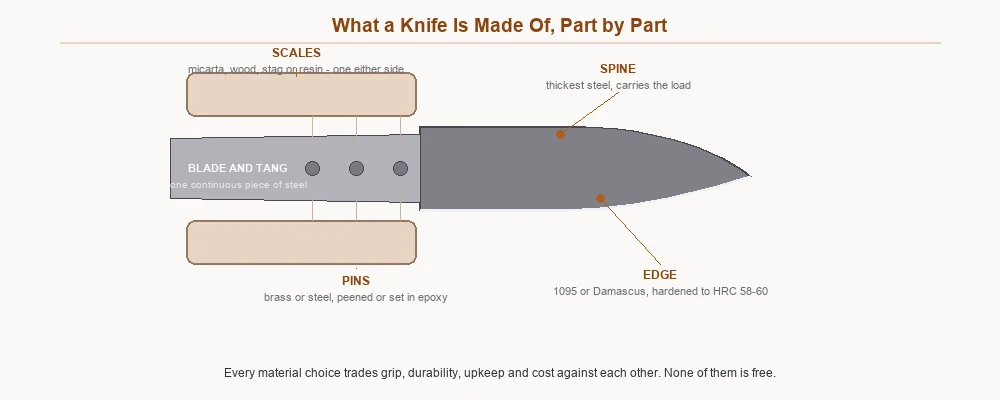
The Blade and Tang
On a full tang knife these are one continuous piece of steel running the length of the handle. This is the part that determines cutting and strength, and it is the only part that cannot be replaced later.
The Scales
Two pieces of handle material pinned either side of the tang. Replaceable, which is worth remembering: a knife with a blade you like and a handle you do not is a rehandling job, not a write-off.
The Pins and Fittings
Small, cheap, and responsible for a surprising share of failures. Corroded pins loosen scales; dissimilar metals in contact accelerate that.
The Sheath
Not part of the knife, entirely part of whether you use it. Budget for it separately, as our guide on where to spend your money on knives argues in more detail.
Carbon Steels: The Working Standard
What Defines the Family
Iron and carbon with little else. Carbon content above roughly 0.6 percent, no meaningful chromium. The 10-series names encode it: 1075, 1080, 1084, 1095, where the last two digits are hundredths of a percent carbon.
1095, The One We Forge
Around 0.95 percent carbon. Hardens readily, takes a very keen edge, sharpens easily on a basic stone, and holds an edge well. Our blades finish at HRC 58 to 60.
15N20, The Contrast Steel
A nickel-bearing carbon steel, roughly two percent nickel. On its own it is a good tough blade steel. In a Damascus billet its role is that the nickel resists acid etching, which is what makes the bright layers visible.
The Trade-off You Accept
Carbon steels rust. Not eventually but quickly, if left wet. In exchange you get easy sharpening, a keen edge and low cost. Our maintenance guide covers the routine that makes this a non-issue.
Patina, and Why It Is Not a Fault
Carbon steel develops a stable grey-blue oxide layer with use. It is mildly protective, it is not rust, and many owners encourage it deliberately.
Why the 10-Series Numbering Helps You
The naming convention is one of the few genuinely useful shortcuts in knife buying. In the 10xx series the first two digits indicate plain carbon steel and the last two give carbon content in hundredths of a percent, so 1075 is 0.75 percent carbon and 1095 is 0.95. More carbon allows greater hardness and therefore longer edge life, at some cost in toughness. This means you can read a rough performance profile straight off the name, which is not true of proprietary stainless designations where the numbers are marketing rather than composition.
What the Numbers Do Not Tell You
They say nothing about how the steel was treated, which is the larger variable. Two 1095 blades can differ more from each other than a 1075 and a 1095 treated equally well. Read the grade as a starting point and the hardness as the answer.
Stainless Steels: Buying Corrosion Resistance
The Threshold That Matters
Roughly 11 percent chromium or more. Below that a steel is not stainless regardless of what else is in it. Chromium forms a dense oxide film that reseals when scratched.
The Common Grades
440C is the traditional workhorse, easy to sharpen, moderate edge life. AUS-8 is softer and very forgiving. VG-10 and 154CM hold an edge notably longer and take more effort to sharpen. Each is a different point on the same curve.
What You Give Up
Stainless steels are generally harder to sharpen and, at equivalent hardness, hold an edge slightly less well than a good carbon steel. That gap has narrowed enormously and for most users is now academic.
When Stainless Is Simply Correct
Fishing, boats, coastal living, or any knife that will be put away damp. Our comparison of stainless and carbon steel knives covers the decision in full.
Damascus: A Construction, Not a Steel
Worth being explicit: Damascus is not a material. It is two or more steels forge welded together and etched so the boundary shows. Ours is 1095 and 15N20 — both carbon steels, no chromium. It rusts exactly like any other carbon blade and needs the same oiling. Stainless Damascus exists elsewhere and is a different, pricier product.
What the Layers Contribute
Appearance, primarily. A modest crack-deflection benefit at the layer boundaries, which shows up under lateral shock and almost nowhere else. No effect on sharpness or edge retention.
How It Is Made
Stack, forge weld, draw, fold, repeat, then shape, harden and etch. Six to eight hours before shaping begins. The full sequence is in our guide to how Damascus steel is actually made, and what it does and does not change is covered in our Damascus versus high carbon comparison.
| Steel | Family | Chromium | Typical HRC | Edge life | Rusts? | Best for |
|---|---|---|---|---|---|---|
| 1095 | Carbon | None | 58-62 | Good | Yes | General working blades |
| 15N20 | Carbon (nickel) | None | 56-60 | Good | Yes | Damascus contrast layers |
| 1084 | Carbon | None | 57-60 | Good | Yes | Forgiving, easy to heat treat |
| Damascus (1095+15N20) | Carbon laminate | None | 58-60 | Good | Yes | Appearance and craftsmanship |
| 440C | Stainless | 16-18% | 56-59 | Moderate | Rarely | All-round stainless |
| AUS-8 | Stainless | 13-14.5% | 56-58 | Moderate | Rarely | Easy sharpening |
| VG-10 | Stainless | 14-16% | 59-61 | Very good | Rarely | Kitchen and EDC |
| D2 | Semi-stainless | 11-13% | 58-62 | Excellent | Sometimes | Long edge life, harder to sharpen |
Why Two Steels Instead of One
A reasonable question is why anyone bothers welding two steels together when either would make a serviceable blade alone. The practical answer is contrast: without two steels that respond differently to acid, there is no visible pattern and no Damascus. But the pairing is constrained rather than free. The two steels must harden at compatible temperatures and expand and contract at similar rates during quenching, or the billet tears itself apart. 1095 and 15N20 satisfy both conditions while differing enough in nickel content to etch with strong contrast, which is why the combination is close to standard among makers working in carbon Damascus.
Hardness, Toughness and Why Heat Treatment Decides Both
The Two Properties Pull Against Each Other
Harder steel holds an edge longer and chips more readily. Tougher steel absorbs shock and dulls sooner. Every blade is a chosen point between them, set during heat treatment.
Why the Steel Name Tells You Less Than You Think
The same 1095 can leave two workshops at HRC 54 or 61. Those knives behave nothing alike. Heat treatment matters more than the grade, and it is invisible.
What to Ask
What hardness is it finished to, and how is that verified? A stated range such as HRC 58 to 60 indicates measurement. Our knife steel types guide explains what different ranges suit.
Matching Hardness to Task
For chopping and batoning, take the tougher end. For kitchen and detail work, take the harder end. For general field use, the middle.
Handle Materials, Side by Side
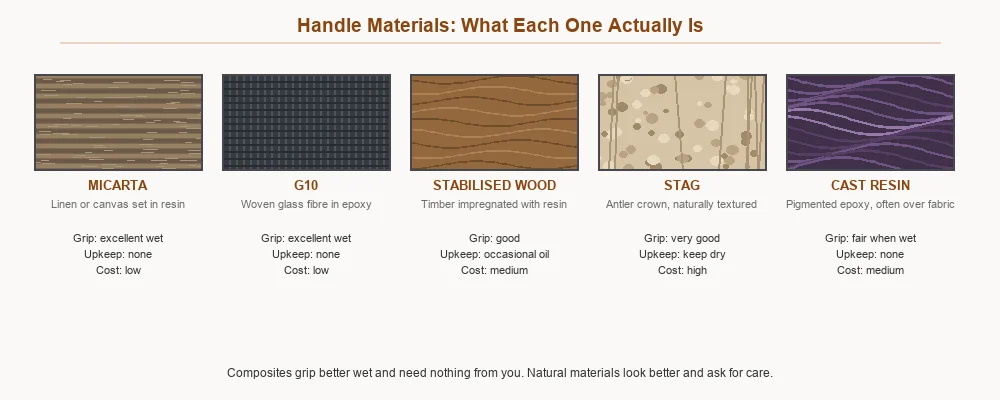
Seen Together, the Logic Is Clear
The composites are textured and indifferent to water. The naturals are more beautiful and want looking after. That is essentially the whole decision.
| Material | What it is | Grip when wet | Upkeep | Durability | Cost |
|---|---|---|---|---|---|
| Micarta | Linen or canvas in phenolic resin | Excellent | None | Very high | Low |
| G10 | Woven glass fibre in epoxy | Excellent | None | Very high | Low |
| Stabilised wood | Timber impregnated with resin | Good | Occasional oil | High | Medium |
| Untreated wood | Natural timber | Fair | Regular oil | Moderate | Low |
| Stag / antler | Natural antler crown | Very good | Keep dry | High | High |
| Bone | Polished bone | Fair | Keep dry | Moderate | Medium |
| Sheep horn | Natural horn | Good | Keep dry, avoid heat | Moderate | Medium |
| Cast resin | Pigmented epoxy | Fair | None | High | Medium |
Handle Shape Beats Handle Material
Before choosing between these materials, be aware that shape outranks all of them. A well-shaped handle in plain wood will outperform a poorly-shaped one in premium micarta, because grip comes principally from geometry: a slight swell in the palm, a defined index finger position, and no hard edges where the scales meet the tang. Material determines how the handle behaves when wet and how much care it wants. Shape determines whether it is comfortable at all, and comfort is what you will actually notice across twenty years of use.
The Test Worth Doing
Hold the knife in a pinch grip on the blade, not just wrapped around the handle, because that is how most cutting is actually done. Then hold it in a reverse grip. If either position puts a hard edge into your hand, no material will rescue it.
Micarta and G10: The Unglamorous Best Answer
What They Are
Micarta is fabric — linen, canvas or paper — saturated in resin and compressed. G10 is the same idea with woven glass fibre. Both are essentially engineered laminates.
Why They Win on Function
They are dimensionally stable, do not absorb water, do not shrink or swell with humidity, tolerate solvents and oils, and grip better wet than dry.
Why They Are Not Always Chosen
Because they look industrial. A micarta handle is a superb tool and a plain object, and many buyers reasonably want the knife to be handsome. That is a real preference, not a mistake.
Green Micarta in Practice
It patinates gently with handling, darkening where your hand sits. Some owners like this a great deal.
Micarta and G10 Compared to Each Other
The two are close enough that most buyers treat them as interchangeable, and largely they are. Micarta is slightly warmer to the touch and develops a subtle sheen where your hand sits, which some owners find pleasant and others read as wear. G10 is marginally harder, holds a sharper machined texture, and stays visually identical for decades. Micarta is generally a little easier to shape and finish, which is why hand makers reach for it more often. If you cannot decide, choose on how the texture feels rather than on specification, because the functional difference between them is smaller than the difference between either and a polished natural handle.
Wood, Stag, Bone and Horn
Stabilised Versus Untreated Wood
Stabilised wood has been vacuum-impregnated with resin, which stops it moving with humidity and makes it nearly maintenance free. Untreated wood is warmer in the hand and will eventually shrink away from the tang if it is not oiled.
Stag and Antler
Naturally textured, so grip is genuinely good, and no two are alike. Expensive, and it dislikes prolonged wet.
Bone and Sheep Horn
Beautiful, traditional, and more slippery when polished than most buyers expect. Horn also dislikes heat and can crack if left somewhere hot.
The Honest Position
Natural materials are chosen because they are lovely and because a handmade knife deserves a handle that looks made. They are functionally adequate rather than optimal, and that is fine.
Grip When Your Hands Are Wet
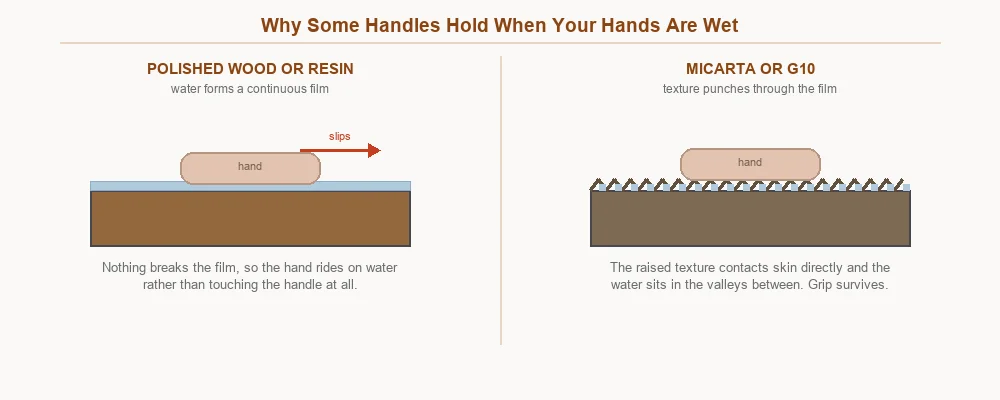
Why Polished Surfaces Fail
Water forms an unbroken film between skin and handle. Nothing punctures it, so your hand is riding on water rather than touching the knife.
Why Texture Works
Raised texture makes direct contact with skin while the water sits in the valleys between. Grip survives because contact survives.
The Practical Rule
If the knife will be used with wet or bloody hands — fishing, field dressing, kitchen work — choose a textured material or a shape with a genuine finger guard. This matters far more than the blade steel for choosing a hunting knife or a fishing and camping knife.
How Natural Handles Fail, and Whether It Matters
Natural materials fail predictably, which makes the risk manageable rather than alarming. Untreated wood shrinks in dry heat and swells in damp, so scales eventually sit slightly proud of the tang and a fingernail catches at the joint. Bone and horn crack if left in a hot car or near a radiator. Stag is the most durable of the naturals but darkens and dries over decades.
None of these ruins a knife. All of them are repairable by rehandling, which is a modest job on a full tang blade and often cheaper than people expect. If you want a natural handle and a knife that lasts, buy the natural handle and accept that it may be replaced once in the knife’s life. That is a very different proposition from the blade itself failing, which cannot be repaired.
Pins, Bolsters, Guards and Liners
Pins
Usually brass or stainless. Peened pins spread on both ends and hold mechanically; epoxy-only pins rely on adhesive. Peened is more durable.
Why Dissimilar Metals Matter
Brass pins in a carbon steel tang, kept damp, will corrode faster than either would alone. It is a slow problem and a real one. Keeping the knife dry solves it entirely.
Bolsters and Guards
A guard stops your hand sliding onto the edge under pressure, which is a safety feature rather than a decorative one on any knife used for thrusting or field dressing.
Liners
Thin layers of contrasting material between scale and tang. Almost entirely decorative, and one of the clearest signals of hand work.
Full Tang, Partial Tang and Rat-Tail
Tang construction is a material decision in its own right and one that buyers frequently overlook. A full tang runs the entire length and width of the handle, with scales pinned either side, and it is the strongest arrangement because there is no joint to fail. A partial tang stops short inside the handle. A rat-tail tang narrows to a thin rod threaded into the handle, which is where most inexpensive fixed blades break, typically at the shoulder where blade meets tang.
You can usually identify a full tang by looking at the handle from the side: the steel should be visible as a continuous strip sandwiched between the scales, running all the way to the butt. If the handle is a single piece with no visible tang line, ask before assuming. For any knife that will be batoned, pried with or used hard, this single detail matters more than the steel grade.
Sheath Materials
Leather
Traditional, quiet, comfortable, and it moulds to the knife over time. It absorbs water and will hold it against the blade, so a wet leather sheath must be dried with the knife out of it.
Kydex and Moulded Synthetics
Waterproof, precise retention, audible click. Noisy, can trap grit which then abrades the blade finish, and unforgiving if the fit is wrong.
Canvas and Nylon
Cheap and light. Retention is usually poor and edges cut through them over years.
What to Choose
Leather for dry-country and traditional carry, synthetic for wet work. If the knife is carbon steel and the sheath is leather, never store the knife in it long term: the tannins accelerate corrosion.
Retention Matters More Than Material
Whichever sheath material you choose, retention is the property that decides whether the arrangement works. A sheath must hold the knife securely enough that it stays put when you bend, kneel or fall, and release it easily enough that you can draw one-handed without a struggle. Those two requirements pull against each other, and getting the balance right is a matter of fit rather than material.
Test it by inverting the sheathed knife and shaking gently. Nothing should move. Then draw it with the hand you would actually use, wearing whatever gloves the job involves. A sheath that passes both tests in leather is better than one that fails either in kydex, and the reverse is equally true.
Matching Materials to How You Will Use It
| Use | Blade steel | Handle | Sheath | Reasoning |
|---|---|---|---|---|
| Kitchen, daily | Carbon or VG-10 | Stabilised wood or micarta | Block or strip | Dry environment, comfort over hours |
| Hunting, field dressing | 1095 or Damascus | Micarta, stag or textured wood | Leather | Wet hands, needs grip and a guard |
| Fishing, boats | Stainless | G10 or micarta | Synthetic | Constant water; carbon will rust |
| Camping, bushcraft | Tough carbon | Micarta or G10 | Leather or synthetic | Impact resistance and indifference to weather |
| Everyday carry | Stainless or carbon | G10, micarta or resin | Pocket clip | Convenience and low upkeep |
| Display or gift | Damascus | Stag, bone or figured wood | Leather | Bought to be looked at, and that is legitimate |
The One Rule That Never Changes
Match the material to the environment, not to the price. A stag-handled carbon Damascus knife is a beautiful object and a poor choice for a fishing boat, at any price.
The Twenty-Year View
Materials age at very different rates, and it is worth picturing the knife well into its life rather than on the day it arrives. Micarta and G10 will look essentially unchanged in twenty years. Stabilised wood darkens slightly and gains character. Untreated wood will likely have been re-oiled several times and may have moved enough to want attention. Stag dries and deepens in colour. A carbon steel blade will carry a settled patina that most owners come to prefer to the original finish, and the etch on a Damascus blade will have softened, though a few minutes of re-etching brings it back.
None of this is deterioration so much as change, and it is one of the genuine pleasures of owning a knife made from real materials. The exception is neglect: pitting from stored moisture is the one form of ageing that cannot be undone, on any material combination at any price.
Material Mistakes Worth Avoiding
Assuming Damascus Resists Rust
The single most common error, and the most expensive in ruined blades.
Buying Polished Naturals for Wet Work
Polished bone or resin in a wet hand is genuinely hazardous, not merely inconvenient.
Storing a Carbon Blade in a Leather Sheath
Leather holds moisture and its tannins are acidic. Long-term storage in a sheath is how good blades get pitted.
Judging Steel by Name Alone
Without a stated hardness, a steel name tells you what the blade could be, not what it is.
Ignoring the Handle Because the Blade Is Impressive
You hold the handle. Over years, its shape and grip affect your experience more than any blade specification, which is why our use case guide treats it as a primary decision. Browse the HM Knives collection and you will see the same blade offered with several handle options for exactly this reason.
Frequently Asked Questions
What is the best handle material for a knife?
Micarta or G10 if you are choosing on function alone. Both grip better wet than dry, are dimensionally stable, and need no maintenance. Natural materials like stag and stabilised wood are chosen for appearance and are functionally adequate rather than superior.
Is Damascus steel a material?
No. Damascus is a construction method: two or more steels forge welded, folded and etched so the boundary shows as a pattern. Ours uses 1095 and 15N20, both carbon steels, so it rusts and needs oiling like any carbon blade.
What steel do HM Knives blades use?
Our Damascus blades are forged from 1095 and 1043/15N20 and finished at HRC 58 to 60. Both are high carbon steels with no meaningful chromium, so they take a keen edge, sharpen easily and require drying and occasional oiling.
Do brass pins corrode?
Brass in contact with carbon steel will corrode faster than either metal alone if kept damp, because the dissimilar metals set up a small galvanic cell. It is slow and entirely preventable by drying the knife after use.
Should I store my knife in its leather sheath?
Not long term. Leather absorbs moisture and its tannins are mildly acidic, which is a reliable way to pit a carbon steel blade. Use the sheath for carry and store the knife outside it, lightly oiled.
Is stabilised wood better than natural wood?
For a working knife, yes. Stabilised wood is vacuum-impregnated with resin so it does not shrink, swell or crack with humidity, and it needs almost no maintenance. Untreated wood feels warmer but will move over time.
Choosing Materials With Intent
Four decisions, not one. The steel decides how the knife cuts and whether it rusts. The handle decides whether you enjoy holding it and whether you keep hold of it when wet. The pins and fittings decide whether it survives a decade of damp. The sheath decides whether it is with you at all.
Most of these have a functionally correct answer and a beautiful answer, and they are frequently not the same. Composites outperform naturals on grip and upkeep; naturals look better and make the knife an object rather than a tool. Both are legitimate purchases, and the only real mistake is choosing the beautiful answer while believing it is the functional one.
Decide where the knife will live first, let the environment rule out what will not survive it, and choose freely among what remains. If you are weighing two specific configurations, contact us and we will tell you which will hold up to the work you have described, and our knife care tips will keep it doing so.
From Our Workshop
Each material in this guide, in a knife that uses it. Prices are on each listing.
- J2 Steel 11 inch Hand Made Fishing Camping Knife with Green Micarta Handle — micarta — grippier wet than dry.
- Damascus Tanto Knife — Genuine Stag Handle — genuine stag — textured by nature.
- Damascus Skinner Knife — Bone Handle with Mosaic Pin Detail — bone with mosaic pins — handsome, and slippery once polished and wet.
- Wenge Wood Bowie Knife — J2 Steel, Full Tang — wenge wood — dense and stable.
- Bull Cutter Knife — Patterned Resin Handle, J2 Steel — resin — waterproof, and the only one that takes any colour.
Browse the full range.