
Table of Contents
- Why This Choice Confuses So Many Buyers
- Damascus Steel: What It Actually Is
- How Damascus Is Made: Forge, Draw, Fold
- Why the Pattern Appears at All
- High Carbon Steel: The Single-Steel Standard
- The Real Difference, and the Myth to Drop First
- Edge Retention: What Actually Decides It
- Toughness and the Case for Lamination
- Rust: Both of These Steels Will Corrode
- Maintenance: What Each One Asks of You
- What Layer Count Changes, and What It Does Not
- Cost: What the Premium Actually Buys
- Myths Worth Retiring
- How to Choose Between Them
- Frequently Asked Questions
- The Honest Verdict
Why This Choice Confuses So Many Buyers
Ask ten knife shops what separates Damascus from high carbon steel and you will get answers ranging from the mystical to the flatly untrue. Damascus is described as a steel in its own right, as a lost ancient secret, as rust-proof, as sharper by nature. Most of this is marketing that has been repeated until it sounds like metallurgy.
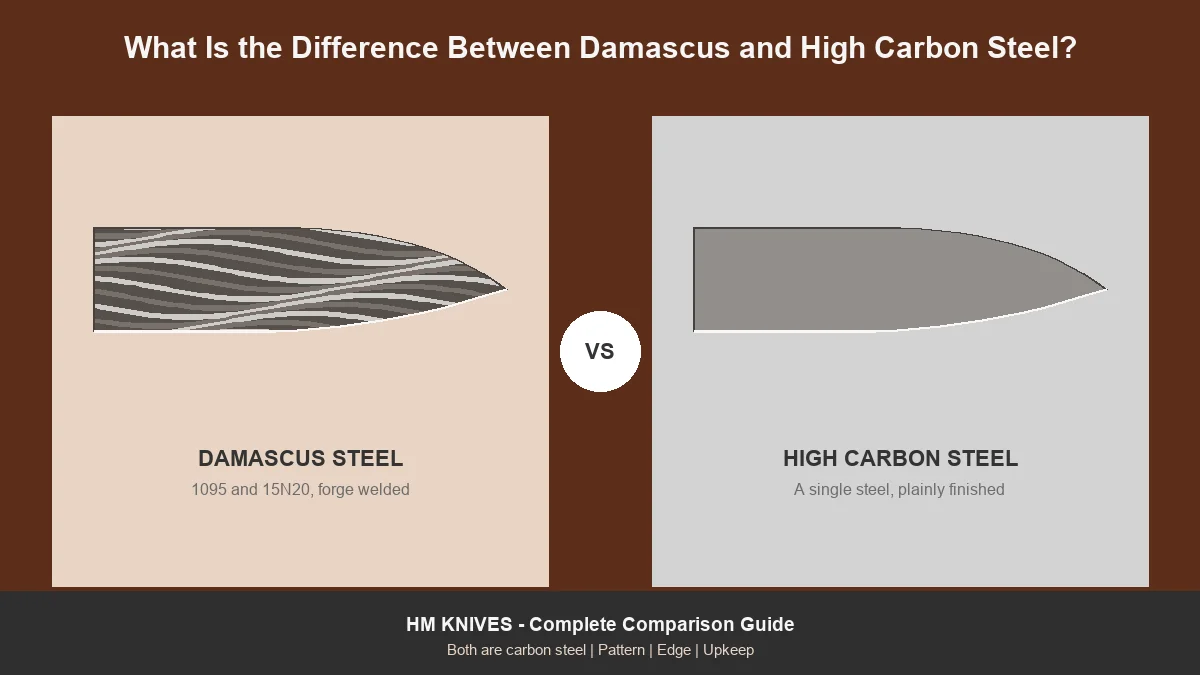
The honest version is simpler and considerably more useful. Damascus is not a steel. It is a construction method: two or more steels forge welded together, folded, and etched so the boundary between them shows as a pattern. What that construction gives you, and what it does not, depends entirely on which steels went into it.
This guide covers what our Damascus is actually made from, what the layers do and do not change, and which of the two makes sense for the way you work.
What You Will Not Find Here
No claims that Damascus resists rust, because ours does not. No laboratory figures we did not measure. Where the honest answer is “these two perform about the same,” that is what it says.
Damascus Steel: What It Actually Is
Modern Damascus, sometimes more accurately called pattern-welded steel, is made by stacking bars of two different steels, forge welding them into a single billet, then drawing and folding that billet until it contains hundreds of alternating layers.
The Two Steels in Our Billets
Our Damascus blades are forged from 1095 and 1043/15N20. Both are high carbon steels. Neither is stainless. The 15N20 carries roughly two percent nickel, and that nickel is the whole reason the pattern is visible: it resists the acid etch that darkens the 1095 beside it.
| 1095 | 15N20 | Why the pair works | |
|---|---|---|---|
| Carbon | ~0.95% | ~0.75% | Both hard enough to take an edge |
| Nickel | None | ~2% | Nickel is what resists the acid etch |
| Chromium | None | None | Neither is remotely stainless |
| Reaction to etching | Darkens | Stays bright | This contrast is the pattern |
| Hardness achievable | HRC 58-62 | HRC 56-60 | Close enough to harden as one |
| Role in the billet | The cutting steel | The contrast steel | 1095 does most of the work at the edge |
Why These Two and Not Others
The pairing is not arbitrary. Two steels welded into one blade must harden at compatible temperatures and expand and contract at similar rates, or the billet tears itself apart during quenching. 1095 and 15N20 are close enough on both counts to behave as a single piece of steel, while differing enough in nickel content to produce strong visual contrast. Plenty of steel pairs look promising on paper and delaminate in the quench.
What Historical Damascus Was
The original wootz Damascus of the medieval Middle East was something else entirely: a crucible steel whose banding came from carbide segregation during slow cooling, not from folding. That process was genuinely lost for centuries. Modern pattern welding produces a comparable look through an entirely different route, and no reputable maker claims otherwise.
Why the Name Persists
Because it sells, and because the visual result is genuinely reminiscent of the historical material. There is nothing dishonest in calling a pattern-welded blade Damascus, provided nobody pretends the steel has properties it does not have.
How Damascus Is Made: Forge, Draw, Fold
The process is straightforward to describe and difficult to do well.
Stacking the Billet
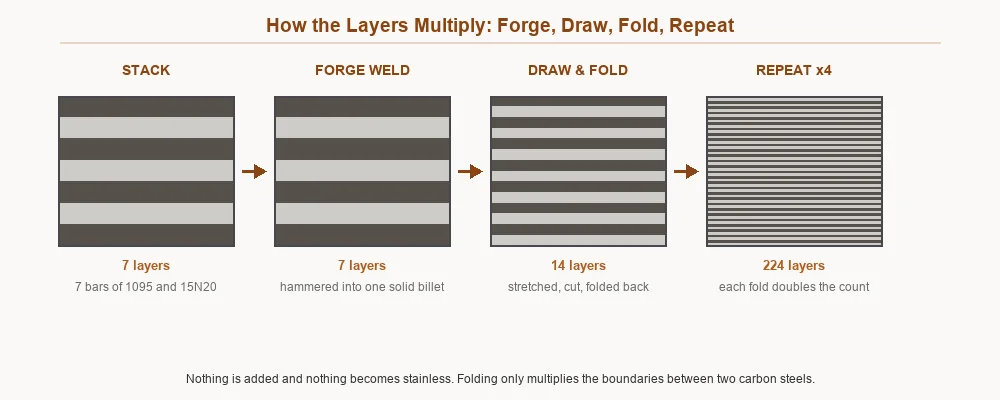
Alternating bars of 1095 and 15N20 are cut to size and stacked, typically seven to eleven bars to start. The stack is cleaned meticulously, because any scale or oxide trapped between bars becomes a cold shut, a permanent flaw that shows up later as a delamination.
The Forge Weld
The stack is brought to welding heat, fluxed, and hammered until the separate bars become one piece of steel. This is the step where billets fail. Too cool and the layers do not join; too hot and the steel burns. There is no repairing a bad weld further down the line.
Drawing and Folding
The welded billet is drawn out longer, cut, folded back on itself, and rewelded. Each fold doubles the layer count. Seven layers becomes fourteen, then twenty-eight, and after four or five folds the billet holds well over two hundred layers.
Shaping, Heat Treatment and Etching
Only then is the billet forged to a blade shape, normalised, hardened and tempered to its working hardness, ground, and finally etched in acid to reveal the pattern. Our blades come off this process at HRC 58 to 60. If you want the full sequence in detail, our guide to how Damascus steel is actually made walks through each stage.
What Goes Wrong, and How to Spot It
Three failures account for most bad Damascus. A cold shut is an unwelded seam that shows as a fine dark line running with the layers, often near the spine where forging pressure was lowest; it is a crack waiting to open. Delamination is the same failure further along, visible as a lifted edge or a hairline gap at the plunge. Carbon migration happens when a billet is held at heat too long and carbon diffuses between layers, softening the pattern contrast and, in extreme cases, the edge itself.
Inspect a Damascus blade in raking light along the flats and the spine. The pattern should be continuous and the layer lines unbroken. Any line that crosses the pattern rather than following it deserves a question to the seller.
Where the Hours Go
A single billet takes six to eight hours of skilled work before it becomes a blade at all. That labour, not exotic material, is what you pay for.
Why the Pattern Appears at All
This is the part most guides skip, and it explains a great deal about what Damascus is and is not.
Before the Etch, the Pattern Is Nearly Invisible
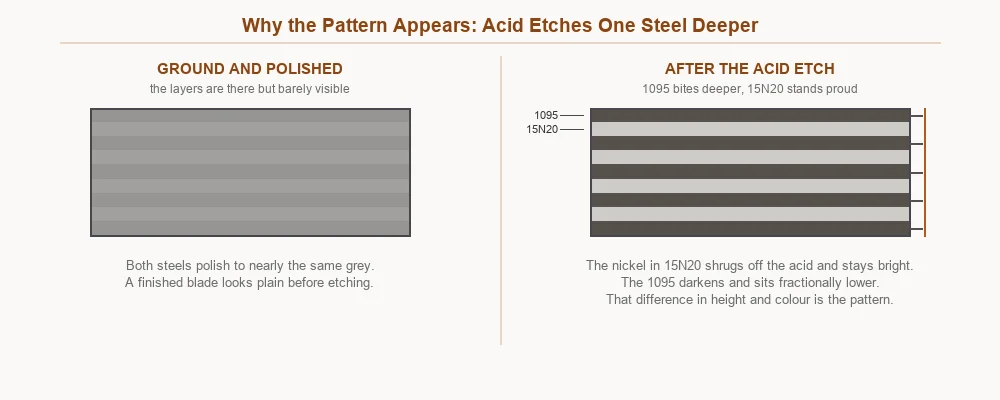
A ground and polished Damascus blade looks almost plain. Both steels take a similar finish, and the layer boundaries barely register.
What the Acid Does
Dipped in a mild acid, the 1095 corrodes fractionally faster and darkens. The nickel in the 15N20 resists, so those layers stay bright and stand a few microns proud. The pattern you see is that difference in colour and height, nothing more.
The Consequence Nobody Mentions
An etched surface is a slightly rougher surface, and the etch has already begun a corrosion process. This is one reason a Damascus blade wants oiling rather than neglect, and it is the opposite of the rust-proof story often attached to it.
High Carbon Steel: The Single-Steel Standard
High carbon steel is exactly what it sounds like: one steel, chosen for its carbon content, hardened and put to work.
What Counts as High Carbon
Generally 0.6 percent carbon and up. The common blade grades are 1075, 1080, 1084 and 1095, with the number indicating carbon content. More carbon allows greater hardness, which allows a finer edge held longer, at some cost in toughness.
Why Working Makers Keep Using It
It is predictable. Heat treatment is well understood, results are repeatable, and the steel gives clear feedback in the shop. It sharpens easily, takes a keen edge, and costs a fraction of exotic alternatives. Our guide to knife steel types and how they perform covers each grade in more detail.
The Trade-off It Asks You to Accept
It rusts. Not eventually, but quickly, if you leave it wet. That single characteristic is what pushes buyers toward stainless, and it is covered properly in our comparison of stainless and carbon steel knives.
The Real Difference, and the Myth to Drop First
The correction that matters most: our Damascus is not stainless and contains no meaningful chromium. It is two carbon steels welded together. It rusts on the same timescale as plain high carbon steel and wants the same care. Any source telling you otherwise is describing stainless Damascus, a different and considerably more expensive product that we do not make.
So What Is Genuinely Different?
Appearance, first and most honestly. A Damascus blade is a made object in a way a plain blade is not, and that is a legitimate reason to want one. Second, the lamination itself contributes a modest toughness benefit, discussed below. Third, cost, which follows directly from the labour involved.
What Is Not Different
Corrosion behaviour. Sharpening technique. Edge geometry. The angles, stones and routine are identical, as set out in our complete knife maintenance guide.
| Property | Our Damascus (1095 + 15N20) | High Carbon (1095) | Honest Verdict |
|---|---|---|---|
| Chromium content | None to speak of | None to speak of | No difference |
| Corrosion resistance | Low — will rust | Low — will rust | No meaningful difference |
| Working hardness | HRC 58-60 | HRC 58-60 | Same range |
| Edge retention | Good | Good | Driven by heat treat, not pattern |
| Toughness | Slightly better | Good | Small edge to the laminate |
| Sharpening difficulty | Normal | Normal | No difference |
| Appearance | Distinctive layered pattern | Plain, often satin or forced patina | The genuine differentiator |
| Typical cost | 2-4x | Baseline | You are buying labour and looks |
Edge Retention: What Actually Decides It
Edge retention comes from three things, and the pattern is not among them.
Carbon Content and Carbide Structure
More carbon means more hard carbides suspended in the steel, and carbides are what resist abrasion. This is the largest single factor.
Heat Treatment
The second largest, and the one buyers never see. The same 1095 can come out of two shops at HRC 54 or HRC 61, and those two knives behave nothing alike. A well heat treated plain carbon blade will comfortably outperform a badly treated Damascus one.
Edge Geometry
A thin, acute edge cuts better and dulls sooner. A thicker edge lasts longer and cuts less keenly. This is a choice made at the grinder, independent of the steel.
Why Damascus Does Not Sit Above This
Because a Damascus edge is, at any given point, simply one of its constituent steels. Where the apex passes through a 1095 layer it behaves as 1095. There is no synergy that makes the whole harder than its parts. Expect performance in the same band as a good single carbon steel, because that is what it is.
How to Judge Heat Treatment When You Cannot See It
Since heat treatment matters more than the pattern and is invisible in photographs, buyers need proxies. Ask what hardness the blade is finished to; a maker who cannot answer in HRC is not measuring. Ask whether blades are normalised before hardening, and whether tempering is done in a controlled oven rather than by eye. Look for a stated hardness range rather than a single number, because real production varies by a point or two. A maker who publishes HRC 58-60 and explains their process is telling you more about how the knife will cut than any layer count ever will.
The Test You Can Do Yourself
Cut something abrasive and repetitive: cardboard is the standard. A properly hardened carbon blade will slice clean corrugated card thirty or forty times before the edge starts tearing rather than cutting. A soft blade tears within a dozen. This tells you more in five minutes than a specification sheet does.
Toughness and the Case for Lamination
Here the laminate does earn something, though less dramatically than usually claimed.
How Layer Boundaries Behave Under Stress
A crack propagating through homogeneous steel runs in a straight line. In a laminated billet it meets hundreds of boundaries between steels of slightly different hardness, and each boundary can deflect or blunt it. The practical result is a blade marginally more forgiving of lateral shock.
How Much Does This Matter?
Modestly, and mostly at the extremes. For kitchen work or general field use you will never encounter it. For a blade that gets batoned or pried with, it is a real if small advantage. Note that both steels here are tough enough that the difference rarely decides anything, and format matters far more, which is why our comparison of folding and fixed blade knives is the more consequential read for hard use.
The Counterweight: Weld Quality
A laminate is only as good as its welds. A billet with a cold shut has a built-in crack, and it will fail sooner than plain steel would have. This is precisely why forge welding skill matters more than layer count, and why handmade versus production construction is worth understanding before you buy.
Rust: Both of These Steels Will Corrode
This section previously said something different, and it was wrong. Here is the accurate position.
Neither Blade Is Stainless
Stainless steel requires roughly 11 percent chromium or more to form the passive oxide film that resists corrosion. Our Damascus billet is 1095 and 15N20. Neither carries chromium in that range. Neither is stainless, in combination or alone.
The Nickel Question
The nickel in 15N20 helps that steel resist the etching acid, and people sometimes extrapolate from this to corrosion resistance generally. At around two percent, nickel does not confer stainlessness. A 15N20 layer left wet will rust.
What This Means in Practice
Wipe the blade dry after use. Do not leave it in a sink, a wet sheath, or a damp pack. Oil it if it is going to sit unused. This is the same advice as for any carbon steel blade, and our knife care tips cover it in a couple of minutes.
If Rust Has Already Started
Surface rust on either steel is recoverable and not a crisis. Work a drop of light oil over the spot with a wine cork or a soft brass brush, both of which are softer than hardened steel and will lift oxide without scratching. For heavier spotting, a paste of bicarbonate of soda and water left for a few minutes, then worked gently, will break the bond. Avoid steel wool and abrasive pads, which scour the surface and, on Damascus, flatten the etch contrast permanently.
Pitting is different. Once rust has eaten into the steel it leaves a crater that no amount of polishing removes, and on an edge a pit becomes a permanent weak point where chips start. This is why catching it early matters more than treating it well.
Patina Is Not Rust
Both steels will develop a stable grey-blue patina with use, and that layer is mildly protective. Red-orange rust is different: it flakes, it pits, and it keeps going. Learn the difference and you will worry far less.
Maintenance: What Each One Asks of You
The Shared Routine
Dry after every use. Clean off anything acidic promptly. Light oil monthly, or before storage. Sharpen when it stops cutting rather than on a calendar.
Where Damascus Asks Slightly More
The etched surface is marginally more textured than a polished one, giving corrosion a little more purchase. Aggressive polishing or abrasive cleaners will also dull the pattern contrast over years, so avoid scouring pads on the flats.
Sharpening Either One
Identically. Same angles, same stones, same progression. Sharpening a Damascus blade does not damage the pattern, because the pattern runs through the entire thickness of the steel rather than sitting on the surface.
| Task | Frequency | Damascus | High Carbon |
|---|---|---|---|
| Wipe and dry | After every use | Essential | Essential |
| Light oil coat | Monthly, or before storage | Essential | Essential |
| Re-etch to refresh pattern | Every few years, optional | Occasionally wanted | Not applicable |
| Sharpening | When performance drops | Standard technique | Standard technique |
| Avoid abrasive cleaners | Always | Dulls the contrast | Scratches the finish |
| Wet storage | Never | Rusts | Rusts |
What Layer Count Changes, and What It Does Not
Layer counts are the headline figure in Damascus marketing, and they are close to meaningless as a performance measure.
What More Layers Give You
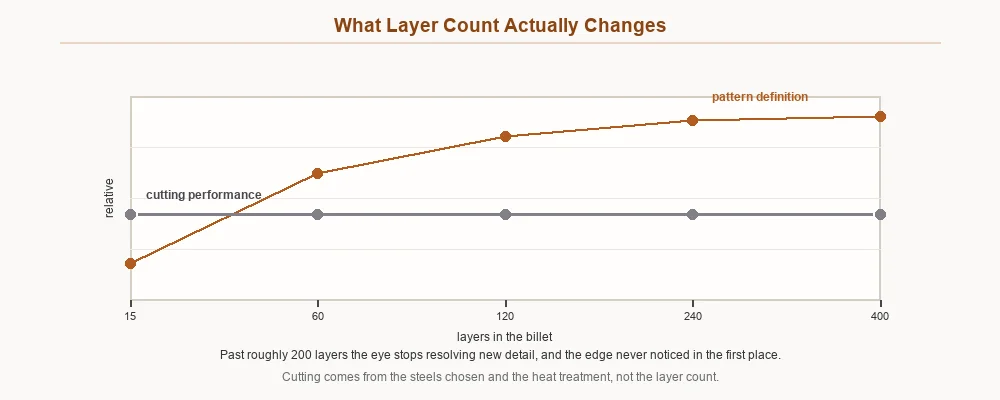
A finer, tighter pattern. Below about sixty layers the pattern reads as coarse banding. Between roughly one hundred and three hundred you get the crisp definition most people picture. Past that, the layers become finer than the eye resolves at arm’s length.
What More Layers Do Not Give You
A sharper edge, better retention, or greater hardness. A 500-layer blade and a 120-layer blade of the same steels, heat treated identically, cut the same.
How to Read a Layer Count Honestly
Treat it as a description of appearance, like a colour. If a seller presents a high layer count as a performance specification, that tells you something useful about the seller. Our guide on where to spend your money on knives covers which specifications genuinely predict quality.
Cost: What the Premium Actually Buys
The Labour Arithmetic
A plain carbon blade starts as a piece of stock. A Damascus blade starts as six to eight hours of stacking, welding, drawing and folding before shaping even begins, with a genuine risk of scrapping the billet along the way. That is the premium, and it is real work rather than a markup on mystique.
Where the Money Does Not Go
Not into rarer or better material. 1095 and 15N20 are ordinary, affordable steels. Nobody is paying for exotic alloy content.
Price Tiers and What Changes Between Them
Below roughly $120, Damascus is usually imported billet stock, sometimes acid-etched to imply more layers than are present, and the heat treatment is the first thing that gets economised. Between $150 and $400 you reach genuinely hand-forged billets with honest layer counts and controlled hardening, which is where the value sits for most buyers. Above $500 you are paying for finish, handle materials, sheath work and the maker’s reputation, all legitimate but with diminishing returns on cutting performance. A plain high carbon blade reaches its performance ceiling far earlier, often around $80 to $150.
Is It Worth It?
If you want an object with visible craftsmanship in it, unequivocally yes, and that is a perfectly good reason. If you are buying purely on cutting performance per pound spent, a well made plain carbon blade is the rational choice and we will tell you so. Browse the HM Knives collection and you will find both, priced accordingly.
Myths Worth Retiring
Myth: Damascus Steel Does Not Rust
False for any carbon Damascus, which is the overwhelming majority of it and all of ours. Stainless Damascus exists and is a distinct, pricier product.
Myth: Damascus Is Sharper by Nature
Sharpness is geometry and heat treatment. The pattern contributes nothing.
Myth: The Layers Are a Serrated Edge Under Magnification
They are not. The layers are metallurgical, not geometric, and the apex is as continuous as any other blade’s.
Myth: More Layers Means Better Steel
More layers means a finer pattern. Nothing else.
Myth: Damascus Cannot Be Sharpened Normally
It can, and should be. Same stones, same angles.
Myth: A Damascus Pattern Can Wear Off
It cannot, because it runs through the steel. It can fade at the surface as the etch relaxes, and a re-etch restores it.
How to Choose Between Them
Choose Damascus If
You value how the blade looks and the fact that a person made it, you are buying a gift or a piece you will keep, and you accept carbon steel maintenance. Our hunting knives and kitchen and chef knives ranges both include Damascus options.
Choose High Carbon If
You want maximum performance per pound spent, the knife is a working tool that will get scratched anyway, or you would rather put the difference toward a better sheath or a second knife.
The Two-Knife Answer
Buyers agonise over this choice more than it deserves, usually because they are trying to make one knife carry every role. A more sensible allocation, and the one most people arrive at eventually, is a plain high carbon working knife that gets used hard and sharpened often without a second thought, alongside one Damascus piece that is genuinely nice to own and gets treated accordingly. The two together frequently cost less than a single knife bought at the top of the range while trying to be both.
Choose Neither If
The blade will live somewhere wet and you will not maintain it. In that case you want an actual stainless steel, and no amount of pattern welding substitutes. Our guide to the best knife type for every use case will help you place it, and the right blade profile matters more than either steel for most tasks.
A Practical Check Before You Buy
Ask the seller three questions. What two steels are in the billet? What hardness is the finished blade? Is it stainless? A maker who answers “1095 and 15N20, HRC 58 to 60, and no it is not stainless” is being straight with you. A seller who cannot name the steels, quotes only a layer count, or claims the blade will not rust is either uninformed or hoping you are. That single exchange filters out most of the bad purchases in this category.
Frequently Asked Questions
Is Damascus steel stainless?
Not usually, and not ours. Our Damascus is forged from 1095 and 15N20, both carbon steels with no meaningful chromium. It will rust if neglected. Stainless Damascus is made by some manufacturers using stainless constituent steels, but it is a separate and more expensive product.
Does Damascus hold an edge better than high carbon steel?
Not inherently. Edge retention comes from carbon content, heat treatment and edge geometry. Since our Damascus is built from carbon steels at the same hardness as our plain carbon blades, the two perform in the same band.
Can I sharpen Damascus normally?
Yes. Same stones, same angles, same progression as any carbon steel blade. The pattern runs through the full thickness of the steel, so sharpening never removes it.
How many layers should a good Damascus blade have?
Anything from roughly 120 to 300 gives the crisp pattern most people want. Higher counts refine the appearance further but change nothing about how the knife cuts. Judge the weld quality and the heat treatment instead.
Will the pattern wear off over time?
No. The layers go all the way through the blade. The surface etch can fade with years of polishing and use, and a light re-etch brings the contrast straight back.
Is Damascus worth the extra cost?
If you want visible craftsmanship and will maintain a carbon steel blade, yes. If you are optimising purely for cutting performance per pound, a well made plain high carbon knife is the better buy, and we would rather say so than sell you the wrong thing.
The Honest Verdict
Damascus and high carbon steel are much closer relatives than the marketing suggests. Ours are built from the same family of steels, hardened to the same range, and asking the same care of you. Set them side by side in a blind cutting test and most people could not reliably tell them apart.
What separates them is that one of them shows its making. Hundreds of layers of two steels, welded and folded by hand over hours, etched so you can see the work. That is worth paying for if it is what you want, and it is worth skipping if it is not.
What is not worth doing is buying Damascus because someone told you it resists rust or holds an edge longer. It does neither, and a buyer who believes it will neglect a blade that needed drying and oiling. If you are weighing up two specific knives, contact us and we will tell you which one suits the work, including when the honest answer is the cheaper one.
From Our Workshop
The same argument, in knives you can hold. Prices are on each listing.
- 13 Inch Bowie Knife — Damascus Steel, Bone and Bull Horn Handle — Damascus, 1095 and 15N20 — what you are paying the extra for is this pattern.
- 14 Inch Bowie Knife — J2 Steel, Full Tang — J2, plain high carbon — the same hardness and the same edge, for less.
- Damascus Dagger Knife with Sheath — Bone Handle, Full Tang — Damascus dagger — a small piece where the pattern is most of the point.
Browse the full range.