
Table of Contents
- Why Knife Maintenance Determines Blade Lifespan
- The Fundamentals of Knife Care
- Understanding Sharpness and Blade Geometry
- Honing vs Sharpening: The Critical Difference
- Honing Your Blade: Step-by-Step Technique
- Sharpening Methods: From Stones to Steel
- Whetstones: The Professional Standard
- Honing Rods and the Role of Realignment
- Stropping: The Polish That Extends Edge Life
- Finding Your Optimal Sharpening Angle
- Proper Cleaning: Beyond Rinsing
- Storage Solutions That Protect Your Investment
- Rust Prevention for Carbon Steel and Damascus Blades
- Debunking Common Maintenance Myths
- Building Your Maintenance Routine
- Frequently Asked Questions About Blade Care
- The Long Game: Maintaining Excellence
Why Knife Maintenance Determines Blade Lifespan
You can own the finest knife ever forged—a blade with perfect geometry, premium steel, expert craftsmanship, and a handle that feels like an extension of your hand. But if you don’t maintain it, that knife will disappoint you within months.
Conversely, a moderately priced blade treated with proper maintenance will outperform a premium knife that’s neglected. This isn’t opinion. It’s physics and metallurgy. A dull blade, no matter how expensive, is a bad blade. This holds true across every steel we work with, as our guide to knife steel types explains in detail. A rusty edge, regardless of material, is a compromised edge. A stored blade that’s allowed to corrode is a wasted investment.
Maintenance isn’t complicated. It’s not expensive. It doesn’t require fancy equipment or years of training. But it does require understanding what your blade needs and committing to a simple routine. Here at HM Knives we have spent years helping customers understand maintenance—not to sell sharpening services, but because a well-maintained knife brings genuine joy, and a neglected one brings frustration.
What This Guide Covers
We’ll walk through every aspect of knife maintenance: the difference between honing and sharpening, proven techniques for each, storage methods that actually work, rust prevention for different steel types, and the maintenance schedule that keeps your blade performing at its peak. By the end, you’ll have the knowledge to keep any knife in your collection at peak performance for decades. For a condensed version you can keep near your block, see our quick knife care tips.
The Fundamentals of Knife Care
Before diving into specific techniques, you need to understand the core principles that govern blade maintenance. These principles apply whether you’re working with a $50 utility knife or a $500 Damascus chef’s blade.
Principle 1: Edge Geometry Is Everything
A blade cuts because its edge is thin and sharp. The thinner the edge, the less force needed to cut, and the more refined the cut. Maintenance preserves this edge geometry—or it fails to, and performance degrades. This is why even the smallest maintenance choices matter.
Principle 2: Steel Requires Protection From Its Environment
Steel oxidizes. Carbon steel oxidizes faster than stainless steel, but all steel will rust if exposed to moisture and left unprotected. Damascus blades are particularly stunning but require active protection. Understanding your steel type determines your storage and maintenance approach.
Principle 3: Prevention Beats Correction
An hour spent maintaining your blade prevents days of corrective work. A blade stored properly never develops deep rust. A blade honed regularly never becomes truly dull. A blade cleaned immediately after use never accumulates buildup. Prevention is always easier than correction.
Principle 4: Consistency Matters More Than Intensity
Ten minutes of maintenance per week is infinitely better than eight hours of corrective work every three months. Your blade responds to consistent, gentle care far better than sporadic intense sessions.
Understanding Sharpness and Blade Geometry
To maintain sharpness, you need to understand what sharpness actually is. This isn’t obvious to most users.
What Makes a Blade Sharp?
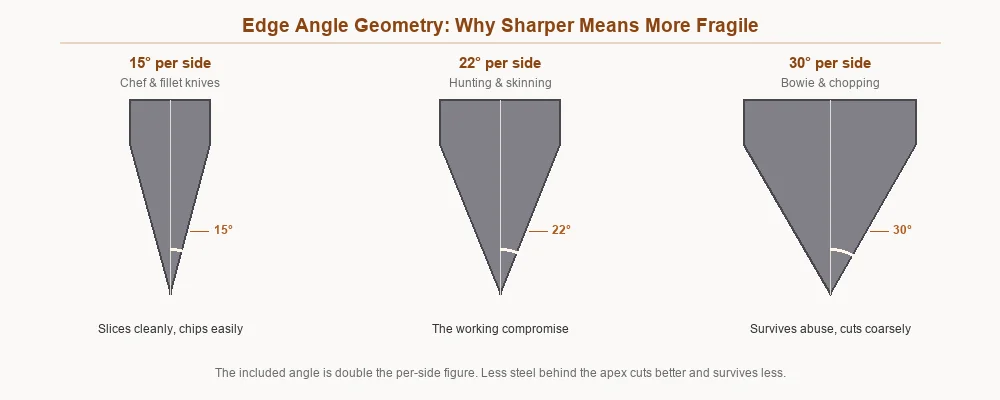
Sharpness is determined by edge geometry—specifically, the angle at which the two sides of the blade meet. A blade is sharp when these sides form an acute angle (typically 15-20 degrees per side for kitchen knives, 20-25 degrees for outdoor/tactical knives). The sharper this angle, the less force needed to cut.
But there’s a tradeoff. A very acute angle (12-15 degrees per side) is extremely sharp but delicate and prone to rolling or chipping under stress. A more obtuse angle (20-25 degrees per side) is more durable but requires more force to cut. This is why different knife types use different angles.
The Difference Between Dull and Damaged
A dull blade has lost its acute edge geometry—the angle has become blunter through use and microscopic rolling of the edge. A damaged blade has actual physical deformation: chips, rolled edges that can’t be corrected by honing, or deformed geometry.
These require different solutions. Dullness is fixed by honing or sharpening (realigning or abrading the edge). Damage requires either professional repair or, in severe cases, blade replacement.
Why Home Cooks Confuse These Concepts
Most people describe any non-performance as “dull.” But when a blade performs poorly, it could be truly dull (minor issue), rolled (moderate issue), or damaged (serious issue). Understanding which problem you have prevents wasting hours trying to sharpen a blade that actually needs professional repair.
Honing vs Sharpening: The Critical Difference
This is the most misunderstood distinction in blade maintenance, and understanding it will transform how you care for your knives. Most people who think they’re sharpening are actually honing—and that’s fine for daily maintenance.
What Is Honing?
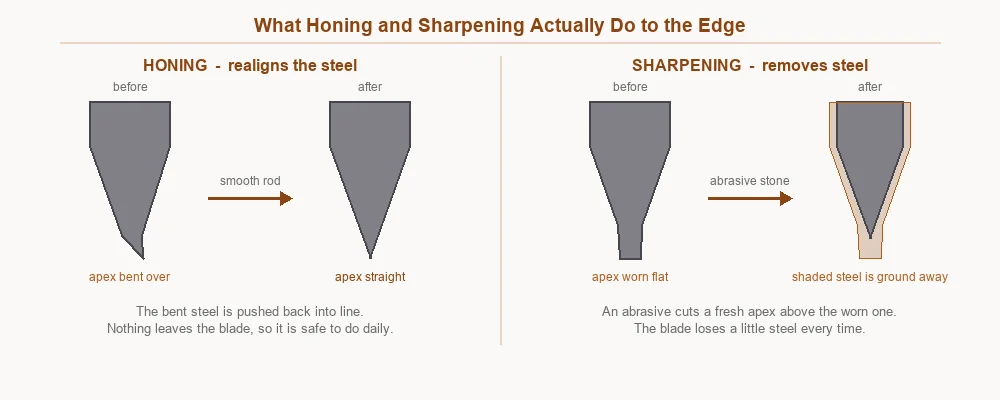
Honing is realignment. Your blade’s edge is made of microscopic particles. During use, these particles bend, roll, and misalign. The edge is still there; it’s just no longer perpendicular to the cutting surface. Honing uses a smooth steel or ceramic rod to realign these particles back into position without removing metal.
Think of it like combing through hair that’s gotten tangled. The hair is still there; you’re just straightening it out. Honing takes 30 seconds and is so gentle it can be done hundreds of times without significantly degrading your blade.
What Is Sharpening?
Sharpening is abrasion. You’re using an abrasive surface (whetstone, sandpaper, diamond plate) to actually remove microscopic amounts of metal from the blade’s edge. This re-establishes the acute angle and removes microscopic damage that honing can’t fix. Sharpening is more aggressive than honing but is necessary periodically.
How Often Should You Hone vs Sharpen?
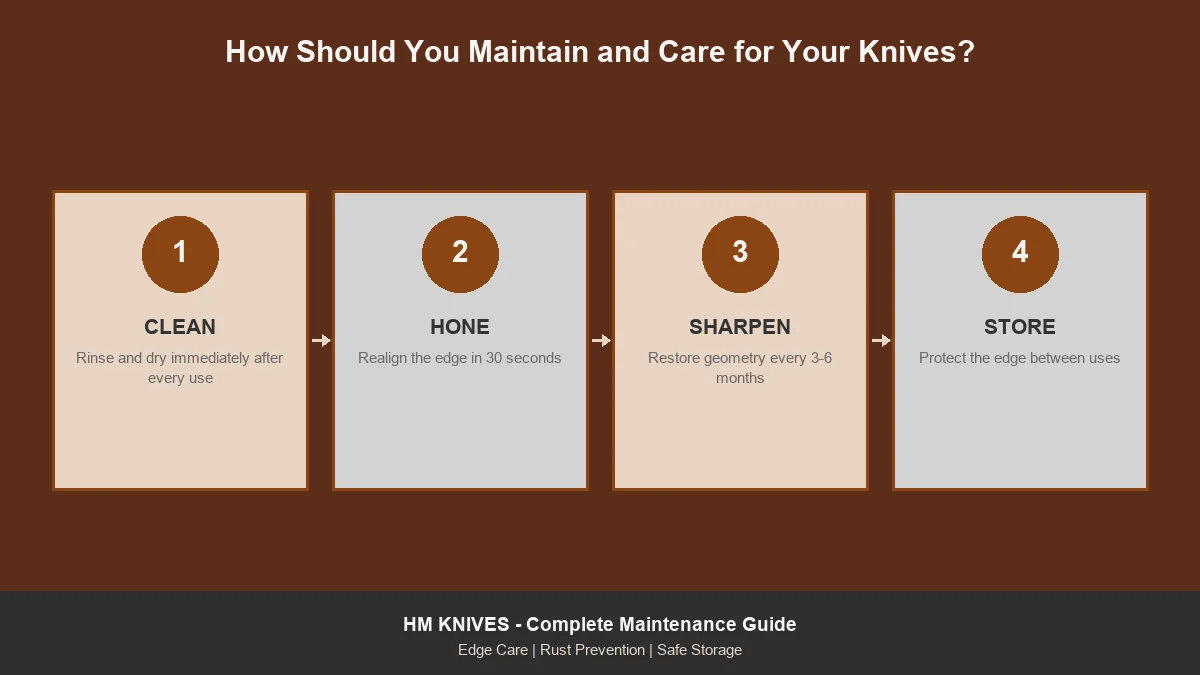
Most serious knife users hone after every use or every few uses (literally takes 10 seconds), and sharpen every 3-6 months depending on intensity of use. This keeps the blade in peak condition year-round without requiring major corrective work.
The Honing Rod Paradox
Many home cooks use a honing rod and assume they’re sharpening when they’re only honing. Their blade performs better after honing, so they think the honing rod sharpens. It doesn’t—it realigns. But realignment often restores enough performance that casual users don’t notice the blade ever truly gets dull. This is why a good honing routine is so valuable.
| Factor | Honing | Sharpening |
|---|---|---|
| What it does | Realigns the existing edge | Removes metal to rebuild the edge |
| Metal removed | None | Microscopic amounts |
| Tool used | Smooth steel or ceramic rod | Whetstone, diamond plate, sandpaper |
| Time required | 30 seconds | 1-2 hours |
| Frequency | After every use, or every few uses | Every 3-6 months |
| Skill needed | Low – learned in one session | Moderate – 10-15 sessions to master |
| Risk of damage | Very low | Moderate if angle is inconsistent |
Honing Your Blade: Step-by-Step Technique
Honing is simple, but technique matters. Done correctly, it preserves blade geometry perfectly. Done incorrectly, you can actually degrade your blade.
What You Need
A honing steel or ceramic rod (6-10 inches long), a stable surface, and your knife. That’s it. Total cost ranges from $15-40 for a quality rod. This is the single best investment you can make in blade maintenance.
The Proper Technique
Hold the rod vertically with the tip resting on a cutting board or stable surface. Position your knife at a 15-20 degree angle to the rod (this depends on your blade; check your knife’s specifications). Place the knife’s heel (near the handle) at the top of the rod. Using light to medium pressure, draw the blade down the rod in a single smooth motion, moving both down and backward so the entire edge contacts the rod. Repeat 3-5 times on each side of the blade.
Common Mistakes That Damage Blades
Pressing too hard is the most common error. Honing requires light pressure—imagine you’re using the weight of the blade itself, not pressing down. Pressing hard can actually deform your edge. Another mistake is using a diagonal angle instead of the correct 15-20 degree angle. This misaligns the edge instead of realigning it.
How to Know If You’re Doing It Right
A properly honed blade immediately feels sharper when cutting. If honing makes no difference, either your blade wasn’t actually rolled (it was truly dull and needs sharpening), or you’re not using the correct angle. Experiment by honing one side of your blade to see the immediate difference.
Sharpening Methods: From Stones to Steel
Sharpening is more involved than honing, but there are multiple methods. Your choice depends on your skill level, budget, and how often you need to sharpen.
The Sharpening Spectrum
Options range from simple pull-through sharpeners (easiest but least effective) to waterstones and oil stones (most effective but require skill and practice). In between are ceramic stones, diamond stones, and electric sharpeners. Each has tradeoffs in cost, ease of use, and result quality.
Matching Method to Skill and Budget
The best sharpening method is the one you will actually use. A pull-through carbide sharpener costs under $15 and takes seconds, but it scrapes metal away aggressively and leaves a coarse edge — acceptable for a beach knife, wasteful on a blade you care about. Guided-rod systems sit in the middle: $50 to $200 buys repeatable angles and a genuinely good edge with almost no learning curve, which makes them the honest recommendation for most owners. Freehand whetstone work produces the finest edge and costs the least over a lifetime, but it asks for ten or fifteen practice sessions before results become consistent. Practise on an inexpensive blade first. The muscle memory transfers completely, and you will not have learned it at the expense of a knife you value.
Whetstones: The Professional Standard
Professional chefs and serious knife enthusiasts use whetstones because they offer the best control and produce the sharpest results. They’re also the most skill-intensive option.
Understanding Whetstone Grits
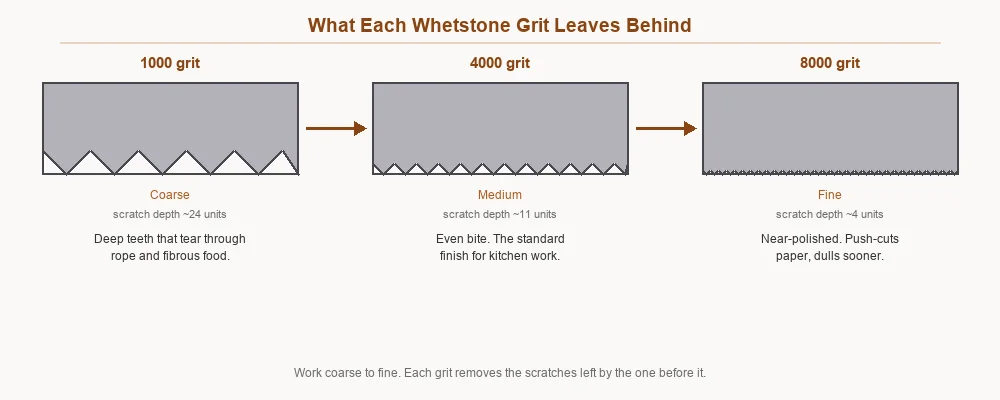
Whetstones are rated by grit—essentially the size of abrasive particles. Lower grits (1000-3000) are coarse and remove material quickly, fixing dull blades efficiently. Higher grits (6000-12000+) are fine and polish the edge to a mirror finish. Most users need two stones: a medium grit (4000-6000) for regular sharpening and a high grit (8000-12000) for polishing. How quickly a blade wears through those grits depends heavily on its steel, which we break down in our knife materials comparison.
| Grit Range | Classification | Purpose | When to Use |
|---|---|---|---|
| 220-1000 | Coarse | Repairs chips and reprofiles badly damaged edges | Rarely – only for damage repair |
| 1000-3000 | Medium-coarse | Removes material quickly on a genuinely dull blade | When honing no longer restores performance |
| 4000-6000 | Medium | Standard sharpening for most household blades | Regular quarterly sharpening |
| 8000-12000 | Fine | Polishes the edge to a refined finish | Finishing pass after medium grit |
| 12000+ | Ultra-fine | Mirror polish, maximum push-cutting sharpness | Optional – for enthusiasts and chefs |
Water Stones vs Oil Stones vs Diamond Plates
Water stones sharpen quickly and are easy to clean (just rinse with water), making them popular for home use. Oil stones last forever and require little maintenance but sharpen more slowly. Diamond plates are fast but can dish (develop a depression) over time if used intensively.
For most home users, a quality 4000-grit water stone and a 8000-grit polishing stone provide an excellent balance of speed, result quality, and ease of use.
The Sharpening Motion
Unlike honing (which is light and realigning), sharpening requires controlled pressure and the proper motion. You’ll typically use an X-pattern or circular motion, maintaining a consistent 15-20 degree angle throughout. The goal is to create a fine burr (microscopic raised edge) on both sides of the blade, which indicates you’ve abraded enough material to re-establish the edge.
Honing Rods and the Role of Realignment
We touched on honing rods earlier, but they deserve deeper exploration because they’re so widely misunderstood.
Honing Steel: The Most Common Option
Traditional honing steels are hardened steel rods, often with a slightly textured surface. They’re durable, affordable ($15-30), and effective for realignment. The texture helps catch and realign the edge without removing significant metal.
Ceramic Honing Rods
Ceramic rods are finer and gentler than steel, making them better for high-end or delicate blades. They cost more ($40-80) but last indefinitely and provide a smoother realignment action.
When NOT to Use a Honing Rod
If your blade is truly dull (not just rolled), honing won’t fix it—sharpening will. If your blade has visible damage or chips, honing will make no difference. Trying to “fix” a truly dull blade with repeated honing is frustrating and leads to the misconception that honing doesn’t work. It works perfectly—but only for rolled edges, not dull ones.
Stropping: The Polish That Extends Edge Life
Stropping is the secret weapon of professional chefs and cutlers. It’s not sharpening, not honing—it’s polishing the edge to microscopic perfection.
What Is Stropping?
Stropping uses a fine leather pad (often charged with stropping compound—a very fine abrasive paste) to polish the blade edge. This removes microscopic debris, aligns any remaining irregularities, and polishes the edge to a mirror finish. The result is a blade that cuts even better than right after sharpening.
DIY vs Professional Stropping Strops
You can make a stropping strop using an old leather belt or jacket, mounted on wood. Professional stropping strops cost $20-100 and come charged with stropping compound. Either works—the expensive ones are just more durable and convenient.
The Stropping Motion
Unlike sharpening (where you press into the stone), stropping requires pulling the blade spine-first away from the strop. This prevents the edge from digging into the leather. A few passes (5-10) on each side before each use will maintain an astonishingly sharp edge.
Finding Your Optimal Sharpening Angle
Different blades perform best at different edge angles. Understanding your blade’s optimal angle ensures you sharpen correctly.
| Knife Type | Angle Per Side | Total Included Angle | Trade-off |
|---|---|---|---|
| Kitchen chef’s knife | 15-18° | 30-36° | Keen slicing edge, needs more frequent honing |
| Fillet and boning knife | 12-15° | 24-30° | Maximum acuteness, most delicate edge |
| Hunting and skinning knife | 20-22° | 40-44° | Balanced edge for field dressing |
| Bushcraft and camp knife | 22-25° | 44-50° | Durable edge that tolerates chopping |
| Bowie and chopping blade | 25-30° | 50-60° | Maximum durability, least fine slicing |
Kitchen Knives: 15-20 Degrees Per Side
Chef’s knives typically perform best at 15-18 degrees per side (30-36 degrees total). This creates a sharp edge that cuts vegetables and meat efficiently while remaining durable enough for daily kitchen work.
Outdoor and Tactical Knives: 20-25 Degrees Per Side
Bushcraft, hunting, and tactical knives typically use 22-25 degrees per side (44-50 degrees total). This more durable angle withstands chopping, prying, and demanding fieldwork.
Specialty Blades: Variable Angles
Different blade profiles may have different optimal angles. Clip points often perform best at slightly more acute angles than drop points. Your blade’s documentation or a conversation with your knifemaker will clarify the intended angle.
How to Measure Angle During Sharpening
The easiest method is using angle guides that attach to your blade and rest on the whetstone, maintaining consistent angle. These cost $10-20 and remove guesswork. Alternatively, develop muscle memory through practice—most experienced sharpeners free-hand by feel after 10-15 sessions.
Proper Cleaning: Beyond Rinsing
Your maintenance routine means nothing if you don’t clean your blade properly between uses.
Why Immediate Cleaning Matters
Food residue, particularly acidic substances and salt, accelerates corrosion on all steel types. Water left on the blade starts oxidation. Even stainless steel can develop surface corrosion if acidic food is left on it long enough. Cleaning immediately after use prevents nearly all corrosion-related problems.
The Proper Cleaning Method
Rinse your blade under warm water to remove surface debris. Use a soft sponge or cloth (never abrasive scrubbers—they damage the finish and edge) to wipe both sides of the blade and the spine. Pay special attention to the heel, where food particles accumulate. Dry completely with a soft cloth, paying special attention to the handle where moisture can cause rust at the blade-handle junction.
Dealing With Stubborn Buildup
If residue has hardened, soak the blade briefly in warm water to soften it, then use a soft plastic scraper or wooden tool to gently remove it. Never use a metal scraper—it will scratch your blade. For Damascus or decorative finishes, extra care is needed to avoid damaging the visual pattern.
Storage Solutions That Protect Your Investment
How you store your knife between uses dramatically affects long-term performance and appearance.
Magnetic Strips vs Blocks vs Drawers
Magnetic strips keep blades accessible and visible while protecting edges from drawer damage. This suits kitchen and chef knives that get reached for daily. Knife blocks protect edges but make blades less accessible and can trap moisture in the block. Drawer storage with blade guards protects both edges and is convenient if you have many knives, though removed guards are often misplaced.
For carbon steel and Damascus blades, ensure storage location is dry and well-ventilated to minimize corrosion risk.
The Ideal Storage Environment
Cool, dry, and out of direct sunlight. Humidity accelerates rust on all steel. Extreme temperature fluctuations cause condensation. Sunlight fades decorative finishes. This matters most for pattern-welded blades, where the etched contrast is part of the value — our guide to how Damascus steel is made explains why that pattern needs protecting. A temperature-stable, dry location extends blade life considerably.
Pivots deserve their own attention. On folding knives, moisture wicks into the pivot and liner where you cannot see it, so a drop of light oil worked through the open and closed action every few weeks does more good than anything you apply to the blade face.
Protective Coatings for Long-Term Storage
If you’re storing a blade for months without use, a light oil coating (food-grade mineral oil) protects the blade from corrosion. Apply a thin coat, wipe away excess, and store in a dry location. Before next use, clean the oil off thoroughly.
Rust Prevention for Carbon Steel and Damascus Blades
Carbon steel and Damascus blades require more active protection than stainless steel, but they reward you with superior edge retention and aesthetic beauty.
Why Carbon Steel Rusts Faster
Carbon steel contains iron and carbon but lacks the chromium that makes stainless steel corrosion-resistant. Chromium creates an invisible oxide layer that prevents rust. Without it, carbon steel will rust if exposed to moisture and not protected.
Active Maintenance for Carbon Steel
Dry immediately after every use—don’t let it air dry. Store in a dry location. If you live in a humid climate, consider occasional light oiling (monthly is usually sufficient). Many users apply a light oil coating immediately after cleaning, wipe away excess, and store.
Patina Development and Acceptance
Carbon steel blades develop a patina over time—a dark, protective oxide layer. Many users embrace this as part of the blade’s character. A patina actually protects the steel from further rust better than bare metal. If you want to maintain a shiny appearance, you’ll need to oil and clean more frequently. If you accept patina development, maintenance becomes easier.
Removing Light Surface Rust
If light surface rust appears, use a soft cloth and very fine steel wool (#0000 or finer) to gently polish it away. For Damascus blades, be extra gentle to avoid disturbing the pattern. Follow with immediate drying and light oiling.
Debunking Common Maintenance Myths
Misinformation about knife maintenance is rampant. Let’s clear up the most persistent myths.
Myth 1: Dishwashers Are Fine
False. Dishwashers expose blades to extreme heat, harsh chemicals, and aggressive contact with other utensils. Even one cycle can damage an edge and accelerate corrosion. Hand wash every time—it takes 30 seconds.
Myth 2: Sharpening Removes “Too Much” Metal
If done correctly, sharpening removes microscopic amounts of metal (literally microns). You would need to sharpen the same blade thousands of times before metal loss becomes noticeable. Proper sharpening every 3-6 months won’t noticeably reduce blade length for decades.
Myth 3: You Must Sharpen on Expensive Professional Equipment
A $30 whetstone produces results identical to $300+ professional equipment. What matters is technique and understanding, not cost. Professional sharpeners’ expertise and equipment speed the process, but results from a properly used home stone are excellent.
Myth 4: Stainless Steel Never Needs Maintenance
Stainless steel resists rust much better than carbon steel but doesn’t prevent it entirely. Stainless blades still become dull and benefit from regular honing. They can still develop surface corrosion under neglect. “Stainless” means corrosion-resistant, not corrosion-proof.
Myth 5: A Honing Rod Can Fix a Chipped Edge
It cannot, and trying will make the damage worse. Honing realigns metal that is still attached to the blade; a chip is metal that has left. Running a chipped edge along a honing rod simply rolls the surrounding steel into the void and produces a wavy, weakened edge either side of the original chip. Chips need abrasion — a coarse stone in the 220 to 1000 grit range, worked until the edge is level with the deepest point of the damage, then progressively refined back up through the grits. On a deep chip this removes noticeable blade height and is worth handing to a professional rather than learning on.
Building Your Maintenance Routine
Consistency beats intensity. Here’s a maintenance schedule that keeps blades in peak condition with minimal time investment.
Daily/Per-Use Maintenance (2 minutes)
After every use: rinse blade, dry completely, and optionally hone if the blade is showing use (light pressure, 3-5 passes per side). This takes 30-120 seconds and keeps your blade performing excellently.
Weekly Maintenance (5 minutes)
Once weekly: thorough cleaning focusing on the heel and handle-blade junction, verify no buildup or corrosion, and light oil coating if you own carbon steel or Damascus blades. This prevents most maintenance issues from ever developing.
Monthly Maintenance (30 minutes)
Once monthly: full honing session (more passes than quick maintenance) and close inspection for any damage or corrosion. Address any issues found before they escalate.
Quarterly Maintenance (1-2 hours)
Every 3 months: light sharpening using whetstones if your blade is showing noticeable dulling. Most casual users sharpen 2-4 times annually; heavy users may sharpen monthly.
Annual Deep Maintenance (Full day)
Once yearly: professional sharpening if you’re not confident in your skills, full inspection of the blade and handle, and addressing any wear or damage discovered. Blades that see hard field seasons — particularly hunting knives — benefit most from this annual reset. This resets everything and ensures your knife is truly at peak condition for the next year.
Frequently Asked Questions About Blade Care
How Often Should I Sharpen?
Depends on use intensity. Casual kitchen users sharpen 2-4 times yearly. Heavy users or professional chefs sharpen monthly or more. If your blade feels noticeably dull when cutting normally, it needs sharpening. If honing restores performance, it just needed realignment.
Can I Use a Ceramic Rod on a Damascus Blade?
Yes, ceramic rods are actually excellent for Damascus blades because they’re gentler on decorative finishes. Use light pressure and consistent angle to avoid damaging the pattern.
Should I Store My Knife in a Block or on a Magnetic Strip?
Both work well. Blocks are more protective and look elegant on countertops. Magnetic strips keep blades accessible and visible. Choose based on your kitchen layout and frequency of use. Ensure whatever method you choose keeps the blade dry and protected.
Is It Worth Buying Expensive Whetstones?
Better stones produce faster results and last longer, but cheap stones work fine. A $30 4000-grit stone produces identical results to a $100 stone—it just takes longer and wears out faster. For home users sharpening occasionally, cheaper stones are perfectly adequate.
Can I Sharpen a Serrated Blade?
Yes, but it’s more complex than sharpening straight edges. Each serration needs individual attention, typically using a round whetstone or specialized serrated-blade sharpeners. For most users, professional sharpening of serrated blades is worth the cost.
What’s the Difference Between Stropping and Honing?
Honing realigns a rolled edge using a smooth or textured steel/ceramic rod. Stropping polishes the edge using fine abrasive compound on leather. Both are gentle and don’t remove significant metal. Together, they’re the secret to maintaining razor-sharp blades between sharpenings.
The Long Game: Maintaining Excellence
Knife maintenance isn’t about achieving perfection. It’s about sustaining performance. A blade properly maintained will outperform an expensive blade that’s neglected, every single time.
The good news: maintenance is simple, inexpensive, and genuinely rewarding. Spending five minutes weekly and one hour quarterly keeps your blade at peak condition indefinitely. That’s it.
Start today. Choose a method that fits your lifestyle. If you are still deciding which blade deserves that care, our guide to the best knife type for every use case is the place to begin, and our guide to where to spend your money explains which upgrades actually pay off. Hone after using, clean immediately, store properly, and sharpen when needed. Within months, you’ll understand why people who take blade maintenance seriously never go back to neglecting their knives.
Your blade is a tool deserving of care. Give it that care, and it will reward you with decades of reliable performance. Every blade in the HM Knives collection is built to be maintained rather than replaced, and we are glad to talk through the right routine for your blade — just contact us.

From Our Workshop
Knives that need the routine in this guide, and one that needs less of it. Prices are on each listing.
- 13 Inch Bowie Knife — Damascus Steel, Bone and Bull Horn Handle — Damascus — carbon steel, so it wants drying and oiling.
- D2 Steel Hunting Dagger Knife with Sheep Horn Handle — D2 — the most forgiving thing we make if you are forgetful.
- J2 Steel 11 inch Hand Made Fishing Camping Knife with Green Micarta Handle — micarta handle — nothing organic to dry out or crack.
Browse the full range.