
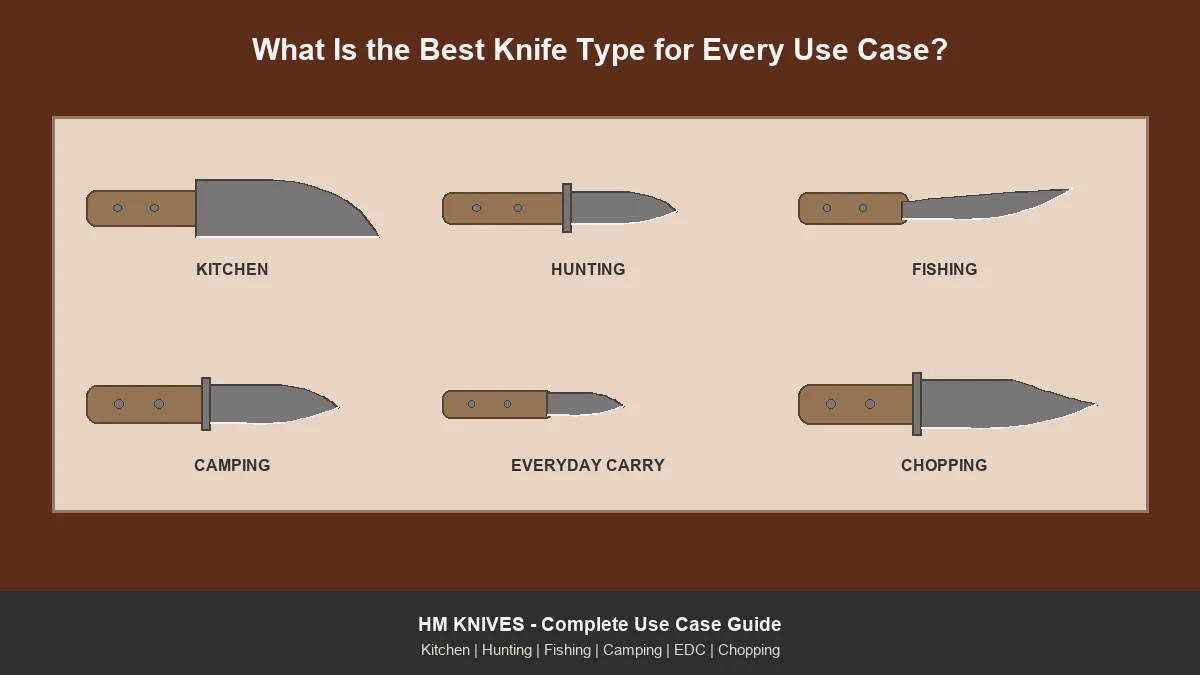
Table of Contents
- Why "Best Knife" Is Almost Always the Wrong Question
- The Three Questions That Settle It
- The Main Knife Types, Drawn to Scale
- Kitchen and Food Preparation
- Hunting and Field Dressing
- Fishing and Filleting
- Camping and Bushcraft
- Everyday Carry
- Bowie, Machete and Chopping Work
- Choosing Blade Length
- Which Steel Suits Which Use
- If You Can Only Own One
- Building a Collection in the Right Order
- Buying Mistakes That Cost People Money
- Frequently Asked Questions
- Matching Knife to Work
Why "Best Knife" Is Almost Always the Wrong Question
People arrive at knife shopping asking which knife is best, and leave frustrated because every answer contradicts the last one. A hunter says drop point. A chef says nothing under eight inches. Someone on a forum insists you need a fixed blade or you are not serious. All of them are right about their own work and useless about yours.
A knife is not a general-purpose object. It is a wedge of steel shaped for a family of tasks, and the shaping that makes it excellent at one thing routinely makes it poor at another. A fillet blade that follows a fish spine beautifully will bend alarmingly if you try to split kindling. A chopper that handles firewood will destroy a tomato.
So the question worth asking is not which knife is best, but which knife is right for the specific work you do most. That question has clear answers.
What This Guide Does
It works through the main use cases one by one, says plainly which type suits each, and gives the blade length, profile and steel that go with it. Where two options are genuinely close, it says so rather than inventing a winner.
The Three Questions That Settle It
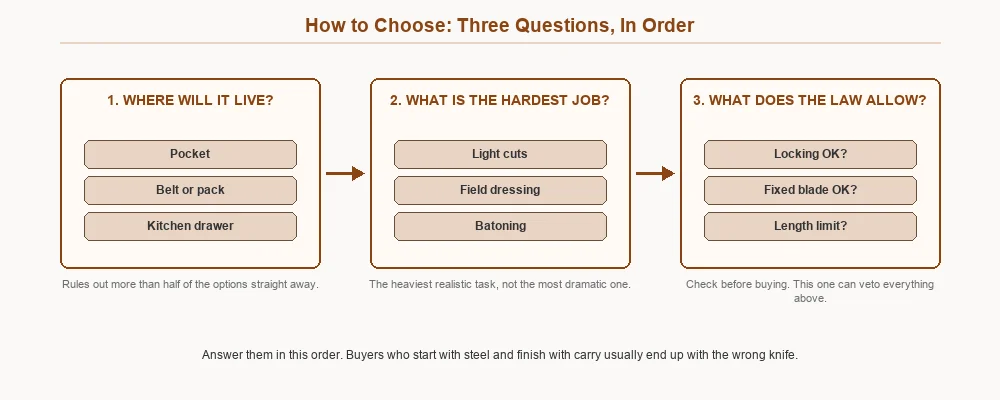
Question One: Where Will It Live?
Pocket, belt, pack, kitchen drawer, tackle box. This single answer eliminates more than half the options immediately, because a knife that does not fit its environment simply does not get used. A superb fixed blade in a drawer loses to a mediocre folder in a pocket every time.
Question Two: What Is the Hardest Thing It Must Do?
Not the most dramatic thing you can imagine, the hardest thing you will realistically ask of it in a normal year. Most people wildly overestimate this and buy far more knife than their actual work requires.
Question Three: What Does the Law Allow?
Check before buying, not after. Rules vary by country, state and sometimes city, and workplaces often impose stricter limits than the law. This question can veto everything above it.
Why the Order Matters
Buyers who start with steel and finish with carry end up with knives they admire and never use. Start with where it lives, and every later decision narrows sensibly.
The Main Knife Types, Drawn to Scale
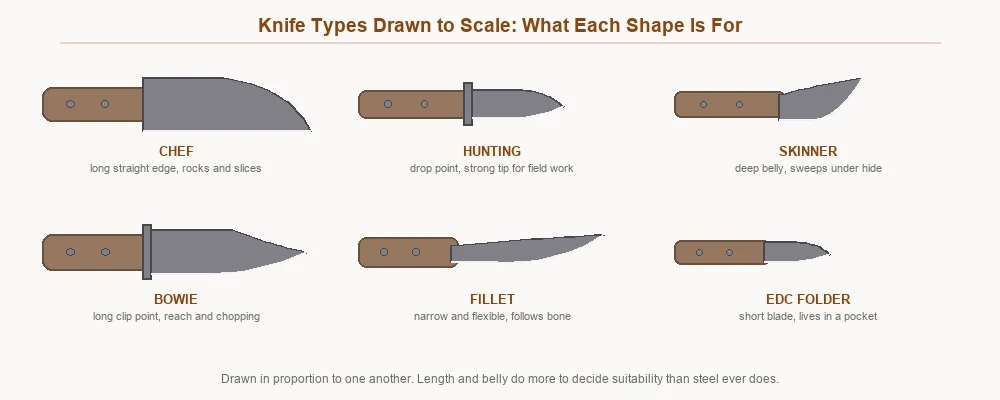
Reading the Shapes
Seen together and in proportion, the logic becomes obvious. The chef’s knife is long with a straight edge for rocking cuts on a board. The skinner is short with an exaggerated belly, because skinning is a sweeping motion rather than a push. The fillet blade is narrow and thin so it can flex around bone. Each shape is a solved problem.
Blade Profile Does the Heavy Lifting
Profile decides more about suitability than steel does, which is why our guide to blade profiles and when to use them is worth reading alongside this one. A drop point in mediocre steel will outperform a tanto in premium steel for field dressing, because the shape is right.
Folding or Fixed Sits Underneath All of This
Every type below exists in both formats, and that choice affects strength, cleaning and legality more than shape does. Our comparison of folding and fixed blade knives covers the trade-off in full.
Kitchen and Food Preparation
What the Work Demands
Repetitive precision cuts on a board, long slicing strokes, and enough length to pass through an onion or a roast in one motion. Hygiene matters, so the whole blade must be washable, which rules out folders entirely.
The Answer: A Fixed Chef’s Knife, 200-250mm
An eight to ten inch chef’s knife handles perhaps eighty percent of kitchen work on its own. Straight-ish edge with a gentle curve toward the tip, thin behind the edge, comfortable enough to hold for twenty minutes.
The Two Knives That Complete It
A paring knife around 75-100mm for work done in the hand rather than on a board, and a bread or slicing knife for anything long and soft. Three knives cover a domestic kitchen completely.
What You Do Not Need
The fourteen-piece block. Most of those slots hold knives that will never be sharpened and rarely used. Buy three good ones instead. Our kitchen and chef knives range is built around that principle.
Why Length Feels Wrong at First
Most people buying their first proper chef’s knife find a 200mm blade alarming and reach for something shorter. Within a fortnight the shorter knife feels cramped. Length is what lets the edge pass through an onion in a single stroke instead of sawing, and sawing is what makes home cooks think their knife is blunt. Buy the length that suits the board, not the length that feels safe in the shop.
Handle Comfort Outranks Blade Specification
Kitchen knives are held for longer stretches than any other type. A handle that causes a hot spot after ten minutes of prep will quietly become the knife you stop reaching for, whatever the steel. If you can hold a knife before buying, hold it in a pinch grip on the blade rather than gripping the handle alone, because that is how it will actually be used.
Edge Angle for Kitchen Work
15 to 18 degrees per side. Acute enough to slice cleanly, and since kitchen knives rarely meet anything harder than bone, the fragility never becomes a problem.
Hunting and Field Dressing
What the Work Demands
Controlled cuts inside a body cavity with wet, slippery hands, sustained pressure, and thorough cleaning afterwards. Deployment must be reliable with cold fingers.
The Answer: A Fixed Drop Point, 90-115mm
A drop point puts the tip below the spine line, which gives a strong point that will not perforate organs when you are working blind. Ninety to a hundred and fifteen millimetres reaches everything without becoming unwieldy inside a cavity.
When a Skinner Earns Its Place
If you process several animals a season, a dedicated skinner with a deep sweeping belly separates hide considerably faster. For one or two animals a year, a drop point does both jobs adequately.
Why Not a Folder
Blood and tissue migrate into the pivot and are genuinely difficult to remove. It is a hygiene problem before it is a performance one.
Gut Hooks: Useful or Gimmick?
Genuinely useful if you open a lot of hide and have practised with one. Awkward and hard to sharpen if you have not. Most hunters are better served by a well-controlled drop point tip. Our guide on choosing the right hunting knife goes deeper on this, and the hunting knives range covers both.
Sheath and Carry Position
A hunting knife spends most of its life sheathed on a belt or pack strap, and the sheath decides whether it is available when you need it. A retention strap that requires two hands is a genuine nuisance with an animal in front of you. Test the draw wearing the gloves you actually hunt in, not bare-handed in a shop.
Fishing and Filleting
What the Work Demands
Following the contour of a spine with a thin blade, minimal waste, and constant exposure to water.
The Answer: A Flexible Fillet Blade, 150-230mm
Narrow, thin, and deliberately flexible so it can ride the bone rather than cut through it. Length should roughly match the fish you handle most: 150mm for panfish, 200mm and up for salmon or larger.
The Steel Question Is Different Here
This is the one use case where stainless has a clear, practical advantage. A carbon blade used on a wet boat and put away damp will rust, and our comparison of stainless and carbon steel explains exactly why.
A Camp Knife Is Not a Fillet Knife
People try to fillet with a stiff camp blade and mangle the fish. Flex is the entire point. See the fishing and camping knives range for blades built for it.
Stiff Backup Beats a Second Fillet Knife
Anglers frequently buy two fillet knives in different lengths and then discover the job they actually needed a second blade for is cutting line, opening bait packaging and prising hooks, none of which suit a flexible blade. A short stiff knife alongside one good fillet blade covers a day on the water far better than two flexible blades do.
Camping and Bushcraft
What the Work Demands
Splitting kindling, carving, food preparation, cutting cord, and surviving being dropped on rock. Strength matters more than finesse.
The Answer: A Full Tang Fixed Blade, 110-140mm
Full tang is not negotiable here. Batoning drives the blade through wood by striking the spine, and any joint in the knife becomes the failure point. A 110-140mm drop point with a reasonably thick spine covers essentially all camp work.
Why Not Longer?
Because past about 140mm you lose the fine control that carving and food prep need, and gain chopping ability you can get more safely from a small axe. Camp knives that try to be axes do both jobs badly.
Grind and Edge Angle
22 to 25 degrees per side. A more acute edge will chip on wood knots. A Scandi grind is popular for carving because it registers flat against the wood.
The Folder as Backup
Worth carrying a folder as a second knife for light tasks, so the main blade stays clean and sharp for the work that needs it.
Spine Thickness Is the Specification That Matters
For camp work, look at the spine rather than the blade length. Around 3.5 to 4.5mm is the working range: thick enough to take baton strikes without flexing, thin enough that the knife still carves and prepares food. Below 3mm you have a knife that will bend under batoning; above 5mm you are carrying weight that only helps if you chop, and a small axe chops better anyway.
A Squared Spine Is Worth Asking About
A spine ground to a sharp ninety degree corner will throw sparks from a ferrocerium rod and scrape tinder cleanly. A rounded spine does neither. It costs a maker almost nothing and is genuinely useful in the field, so it is worth asking before you buy.
Everyday Carry
What the Work Demands
Opening parcels, cutting cord and tape, trimming, breaking down cardboard. All light, all frequent, all unpredictable in timing.
The Answer: A Folder, 60-90mm Blade
Portability beats capability here by a wide margin. The knife needs to be so unobtrusive that carrying it is not a decision. Sixty to ninety millimetres is legal in most jurisdictions and handles every realistic everyday task.
Lock Choice Matters More Than Steel
A frame lock or a well-made liner lock, checked periodically. A lock that slips is the one genuine hazard in this category.
The Case for a Slipjoint
In jurisdictions that restrict locking knives, a traditional slipjoint is often the only legal carry. For light tasks they are entirely pleasant, provided you respect that the blade can close.
Where to Spend
On the action and the lock, not the layer count or the exotic steel. Browse the folding knives collection and judge how the action feels first.
Bowie, Machete and Chopping Work
What the Work Demands
Mass, reach, and an edge that survives repeated impact.
The Answer: 230mm and Up, With Weight Forward
Chopping is physics. A light blade will not chop regardless of how sharp it is, because the work is done by momentum. A bowie in the 230-300mm range with mass toward the tip does real clearing and camp work.
Edge Angle Goes Obtuse
25 to 30 degrees per side. Anything more acute will roll or chip on the first knot. This is the one category where a coarse edge is correct.
Be Honest About Whether You Need One
Bowies are the most bought and least used category in knife collecting. They are magnificent objects and most owners chop nothing. Browse the bowie knives collection by all means, but buy it because you want it, not because you have convinced yourself you need it.
Weight Distribution Decides How It Chops
Two blades of identical length can chop completely differently depending on where the mass sits. A blade with weight forward of the grip carries momentum into the cut and does the work for you. A balanced or handle-heavy blade of the same length feels nimbler but bounces off wood. If you are buying for chopping, balance the knife on a finger: the point should sit forward of the guard. If it balances at the guard, you have bought a fighting knife, not a chopper.
Choosing Blade Length
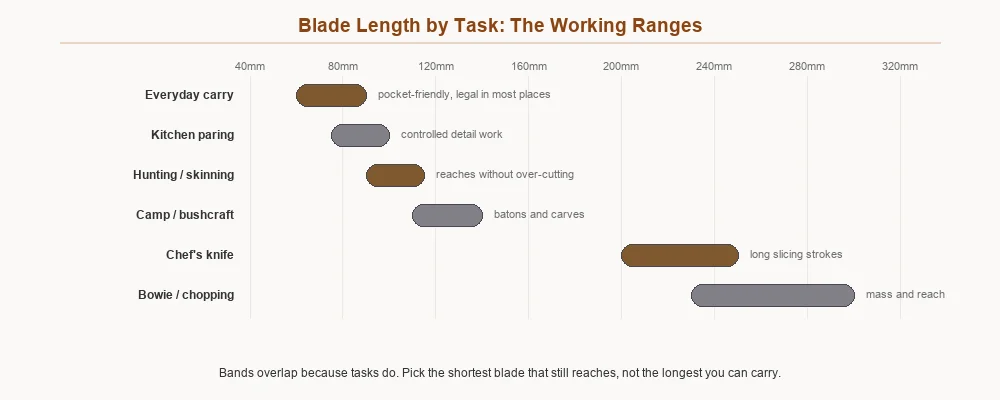
The Ranges Overlap Because Tasks Do
There is no single correct length for a category, only a band that works. The bands overlap because real tasks refuse to stay in their lane.
The Rule Worth Following
Pick the shortest blade that still reaches. Extra length costs control, weight, legality and comfort, and buys capability you probably will not use.
Where Length Is Legally Constrained
Many jurisdictions set carry limits between 75mm and 100mm. If you carry daily, that limit is a hard ceiling regardless of what would perform best.
| Use case | Format | Blade length | Profile | Edge angle |
|---|---|---|---|---|
| Everyday carry | Folder | 60-90mm | Drop point or leaf | 18-20° |
| Kitchen, general | Fixed | 200-250mm | Chef / straight edge | 15-18° |
| Kitchen, detail | Fixed | 75-100mm | Paring / spear | 15-18° |
| Hunting, field dressing | Fixed | 90-115mm | Drop point | 20-22° |
| Skinning | Fixed | 90-110mm | Trailing point | 20-22° |
| Fishing, filleting | Fixed | 150-230mm | Narrow trailing point | 15-18° |
| Camping, bushcraft | Fixed, full tang | 110-140mm | Drop point | 22-25° |
| Chopping, clearing | Fixed, full tang | 230-300mm | Clip point / bowie | 25-30° |
Which Steel Suits Which Use
Wet Environments Want Stainless
Fishing, marine work, and anything stored damp. This is the clearest steel decision in the whole guide.
Dry Work Rewards Carbon
Kitchen, hunting and general field use, provided you dry the blade. Carbon steel sharpens easily, takes a keen edge and costs less.
Damascus Is a Carbon Steel
Worth stating plainly, because it is widely misunderstood: pattern-welded Damascus of the kind we forge is made from carbon steels and will rust if neglected. It is chosen for its appearance and craftsmanship, not for corrosion resistance. Our comparison of Damascus and high carbon steel covers what the layers do and do not change.
Match Hardness to Impact
Harder steel holds an edge longer and chips more readily. For chopping and batoning, take the tougher, slightly softer option. Our knife steel types guide sets out where each grade sits.
| Environment | Recommended steel family | Why | Upkeep required |
|---|---|---|---|
| Wet: boats, coast, filleting | Stainless | Constant water exposure | Rinse and dry, little else |
| Kitchen, indoors | Carbon or stainless | Dry between uses | Dry immediately after washing |
| Hunting, dry field use | Carbon | Sharpens easily in camp | Wipe down, oil after the season |
| Camping, variable weather | Tough carbon or stainless | Impact matters more than edge life | Dry nightly, oil before storage |
| Display or gift | Damascus (carbon) | Bought for appearance | Oil regularly; it will rust if ignored |
| Neglected storage | Stainless only | Nothing else survives inattention | Minimal, but not zero |
Heat Treatment Beats Alloy Choice
One caveat worth carrying through all of this: how a steel is hardened matters more than which steel it is. A well heat treated 1095 blade will outperform a badly treated premium alloy, and you cannot see heat treatment in a photograph. Ask what hardness a maker finishes to. A published range such as HRC 58 to 60 tells you they are measuring; silence on the subject tells you something too.
If You Can Only Own One
The Honest Recommendation
A full tang fixed blade with a 100-120mm drop point in a tough carbon steel, in a decent sheath. It will dress game, prepare food, carve, cut cord, and survive being misused. It is not the best knife for any single task and it is competent at all of them.
If It Has to Live in a Pocket Instead
Then a 75-90mm folder with a solid lock, and accept that heavy tasks are off the table. A knife you have beats a knife you left behind.
The Compromise Nobody Mentions
One knife means sharpening it for one job and using it for another. That is fine, but expect to re-profile the edge occasionally as your use changes.
Short version: kitchen means a chef’s knife, hunting means a drop point, fishing means a flexible fillet blade, camping means a full tang, and everyday carry means a folder. Match the length to the task and the steel to the environment, and the rest is preference.
What Changes If You Live Somewhere Wet
The single-knife recommendation shifts if your climate or work keeps steel damp. Coastal living, commercial fishing, or a job that leaves tools in a van overnight all push the answer toward stainless, even at some cost in edge retention and ease of sharpening. A carbon blade in those conditions demands attention you will eventually stop giving it, and a neglected carbon knife is worse than a stainless one that was never quite as sharp.
Building a Collection in the Right Order
First: The Knife You Will Use Daily
Whatever your actual daily work is. Spend properly here, because this one gets used hundreds of times a year.
Second: The Kitchen
A good chef’s knife improves something you do every day, which almost no other knife purchase can claim.
Third: The Specialist
The hunting, fishing or camp knife for the activity you actually pursue. Buy it when you have a trip booked, not in anticipation of a hobby.
Fourth: The One You Just Want
The Damascus piece, the bowie, the collector’s item. There is nothing wrong with this purchase provided it comes fourth rather than first. Our guide on where to spend your money on knives breaks down which features justify their price.
| Priority | Purchase | Sensible budget share | Why here |
|---|---|---|---|
| 1 | Daily-use knife | 35% | Highest number of uses per year |
| 2 | Kitchen chef’s knife | 30% | Improves a daily activity |
| 3 | Activity specialist | 25% | Buy when the activity is real |
| 4 | The one you simply want | 10% | Legitimate, but last |
When to Stop Buying
Most people reach genuine sufficiency at three or four knives and keep buying anyway. There is nothing wrong with collecting as a hobby, provided you are honest that it has become one. The signal is straightforward: when a new purchase would not change what you are able to cut, you have moved from equipping to collecting. Both are fine; only one of them benefits from reading buying guides.
Buying Mistakes That Cost People Money
Buying for an Imagined Life
The survival knife bought by someone who camps once a year. Buy for the life you have.
Choosing Steel Before Format
Agonising over alloys while ignoring whether the knife will actually be carried. Format decides use; steel decides how often you sharpen.
Believing Length Equals Capability
Longer blades are harder to control, harder to carry and more legally restricted. Most buyers would be better served going shorter.
Ignoring the Sheath
A superb fixed blade in a poor sheath is a knife you stop carrying. The sheath is part of the purchase.
Neglecting Maintenance and Blaming the Knife
Most knives judged disappointing are simply dull or corroded. Our complete maintenance guide and quick care tips solve more performance complaints than upgrading ever does.
Buying a Set When You Needed One Knife
Sets are priced to look like value and are almost never the cheapest route to a good kitchen. The margin on a fourteen-piece block comes from the eleven pieces you will not use, and the three you do use are rarely the best examples the maker offers. Three individually chosen knives will cost less and cut better.
Assuming a Premium Knife Does Not Need Sharpening
Every knife dulls. Better steel extends the interval between sharpenings; it does not remove the requirement. A $300 blade left unsharpened for two years cuts worse than a $40 blade touched up monthly, and the owner of the expensive one usually concludes the knife was overrated.
Frequently Asked Questions
What is the most versatile knife type?
A full tang fixed blade with a 100-120mm drop point. It handles field dressing, food preparation, carving and general cutting competently. It is not the best tool for any one of those jobs, but it is capable at all of them, which is what versatility means.
Can one knife really cover kitchen and outdoor use?
Poorly. Kitchen work wants length, thinness and an acute edge; outdoor work wants a shorter, thicker blade with a more obtuse edge. A knife sharpened for one will underperform at the other. Two modest knives beat one expensive compromise.
What blade length should I choose for everyday carry?
Between 60 and 90mm. That range handles every realistic daily task, stays comfortable in a pocket, and falls within the legal carry limit in most jurisdictions. Check your local limit before buying.
Do I need a different knife for skinning and field dressing?
Only if you process several animals a season. A drop point handles both jobs adequately for occasional use. A dedicated skinner with a deep belly is noticeably faster once volume justifies it.
Is an expensive knife worth it for casual use?
Up to a point. The jump from a poor knife to a well made one is transformative; the jump from good to exceptional is mostly finish and materials. For casual use, buy a well made mid-range knife and spend the difference on a decent sharpening setup.
Which knife should I buy first?
Whichever one matches the cutting you actually do most days. For most people that is either a pocket folder or a kitchen chef’s knife, and both are better first purchases than the specialist outdoor knife people tend to start with.
Matching Knife to Work
There is no best knife, only a best fit. Once you stop asking which knife is superior and start asking what your work actually demands, the choices resolve quickly: kitchen wants length and thinness, hunting wants a controlled point, fishing wants flex, camping wants a full tang, and daily carry wants something you will not notice.
Answer the three questions in order. Where will it live, what is the hardest job it must do, and what does the law allow. Then pick the shortest blade that still reaches, match the steel to the environment, and buy a decent sheath while you are at it.
If you are torn between two specific knives, contact us and we will tell you which one suits the work you have described, including when the honest answer is the cheaper one. You can also browse the full HM Knives collection by category to see how each type is built for its job.

From Our Workshop
One knife for each of the use cases above. Prices are on each listing.
- Bone Handle Chef Knife — Damascus Steel, 11 Inches — kitchen — 11 inch Damascus chef knife, length and thinness.
- D2 Steel Hunting Dagger Knife with Sheep Horn Handle — hunting — controllable point, D2 for low maintenance.
- Damascus Camping Knife — Full Tang, Ashwood Handle — camping — full tang, thick spine, ashwood handle.
- Back Lock Knife Hand Made Damascus Folding EDC Knife — everyday carry — a folder small enough to forget you have.
- Viking Bushcraft Axe — Forged Carbon Steel with Ashwood Handle — wood processing — a bushcraft axe, because a knife is a poor splitter.
Browse the full range.