
Table of Contents
- The Question Most Buyers Get Backwards
- What Actually Decides How a Knife Cuts
- Heat Treatment: The Invisible Half of the Answer
- Thickness Behind the Edge
- The Handle You Will Hold for Twenty Years
- Steel Grade: Worth Something, Not Everything
- The Sheath and How You Carry It
- What You Pay For That Does Not Cut
- The Diminishing Returns Curve
- What Each Price Tier Actually Gets You
- The Purchase With the Highest Return of All
- How to Split a Budget
- Where Saving Money Costs You More
- Upgrades That Genuinely Pay Off
- Frequently Asked Questions
- Spending Where It Counts
The Question Most Buyers Get Backwards
People ask how much they should spend on a knife. It is the wrong question, and it produces bad purchases with impressive consistency. The useful question is where within a budget the money should go, because two knives at the same price can differ enormously in how well they cut, and the difference almost never lies where the marketing points.
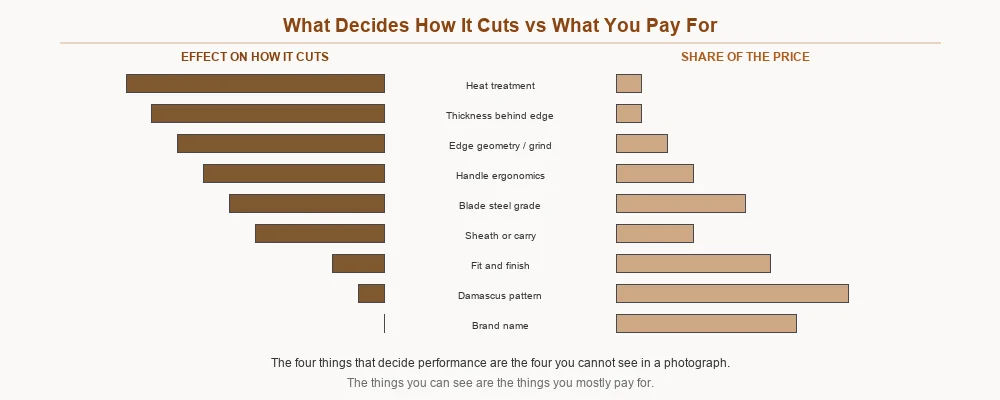
Here is the uncomfortable summary. The four things that most determine whether a knife performs are heat treatment, thickness behind the edge, grind geometry and handle ergonomics. None of them photograph. Meanwhile the things that do photograph — pattern, finish, exotic steel names, brand — absorb most of the price and change very little about the cutting.
This guide sets out where the money genuinely earns its keep, where it does not, and how to allocate a fixed budget so the knife is still sharp in ten years.
Who This Is For
Anyone deciding between two knives at different prices, or wondering whether to stretch. If you are buying a knife as an object to enjoy rather than a tool to use, that is entirely legitimate and this guide will simply tell you which parts of the premium are performance and which are pleasure.
What Actually Decides How a Knife Cuts
The Mismatch in One Picture
Set each component’s effect on performance beside its share of the price and the mismatch is stark. Heat treatment has the largest effect on how a knife performs and costs almost nothing to do properly. Damascus pattern has close to no effect on cutting and can account for a third of the price.
This Is Not an Accusation
Pattern and finish are not frauds. They are the parts you can see and enjoy, and wanting them is reasonable. The mistake is believing you are buying performance when you are buying appearance. Both are fine purchases; only one of them cuts better.
The Practical Consequence
When comparing two knives, ask about the invisible four first. If a seller answers those clearly, the visible features become a preference question rather than a gamble.
| Component | Effect on cutting | Typical share of price | Verdict |
|---|---|---|---|
| Heat treatment | Decisive | Almost none | Spend here, always |
| Thickness behind the edge | Decisive | Almost none | Ask before buying |
| Grind geometry | Large | Small | Worth paying for skill |
| Handle ergonomics | Large over time | Moderate | Worth paying for |
| Steel grade | Moderate | Moderate | Genuine but overrated |
| Sheath or carry system | Moderate in practice | Small | Underrated |
| Fit and finish | Slight | Significant | Pleasure, not performance |
| Damascus pattern | None | Large | Buy it because you want it |
| Brand name | None | Significant | Sometimes a proxy for quality control |
Why the Invisible Four Stay Invisible
There is a structural reason the important properties go unmentioned, and it is not conspiracy. Listings are written to be scanned in ten seconds against competing listings. Hardness needs a sentence of explanation before it means anything to a general buyer; a layer count needs none. Edge thickness requires the buyer to already understand why it matters. Faced with a choice between a specification that sells and one that informs, most sellers reach for the one that sells, and buyers learn to compare on the wrong axes because those are the only axes on offer.
The practical escape is to ask directly. A seller who cannot answer is not necessarily dishonest, but they are telling you the knife was bought in rather than made, and that the person who chose it did not ask either.
Heat Treatment: The Invisible Half of the Answer
What It Is
The controlled heating, quenching and tempering that turns soft steel into a blade. It sets hardness, toughness and how the edge behaves under load.
Why It Dominates
The same 1095 can leave two workshops at HRC 54 or HRC 61. The first will roll and dull under normal use; the second will hold an edge for months. Same steel, same price of raw material, entirely different knives. No other single factor comes close.
Why Nobody Advertises It
Because it is invisible, hard to explain, and cannot be photographed. It is far easier to sell a layer count.
How to Buy For It
Ask what hardness the blade is finished to and how that is verified. A published range like HRC 58 to 60 with an explanation means someone is measuring. Vagueness means they are not, whatever the price. Our guide to knife steel types covers what hardness ranges suit which uses.
Thickness Behind the Edge
The Number That Predicts Cutting
Measured a few millimetres up from the apex, this figure decides how much material the blade has to displace as it passes through. A blade at 0.3mm behind the edge slices; the same blade at 0.8mm wedges and splits.
Why Cheap Knives Are Thick
Thicker edges survive shipping, abuse and warranty claims. From a manufacturer’s perspective a thick edge is risk management. From yours it is the reason the knife feels blunt when it is technically sharp.
The Good News
Unlike heat treatment, this one is fixable. A thick edge can be thinned on a coarse stone, and doing so transforms a mediocre knife. It takes an hour and costs nothing but effort.
What to Ask
How thick is it behind the edge? Most sellers will not know, which is itself informative. Makers who grind their own bevels usually can tell you.
How to Check It Without a Micrometer
Few buyers own measuring equipment, and none are offered it in a shop. Two rough tests work well. Hold the blade up to a light and look at the bevel: a wide, shallow bevel usually means thin stock behind the edge, while a narrow bevel meeting a thick blade means the opposite. Then try to cut something thick and dense, a carrot or a potato rather than paper. A thin blade parts it; a thick one splits it ahead of the edge and the halves crack apart. That cracking is the sound of geometry, not bluntness, and no amount of sharpening will fix it.
Why This Matters More Than Steel Choice
A blade that wedges will feel disappointing regardless of what it is made from, and buyers routinely respond by upgrading steel, which changes nothing. If a knife has ever felt like hard work despite being freshly sharpened, geometry was almost certainly the reason.
The Handle You Will Hold for Twenty Years
Comfort Compounds
A handle that causes a hot spot after ten minutes becomes the knife you stop reaching for. Over years, ergonomics affect your experience more than any blade specification.
Material Matters Less Than Shape
Stabilised wood, micarta, G10 and resin all work. What matters is whether the shape suits your hand and your grip, and whether it stays secure when wet. Beautiful materials on a bad shape remain a bad handle.
Where the Money Goes Wrong
Exotic handle materials command large premiums for appearance. Stag, mammoth ivory and figured burl are genuinely lovely and functionally equivalent to micarta. Pay for them knowingly.
The Test
Hold it in a pinch grip, the way you will actually use it, not just wrapped around the handle. If you cannot hold it before buying, look for a shape without hard edges at the transitions.
Steel Grade: Worth Something, Not Everything
What Better Steel Genuinely Buys
Longer intervals between sharpening, and in stainless grades, corrosion resistance. Both are real benefits worth some money.
What It Does Not Buy
Sharpness. A premium steel and a basic steel sharpened equally are equally sharp on day one. The premium shows up in week three, not on the first cut.
Diminishing Returns Arrive Early
The jump from unspecified mystery steel to a known grade like 1095 or 440C is transformative. The jump from there to a powder metallurgy super steel is real but modest, and comes with harder sharpening.
Match Steel to Environment, Not to Prestige
Wet conditions genuinely need stainless. Dry use rewards carbon. Our comparison of stainless and carbon steel sets out which suits which, and it is a more useful axis than price.
When Premium Steel Is Genuinely Worth It
There is a case for the expensive alloys, and it is narrower than the marketing but real. If you cut abrasive material all day — cardboard, rope, carpet, insulation — the interval between sharpenings dominates your experience, and a powder metallurgy steel can double or triple it. Trades people who use a knife hourly recover that premium in time saved. If you are also unwilling or unable to sharpen frequently, the same logic applies.
When It Is Not
For a knife used a few times a week on food, cord and packaging, the sharpening interval is already months, and doubling it changes nothing you will notice. Worse, the harder steels take considerably longer to sharpen when they finally need it, and are less forgiving of a beginner’s technique. For most buyers a mid-range steel that responds quickly to a stone is the more pleasant ownership experience.
The Sheath and How You Carry It
The Most Underrated Line Item
A superb fixed blade in a poor sheath is a knife you leave at home. Retention, draw angle and comfort decide whether the knife is with you when needed.
What Good Looks Like
Secure without a fight, one-handed draw, no rattle, and it does not dig in when you sit down. Leather needs care; moulded synthetics do not but can trap grit.
Budget for It Separately
Treat the sheath as part of the purchase rather than an accessory. A $40 sheath on a $160 knife is better value than a $200 knife with a poor one.
What You Pay For That Does Not Cut
Damascus Pattern
Genuinely beautiful and genuinely irrelevant to cutting. It also does not resist rust: our Damascus is 1095 and 15N20, both carbon steels, as explained in our Damascus versus high carbon comparison. Buy it for the look, which is reason enough.
Mirror Polish and Decorative Filework
Hours of labour that make the knife lovelier and cut identically.
Exotic Handle Materials
See above. Lovely, functionally neutral.
Brand Premium
Sometimes a genuine proxy for quality control and warranty support, sometimes purely a name. The tell is whether the maker publishes specifications a buyer can check.
Layer Counts
A description of appearance sold as a performance figure. Treat a high layer count as a colour choice.
Format Costs More Than Any Feature
Before optimising within a budget, note that the largest cost driver is often the format itself. A folder carries the cost of a pivot, lock, detent and precise tolerances, none of which contribute to cutting; a fixed blade of the same price puts that money into steel and finishing. Pound for pound you get more knife from a fixed blade, which our comparison of folding and fixed blade knives explains in detail. If a fixed blade suits your carry, it is the better value at every tier.
Profile Is Free
Choosing the right blade shape costs nothing and matters enormously. A correctly shaped blade in a modest steel will outperform an expensive knife of the wrong shape for the task, every time. Reading our guide to blade profiles and when to use them before spending is the cheapest performance upgrade available.
The Diminishing Returns Curve
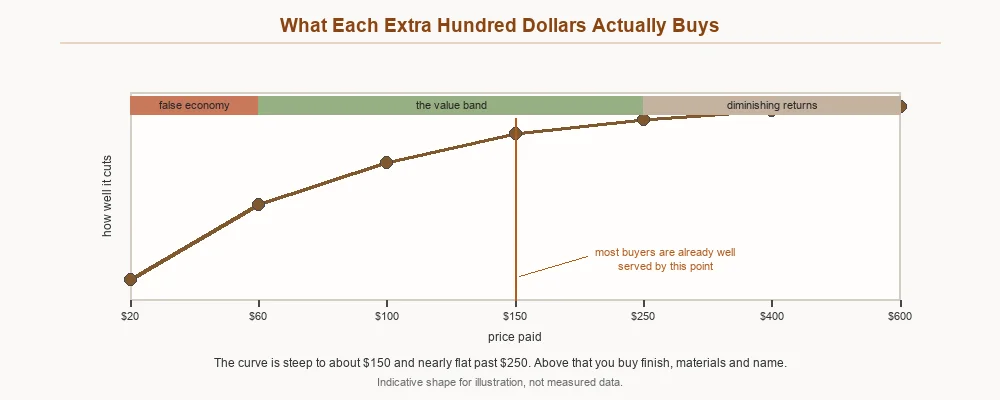
Below About $40: False Economy
Uncontrolled heat treatment, thick edges, handles that come loose. These knives create the belief that all knives are frustrating.
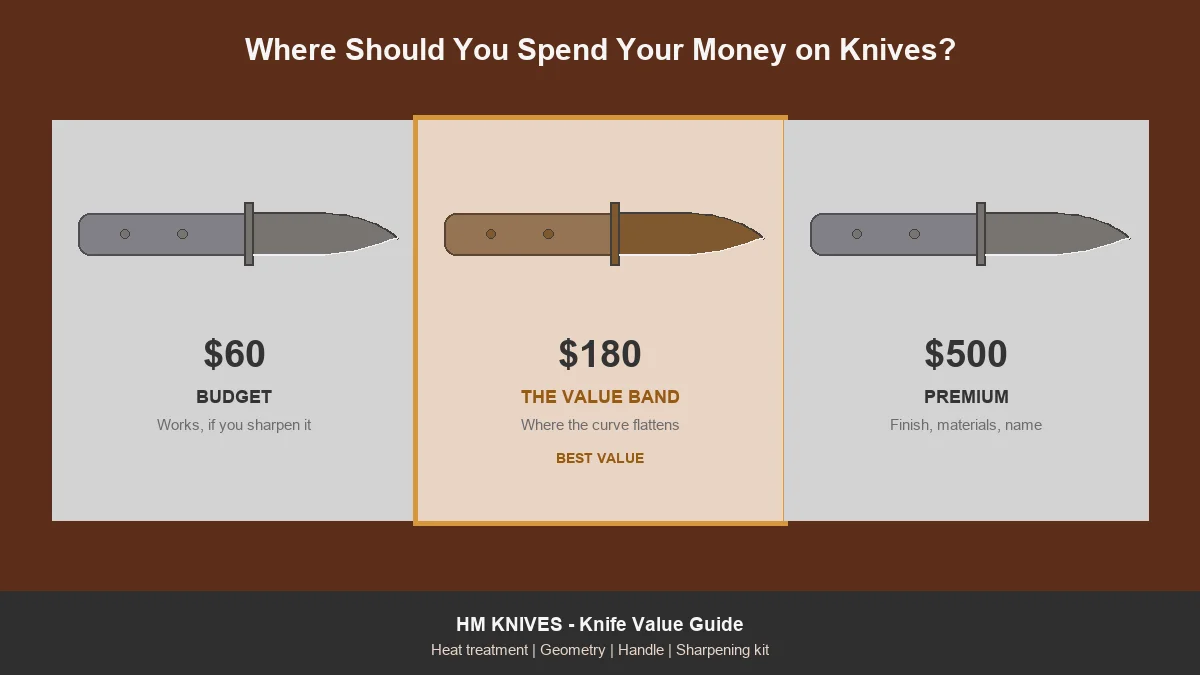
$60 to $200: The Value Band
Here the curve is steepest. Controlled heat treatment, sensible geometry, decent handles. Most people are genuinely well served somewhere in this range and would not detect an upgrade blindfolded.
$200 to $400: Refinement
Better fit and finish, optimised geometry, individual attention. Real improvements, small increments.
Above $400: Objects
Materials, craftsmanship, name and pleasure. Nothing wrong with it, provided you know that is what you are buying. Our comparison of handmade against production knives covers what the premium does and does not include.
Resale Is Not a Reason to Overspend
Buyers sometimes justify stretching by pointing to resale value, and the reasoning rarely survives contact with reality. Handmade knives from established makers do hold value better than production ones, but selling requires finding a buyer, photographing honestly, handling shipping and accepting a discount to retail. Treat a knife as a tool that will be used up slowly, and any residual value as an unexpected bonus rather than part of the purchase calculation. The knives that actually hold value are the ones nobody uses, which rather defeats the point of buying one.
What Each Price Tier Actually Gets You
| Budget | What you should get | What to be suspicious of | Best use |
|---|---|---|---|
| Under $40 | Little worth having | Damascus at this price is decorative etching | Knives you expect to lose |
| $40-$80 | Known steel, honest geometry | Vague steel descriptions | First knife, hard-use tools |
| $80-$200 | Stated hardness, good handle, decent sheath | Paying for pattern over grind | Where most buyers should sit |
| $200-$400 | Individual attention, optimised geometry | Makers who will not state HRC | A knife you intend to keep |
| Above $400 | Finish, materials, craftsmanship | Assuming price guarantees cutting | Objects you want, not tools you need |
The Uncomfortable Implication
If your budget is $400, the best-performing outcome is usually not a $400 knife. It is a $200 knife, a proper sharpening setup, and a good sheath.
Where the Tiers Bite Differently by Use
The tiers above assume general use, and they shift with the job. For a knife that will be abused — site work, boats, lending out — the sensible ceiling drops sharply, because replacement cost matters more than refinement. For a kitchen knife used daily for twenty years, the sensible ceiling rises, because the cost spreads across thousands of uses and the ergonomics compound. For a hunting knife used a dozen times a year, the middle of the range is almost always right: good enough to be reliable in the field, not so precious that you hesitate to use it properly. Our hunting knives and kitchen and chef knives ranges are priced with exactly that difference in mind.
The Purchase With the Highest Return of All
The Arithmetic Nobody Runs
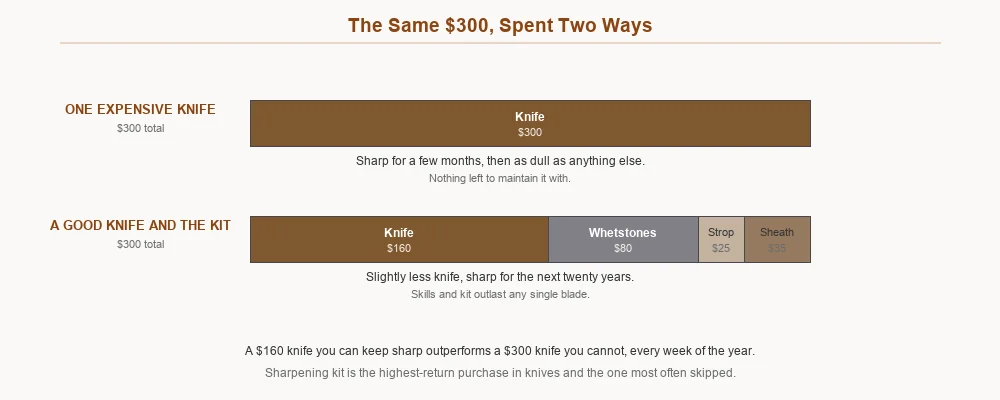
Every knife dulls. A $300 knife with nothing to sharpen it is sharp for a few months and then indistinguishable from anything else in the drawer. A $160 knife with $80 of stones stays sharp indefinitely.
What a Setup Actually Costs
A medium and a fine stone, around $60 to $90 together, plus a strop for another $25. That is the entire requirement for most people.
Why It Gets Skipped
Because stones are not exciting and the knife is. It remains the single highest-return purchase in this entire guide.
Learning to Use It
Ten to fifteen sessions to become genuinely competent, and the skill transfers to every knife you will ever own. Our complete maintenance guide covers technique, angles and grit progression, and our quick care tips cover the daily routine.
How to Split a Budget
| Total budget | Knife | Sharpening kit | Sheath / carry | Reasoning |
|---|---|---|---|---|
| $100 | $70 | $30 | included | Basic stone matters more than a better blade |
| $200 | $130 | $50 | $20 | The value band, properly equipped |
| $300 | $160 | $90 | $50 | Full stone progression and a strop |
| $500 | $320 | $110 | $70 | Better knife once the kit exists |
| $1000 | $700 | $150 | $150 | Kit is already bought; spend on the object |
Buy the Kit Once
Stones are a one-time purchase that serves every knife you will ever own. After the first setup, later budgets can go almost entirely to blades.
If You Already Own Stones
Then ignore the table and spend on the knife. The allocation matters only for the first purchase.
Buying Twice
The most expensive route through this entire subject is buying a cheap knife, finding it frustrating, and buying a good one a year later. That path costs more than buying properly at the start and delivers a year of poor cutting in between. If the budget genuinely will not stretch, buy a modest knife and full sharpening kit rather than a better knife and nothing, because the kit is what prevents the second purchase.
The One Exception
If you do not yet know what you like — which format, which length, which grip — then a deliberately inexpensive knife bought as an experiment is money well spent. Use it hard for six months, notice what irritates you, and let those irritations specify the real purchase. Buyers who do this choose far better the second time, and the cheap knife usually finds a permanent job in a toolbox or glovebox.
Where Saving Money Costs You More
Buying Below $40
You will replace it, and you will have learned nothing about what you like.
Skipping the Sheath
Leads to a knife left at home, which has an effective performance of zero.
Skipping Sharpening Kit
Turns every knife you own into a dull knife within a year.
Buying Damascus for Corrosion Resistance
A specific and common error. It is carbon steel and it rusts. If you need corrosion resistance, buy stainless.
Buying a Set Instead of Individual Knives
The margin on a block comes from the pieces you will never use. Three chosen knives beat fourteen supplied ones, as covered in our use case guide.
Adjusting for What You Already Own
The allocations above assume starting from nothing. Most people are not. If you already own a serviceable knife but no stones, the correct next purchase is stones, full stop, and it will improve every knife in the house rather than adding one more. If you own stones and a knife you like but no way to carry it, buy the sheath. The general rule is to spend on whatever is currently preventing you from using what you already have, and only buy another blade once nothing is.
Households Are Different From Individuals
A shared kitchen changes the calculation, because a knife used by several people gets treated to the standard of the least careful user. In that setting, spend less per knife and more on a magnetic strip or block that keeps edges from knocking together in a drawer, which is where most household knives are actually ruined. A modest knife stored properly outlasts an expensive one stored badly by a wide margin, as our maintenance guide sets out.
Upgrades That Genuinely Pay Off
Thinning the Edge
Free, an hour of work, transforms a thick factory grind. The largest single improvement available to most knife owners.
A Better Sheath
Turns a knife you own into a knife you carry.
A Finer Finishing Stone
Cheap, and improves every knife in the house rather than one.
Rehandling
Worth it on a blade you like with a handle you do not. Often cheaper than replacing the knife, and most makers will quote for the work.
What Rarely Pays Off
Trading up to a marginally better steel while keeping the same geometry and the same absence of sharpening kit.
The short version: spend on heat treatment, geometry, handle and a sharpening setup. Enjoy pattern, finish and materials, but buy them knowing they are pleasure rather than performance. If your budget is tight, buy less knife and buy stones.
Frequently Asked Questions
How much should I spend on my first good knife?
Between $80 and $200 for the knife, plus $50 to $90 for sharpening stones. That combination outperforms a single more expensive knife with nothing to maintain it, and the stones serve every knife you buy afterwards.
Is an expensive knife sharper than a cheap one?
Not on day one. Both can be made equally sharp. The expensive knife may stay sharp longer if its heat treatment is better, and may cut more easily if it is thinner behind the edge, but sharpness itself is a function of sharpening.
Is Damascus worth paying extra for?
Only if you want how it looks. Pattern-welded Damascus is made from carbon steels and offers no corrosion advantage and no inherent cutting advantage. It is bought for craftsmanship and appearance, which are legitimate reasons.
What is the single best upgrade to a knife I already own?
Thinning the edge on a coarse stone. It costs nothing but an hour and usually produces a larger improvement in cutting than buying a knife one tier up would.
Should I buy better steel or better heat treatment?
Heat treatment, without hesitation. A well treated basic steel outperforms a poorly treated premium one, and heat treatment costs the maker almost nothing to get right.
Do brand names justify their premium?
Sometimes. A brand premium can be a proxy for consistent quality control and warranty support, which have real value. The test is whether the maker publishes specifications you can check, such as hardness and steel grade.
Spending Where It Counts
The knife industry sells what can be photographed, because that is what can be sold. Pattern, polish, exotic materials and steel names all appear in listings; hardness, edge thickness and grind quality mostly do not. That is why so many buyers spend more and cut worse.
Ask the four questions that matter. What hardness is it finished to, how thick is it behind the edge, does the handle suit your hand, and how will you carry it. A seller who answers all four is selling you a knife rather than a photograph.
Then buy stones. Whatever your budget, the sharpening kit is the purchase that keeps paying, and it is the one almost everybody skips. Every blade in the HM Knives collection is forged to be maintained rather than replaced, and if you tell us your budget and what you actually cut, we will tell you where within it the money is best spent, including when that means buying less knife.
From Our Workshop
The same money, spent three ways in our range. Prices are on each listing.
- 8 Inch Damascus Dagger — Hand Forged with Bone Handle — entry — 8 inch Damascus dagger, full tang, the cheapest real knife we make.
- Full Tang Skinner Knife — J2 Steel with Sheep Horn Handle — middle — J2 full tang skinner, where the value sits.
- Damascus Steel Hand Made Hunter Knife with Stag Crown Handle & Fancy Hand Engraved Leather Sheath — top — stag crown Damascus, where you are buying craft rather than performance.
Browse the full range.