
Table of Contents
- Buy for the Work, Not the Photograph
- The Three Jobs a Hunting Knife Does
- Blade Profile for Field Work
- Blade Length by Game Size
- Why a Guard Is Not Optional
- Handle Material and Grip
- Tang Construction
- Steel for Field Conditions
- Hardness: Where to Sit on the Scale
- The Sheath Decides Whether You Carry It
- Gut Hooks, Choils and Other Features
- One Knife or Two?
- Caring for It in the Field
- Buying Mistakes Hunters Make
- Frequently Asked Questions
- The Knife That Comes Home With You
Buy for the Work, Not the Photograph
Hunting knives photograph well, which is part of the problem. Long blades, dramatic clip points, stacked leather handles and mirror finishes all sell, and almost none of it helps at four in the morning with cold hands and an animal in front of you.
What helps is a controllable tip, a blade short enough to work inside a cavity, a guard that stops your hand sliding forward when everything is slippery, and a handle you can hold with blood on it. Those four things are unglamorous and they decide whether the knife is a tool or an ornament.
This guide works through each decision in the order that matters, with the specifications that go with them.
The Short Answer
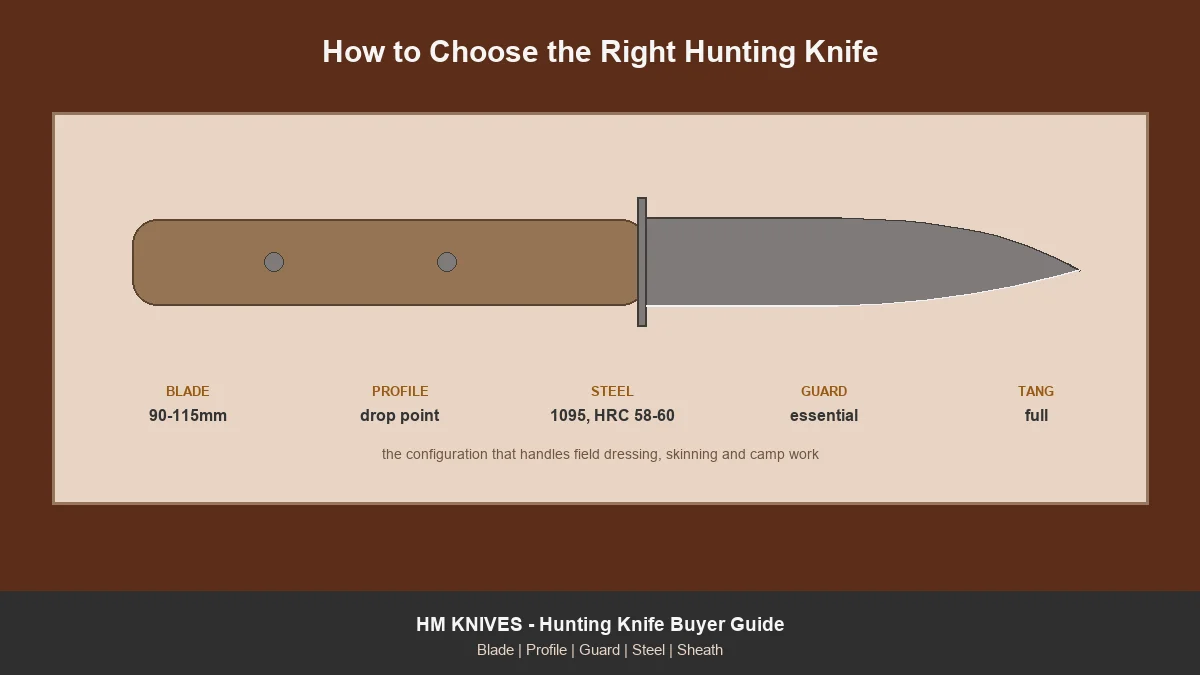
A full tang fixed blade, 90 to 115mm, drop point profile, in a carbon steel at HRC 58 to 60, with a finger guard, a textured handle and a sheath you can draw from one-handed. That configuration handles almost everything a hunter needs.
The Three Jobs a Hunting Knife Does
Field Dressing
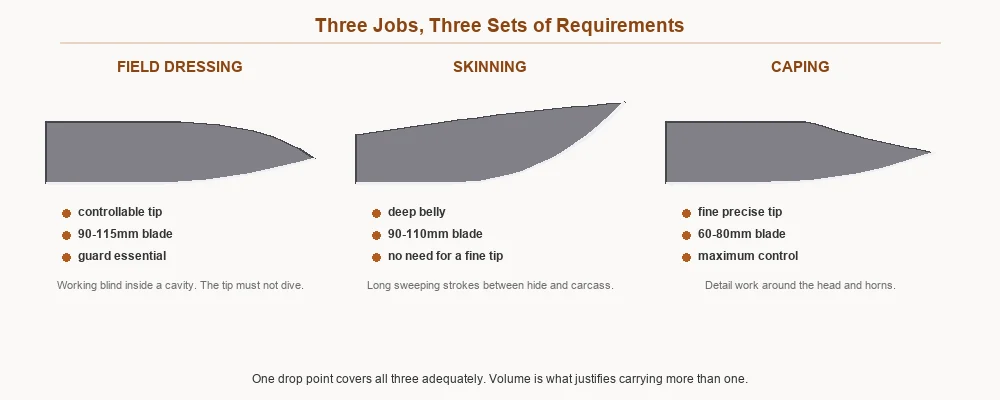
Opening the cavity and removing the organs. Much of it is done by feel rather than sight, so the tip must be controllable and must not dive into anything you did not intend to cut. This is the job that most demands a drop point.
Skinning
Separating hide from carcass with long sweeping strokes. Belly matters here far more than the tip, which is why dedicated skinners have exaggerated curves and blunt-ish points.
Caping
Detail work around the head and horns for a mount. Short blade, fine tip, maximum control. Most hunters never do this and do not need a knife for it.
Why One Knife Usually Wins
A drop point in the 90 to 115mm range does field dressing well, skinning acceptably and caping poorly. For most hunters, that trade is correct, because carrying and maintaining two knives costs more than the time saved.
Blade Profile for Field Work
Why the Drop Point Dominates
Its tip sits below the spine line, so there is steel above the point supporting it. That makes the tip strong, and more importantly it makes it predictable: it goes where you push it rather than dropping into whatever is beneath.
Why Clip Points Are Riskier Here
A clip point has a finer, more acute tip that pierces beautifully and perforates intestines just as beautifully. Excellent for detail work, less forgiving inside a cavity.
Trailing Points and Skinners
Maximum belly, minimal point. Superb at skinning, awkward for anything requiring precision. Worth owning as a second knife if you process volume.
What to Avoid
Tanto profiles have almost no belly and a tip designed for piercing hard material. They are the wrong tool for game entirely. Our guide to blade profiles and when to use them covers the full range, and our visual guide to profiles in use shows the motions each is shaped for.
Blade Thickness Matters as Much as Length
Spine thickness gets far less attention than length and affects field work almost as much. Around 3 to 4mm is the useful band for a hunting knife. Thinner than 2.5mm and the blade flexes when you lever against a joint, which is unnerving and eventually damaging. Thicker than 4.5mm and the knife stops slicing well, because a thick spine means more material to push through hide and muscle regardless of how sharp the edge is.
This is why dedicated skinners are often noticeably thinner than general hunting knives: they never lever against anything, so they can afford geometry optimised purely for cutting. A knife that has to do both jobs sits in the middle and compromises slightly on each.
Blade Length by Game Size
Shorter Than People Expect
The most common error is buying too much blade. A 150mm blade inside a deer cavity is unwieldy and increases the chance of cutting something you did not mean to. Ninety to 115mm reaches everything on animals up to elk.
Small Game
Rabbits, birds and similar want 70 to 90mm. Anything longer is simply in the way.
Deer-Sized Game
90 to 115mm is the sweet spot, and it is where most hunting knives sit for good reason.
Elk, Moose and Large Game
110 to 130mm helps with reach through heavier tissue, and a slightly thicker spine helps when working around joints.
| Game | Blade length | Profile | Why |
|---|---|---|---|
| Rabbit, birds, small game | 70-90mm | Drop point or small clip | Precision matters; length is a hindrance |
| Deer, antelope | 90-115mm | Drop point | Reaches everything without crowding |
| Boar | 100-120mm | Drop point, thicker spine | Tougher hide and heavier joints |
| Elk, moose | 110-130mm | Drop point | Extra reach through deeper tissue |
| Skinning any of the above | 90-110mm | Trailing point | Belly does the work |
| Caping for a mount | 60-80mm | Fine clip point | Detail control around the head |
Why a Guard Is Not Optional
The Mechanism
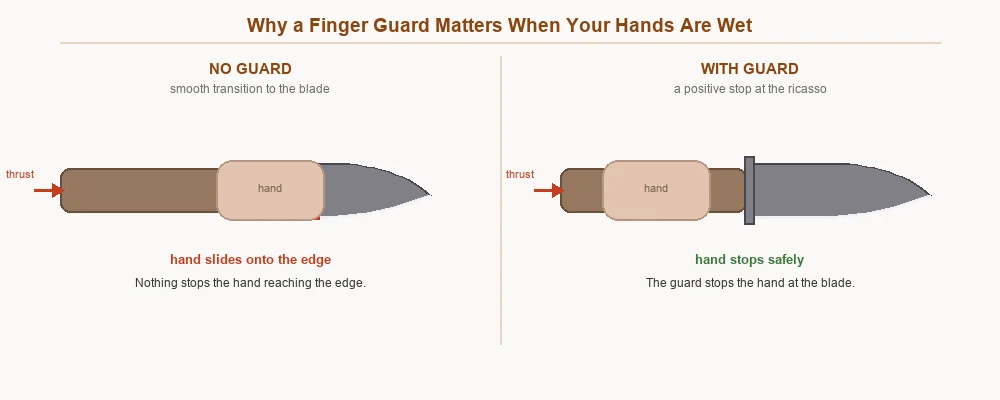
When you push a blade into resistance and it suddenly gives, your hand carries forward. On a dry handle in a workshop, friction usually stops it. On a blood-slick handle in the cold, it does not.
What a Guard Does
Provides a positive stop between hand and edge. It does not need to be large; it needs to exist. A deep finger choil can serve the same purpose on some designs.
The Injury This Prevents
Lacerations across the fingers, sustained miles from a road, with hands already cold and wet. It is the most common serious knife injury in the field and it is almost entirely preventable by this one feature.
What to Check Before Buying
Grip the knife and push your palm hard toward the blade. Something should stop you well short of the edge. If nothing does, the knife is a poor choice for field work whatever else it offers.
Handle Material and Grip
Wet Grip Is the Only Test That Matters
A handle that feels secure in a shop tells you nothing. The relevant condition is wet, cold and greasy, and materials differ enormously under it.
The Materials That Work
Micarta and G10 grip better wet than dry because their texture punches through the water film. Stag is naturally textured and performs well. Textured or checkered wood is good.
The Materials That Do Not
Polished bone, polished resin and smooth hardwood become genuinely hazardous when wet. They look superb and they are the wrong choice for a working hunting knife. Our knife materials guide explains the mechanism.
Shape Outranks Material
A well-shaped handle in plain wood beats a badly shaped one in premium micarta. Look for a slight palm swell, a defined finger position, and no hard edges where the scales meet the tang.
Cold Hands Change Everything
Thin handles that feel precise at room temperature become hard to control with numb fingers or gloves. Err slightly thicker than feels ideal indoors.
Gloves Change the Handle You Need
Almost nobody tries a knife wearing the gloves they will actually hunt in, and it changes the assessment considerably. A thin glove costs a little dexterity; a thick insulated one removes most of your ability to feel where the handle ends and the blade begins, which is exactly why the guard matters more in cold weather.
Gloves also make handles feel smaller, so a knife that seems comfortably chunky bare-handed can feel cramped once you are dressed for the conditions. If you hunt in cold country, hold the knife with a glove on before buying, and accept a handle that feels slightly too large indoors.
Tang Construction
Full Tang, and Why It Matters Here
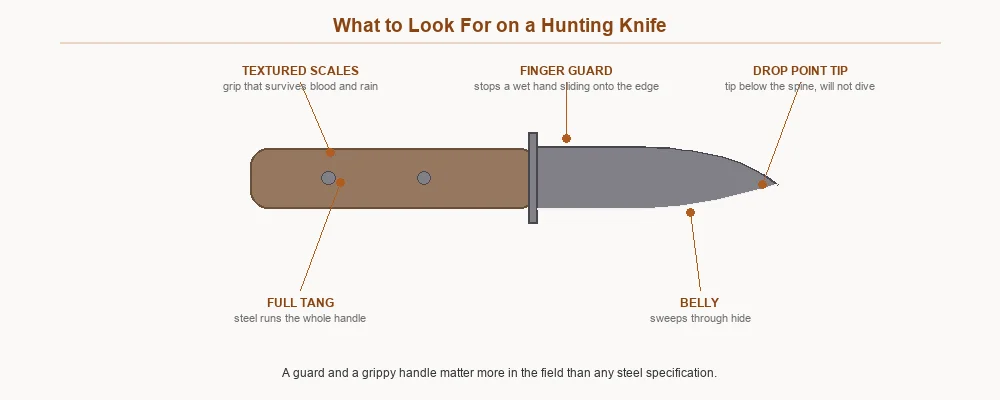
A full tang runs the entire length and width of the handle with scales pinned either side. There is no joint, so there is nothing to fail when you lever against a joint or a rib.
How to Identify It
Look at the handle edge-on. You should see a continuous strip of steel sandwiched between the scales, running to the butt.
What to Avoid
Rat-tail tangs, which narrow to a rod threaded into the handle. They break at the shoulder where blade meets tang, and they break under exactly the loads field work produces.
The Weight Trade
Full tang adds weight, which is real but modest. The security is worth it on a knife that may be used hard a long way from help. Our comparison of folding and fixed blade knives covers why folders are a poor fit for this work.
Steel for Field Conditions
Carbon Steel Is the Traditional Answer
1095 and similar sharpen quickly, take a very keen edge, and can be touched up on almost anything abrasive in camp. That last property matters more in the field than laboratory edge retention figures.
When Stainless Makes More Sense
Wet climates, coastal hunting, waterfowl, or if you know you will not dry the blade until you get home. Corrosion resistance beats keenness when the knife will be neglected.
Damascus in the Field
Our Damascus is 1095 and 15N20, both carbon steels. It is a working knife with a pattern, not a stainless one, and it wants drying and oiling like any carbon blade. Full detail in our Damascus versus high carbon comparison.
The Field Sharpening Point
A steel you can bring back with a small pocket stone in twenty minutes is worth more on a five-day hunt than a super steel you cannot touch without diamond plates. Our guide to knife steel types covers which steels respond to what.
| Conditions you hunt in | Steel | Handle | Why |
|---|---|---|---|
| Dry country, careful owner | 1095 or Damascus | Micarta, stag or textured wood | Keenest edge, easy field touch-ups |
| Wet or coastal | 440C or VG-10 | G10 or micarta | Carbon will rust despite care |
| Waterfowl, marsh | Stainless | G10 | Constant immersion |
| Cold weather, gloves | Either | Thicker textured handle | Numb hands need more grip |
| Long backcountry trips | 1095 | Micarta | Sharpens on any pocket stone |
| Occasional use, stored between seasons | Stainless | Any | Survives being forgotten |
Hardness: Where to Sit on the Scale
The Field Range
HRC 58 to 60 is the working band for hunting knives. Hard enough to hold an edge through an animal, tough enough to survive contact with bone.
Why Not Harder
Above 62 the edge chips when it meets bone, and chips are far worse in the field than a dulled edge because you cannot fix them with a pocket stone.
Why Not Softer
Below 56 the edge rolls partway through the job and you find yourself stropping mid-task.
What to Ask
What hardness is it finished to? A maker who publishes a range is measuring. Ours finish at HRC 58 to 60.
Why Hardness Is the Question Sellers Dodge
Of all the specifications on a hunting knife, hardness is the one most likely to be missing from a listing and the one that predicts field performance best. It is also trivially cheap to measure, which makes its absence informative rather than innocent. A workshop that hardens steel and never checks the result is guessing, and the guess varies batch to batch.
If a seller cannot give you a figure, that does not automatically mean the knife is bad. It does mean nobody can tell you how it will behave, and on a knife you will rely on miles from a road, that uncertainty is worth avoiding for the sake of one question.
The Sheath Decides Whether You Carry It
Retention Versus Access
It must hold the knife when you bend, kneel, crawl or fall, and release it one-handed when you need it. Those pull against each other and the balance is what you are judging.
Leather Versus Synthetic
Leather is quiet, comfortable and moulds over time, but absorbs water and must be dried with the knife out of it. Kydex is waterproof and precise but noisy, and noise matters when stalking.
Test It Properly
Invert the sheathed knife and shake. Nothing should move. Then draw it wearing the gloves you actually hunt in.
Never Store the Knife in Leather
Leather holds moisture and its tannins are acidic. Long-term storage in a sheath is the most reliable way to pit a carbon blade, as covered in our maintenance guide.
Carry Position Is Part of the Sheath Decision
Where the sheath rides matters as much as how it retains. A vertical belt sheath at the hip is traditional and gets in the way when you sit in a vehicle or a stand. A dangler, which hangs the sheath from a short loop, lets the knife swing clear when you sit and is markedly more comfortable over a long day. Scout carry, horizontal across the small of the back, keeps the knife accessible while prone but is slower to draw under stress.
There is no universally right answer, but there is a wrong one for each hunter, and it is usually discovered on the first long day. If you hunt from a stand or spend hours seated, prioritise a dangler or a pack-mounted option over a rigid belt sheath.
Gut Hooks, Choils and Other Features
Gut Hooks
Genuinely fast at opening hide if you have practised with one. Awkward to sharpen, easy to snag, and useless for anything else. Worth it if you open a lot of hide; otherwise a controlled drop point tip does the same job.
Finger Choils
A notch behind the edge that lets you choke up for detail work. Useful, and on some designs it serves as the guard.
Squared Spines
A spine ground to a sharp ninety degrees will scrape tinder and throw sparks from a ferro rod. Costs the maker nothing and is genuinely useful.
Lanyard Holes
More useful than they look. A wrist loop means a dropped knife does not disappear into leaf litter or water.
What You Do Not Need
Serrations, hollow handles, compasses, saw backs. Every one of them adds a failure point or removes steel from somewhere that needed it.
| Feature | Worth having? | Why |
|---|---|---|
| Full tang | Essential | No joint to fail under lateral load |
| Finger guard | Essential | Stops the hand sliding onto the edge when wet |
| Textured handle | Essential | Grip survives blood and rain |
| Drop point profile | Strongly recommended | Predictable tip inside a cavity |
| Squared spine | Nice to have | Scrapes tinder, throws sparks |
| Lanyard hole | Nice to have | A dropped knife stays findable |
| Gut hook | Only if you use it | Fast on hide, awkward to sharpen |
| Serrations | No | Tear tissue and cannot be field sharpened |
| Hollow handle | No | Removes the tang; the knife will break |
| Saw back | No | Saws poorly and removes spine strength |
One Knife or Two?
The Volume Test
Below about three animals a season, one drop point. Above that, a dedicated skinner alongside it starts saving real time.
The Backup Argument
A second small folder is worth carrying regardless, not for game but for everything else: cord, packaging, food, gear repair. It keeps the main blade clean and sharp for the work that needs it.
What Not to Do
Buying a matched three-knife hunting set before your first season. Buy one good knife, use it hard, and let its shortcomings tell you what the second should be. Our use case guide covers building a collection in a sensible order.
Check the Local Rules Before the Season
Knife carry for hunting is generally well provided for in law, but the provisions are usually tied to the activity rather than to you personally. Carrying a fixed blade to and from a hunt is normally lawful as part of legitimate sporting use; the same knife in the same pocket on an unrelated trip into town may not be. Some jurisdictions also set blade length limits that apply regardless of purpose, and a few restrict carry in vehicles or require the knife to be sheathed and stowed rather than worn.
None of this is onerous, but it is worth confirming for your own area and for anywhere you travel to hunt, ideally before you buy rather than after. Guidance from a retailer is not a substitute for the actual statute.
Caring for It in the Field
During the Job
Wipe the blade on grass or cloth as you go. Dried blood is far harder to remove than wet, and it accelerates corrosion on carbon steel.
Back at Camp
Wash in clean water, dry thoroughly including the handle junction, and apply a light oil film. Five minutes.
Touching Up an Edge
A small ceramic or diamond pocket stone weighs almost nothing. Ten passes per side restores a working edge, and a knife that cuts is safer than one you have to force.
After the Season
Full clean, inspection for rust spots and handle movement, a proper sharpening, and oiled storage outside the sheath. Our knife care tips cover the routine.
Practise Before the Season, Not During It
A knife you have never used is a poor companion on the one morning it matters. Whatever you buy, spend an hour with it beforehand: sharpen it yourself so you know how it responds to a stone, draw it repeatedly from the sheath wearing gloves, and cut something demanding so you learn where the balance sits and how the handle behaves when your grip shifts.
If you can, practise the actual task on a smaller animal or a butcher’s offcut before applying it to a trophy. Field dressing is a skill, and the knife is only the part of it you can buy. Hunters who blame equipment for a slow, messy job are frequently describing a technique problem that an afternoon of practice would have solved.
Buying Mistakes Hunters Make
Too Much Blade
The single most common error. Long blades are harder to control in a cavity and buy nothing.
Choosing a Handle Because It Photographs Well
Polished stag and figured burl are beautiful and slippery. If it will be used wet, choose texture.
Believing Damascus Resists Rust
It does not. It is carbon steel and needs the same care, which is a problem only if nobody told you.
Ignoring the Sheath
A knife you cannot draw one-handed while kneeling is a knife you will stop carrying.
Buying Before the First Season
Buy a good mid-range knife first. Preferences form through use, and our guide on where to spend your money on knives covers why the sharpening kit matters more than the upgrade.
The checklist: full tang, 90-115mm drop point, finger guard, textured handle, HRC 58-60, sheath you can draw one-handed. Everything else is preference.
What a Hunting Knife Is Not For
Worth saying plainly, because it accounts for most broken hunting knives. It is not a pry bar, and levering against a pelvis or a joint is how tips snap. It is not a hatchet, and splitting a sternum with a knife and a rock damages both the edge and your confidence in it. It is not a saw, and pelvic bone wants an actual bone saw, which weighs very little and costs less than a replacement blade.
A hunting knife cuts. Ask it to do anything else and it will do that thing badly and then be unavailable for the job it was carried for. Carrying a small saw alongside it solves nearly every case where hunters are tempted to misuse the blade.
Frequently Asked Questions
What size hunting knife do I need for deer?
A blade of 90 to 115mm handles deer-sized game comfortably. It reaches everything inside the cavity without becoming unwieldy. Longer blades are harder to control and increase the risk of cutting something you did not intend to.
Is a drop point or clip point better for hunting?
Drop point, for most hunters. Its tip sits below the spine line, which makes it strong and predictable when you are working by feel inside a cavity. A clip point pierces more easily, which is precisely the risk when the thing beneath the hide is an intestine.
Do I need a gut hook?
Only if you will use it enough to become practised. A gut hook opens hide quickly but is awkward to sharpen and useless for other tasks. Most hunters are better served by a well controlled drop point tip.
Should a hunting knife be stainless or carbon steel?
Carbon steel if you will dry and oil the blade, because it sharpens faster in the field and takes a keener edge. Stainless if you hunt wet country, take waterfowl, or know the knife will be put away damp.
Can I use a folding knife for hunting?
You can for small game, but the pivot traps blood and tissue that are difficult to clean out properly, which is a hygiene problem as much as a maintenance one. For anything deer-sized a fixed blade is the better and safer tool.
What hardness should a hunting knife be?
HRC 58 to 60. Hard enough to hold an edge through an entire animal, tough enough to survive contact with bone without chipping. Chips are worse than dullness in the field because a pocket stone cannot fix them.
The Knife That Comes Home With You
The right hunting knife is boring on paper. A hundred millimetres of drop point in carbon steel, a guard, a grippy handle, a full tang and a sheath that works. There is nothing in that list that photographs dramatically, and every item on it earns its place at the moment you actually need the knife.
Buy for the animal you actually hunt and the weather you actually hunt in. Choose the shortest blade that reaches, insist on a guard, test the handle wet if you can, and check you can draw the knife one-handed with gloves on. Then spend whatever is left on a pocket stone rather than a longer blade.
Knives in our hunting knives range are finished at HRC 58 to 60, and roughly half are full tang while the rest use a hidden tang. Each listing states the construction, so you can match it to how hard you intend to work the knife. If you tell us what you hunt and where, we will tell you which configuration suits it, including when a shorter or cheaper knife is the better answer. You can also browse the wider HM Knives collection if you need a camp or kitchen blade alongside it.

From Our Workshop
Knives from our hunting range that match the specification above. Prices are on each listing.
- D2 Steel Hunting Dagger Knife with Sheep Horn Handle — D2 hunting dagger — controllable point, least maintenance of the three steels.
- Damascus Steel Hand Made Hunting Outdoor Knife with Resin Sheet & Brass Guards Leather Sheath — Damascus outdoor knife with brass guard — a working field knife.
- J2 Steel 11 inch Hand Made Fishing Camping Knife with Green Micarta Handle — micarta handle — the one for wet hands.
- Damascus Steel Hand Made Hunter Knife with Stag Crown Handle & Fancy Hand Engraved Leather Sheath — stag crown Damascus — if it is going to be handed down.
- Damascus Kukri Knife — 19 Inches, Shoulder Belt Carry — 19 inch kukri — a chopper, not a skinner. Included so you can see the difference in person.
Browse all hunting knives.