
Table of Contents
- The Question Behind the Question
- What "Handmade" and "Production" Actually Mean
- The Two Routes, Step by Step
- The Claim That Needs Correcting First
- Does Either One Actually Cut Better?
- Heat Treatment: Where the Real Difference Lives
- Consistency Against Character
- What Goes Wrong in Each
- Where the Money Actually Goes
- Value at Each Price Tier
- How to Judge a Handmade Knife Before Buying
- When Production Is the Better Buy
- Repair, Longevity and Resale
- So Is Handmade Better?
- Frequently Asked Questions
- Buying With Your Eyes Open
The Question Behind the Question
When someone asks whether handmade Damascus is better than a production knife, they are usually asking something more specific and more practical: will I notice the difference, and is the extra money buying performance or a story?
The answer is not the one either camp wants. Handmade knives are not automatically better, and production knives are not automatically soulless. Both statements are marketing rather than fact. What is true is that the two routes fail in different ways, cost money in different places, and suit different buyers.
We forge by hand and we will still tell you when a production knife is the sensible purchase. That is more useful than a sales pitch.
What This Guide Covers
What each term actually means, what happens differently in the workshop, whether either genuinely cuts better, where the money goes, and how to judge a handmade knife before you commit to one. It also corrects a claim about Damascus construction that appears on a great many knife websites, including an earlier version of this page.
What "Handmade" and "Production" Actually Mean
Neither term is regulated, which is exactly why they are worth defining before comparing.
Handmade, Honestly Defined
A blade forged and finished by a person making individual decisions at each stage: stacking and welding the billet, forging the shape, heat treating that specific blade, grinding the bevels by hand, and fitting the handle to that blade rather than to a specification. Hand tools may include power hammers, belt grinders and a forge. Hand does not mean primitive; it means judged rather than programmed.
Production, Honestly Defined
A blade cut, ground and finished to a fixed specification by machines set up once and repeated. Heat treatment happens in batches. A person may still assemble, sharpen and inspect it, but the geometry was decided by a program rather than an eye.
The Large Grey Middle
Most knives sold as handmade sit somewhere between. Blades cut by waterjet then hand ground. Imported billets forged elsewhere and finished locally. Batch heat treatment with hand finishing. None of this is dishonest, but “handmade” covers all of it, so the word alone tells you very little.
The Questions That Cut Through It
Ask who forged the billet, whether blades are heat treated individually or in batches, and whether the bevels were ground by hand or machine. A maker who answers all three plainly is telling you what you are buying. Vagueness is its own answer.
The Two Routes, Step by Step
The Production Route
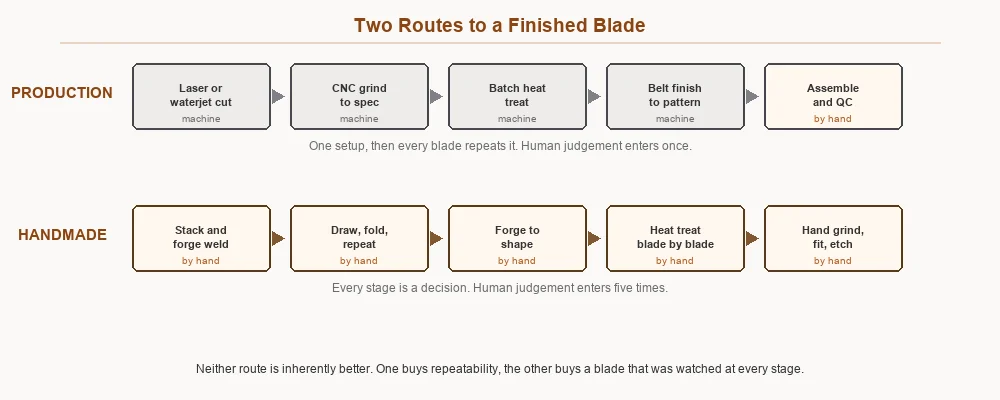
Steel arrives as bar or sheet. Blanks are laser or waterjet cut. CNC machines grind the bevels to a programmed geometry. Blades go through a heat treatment oven in batches, quenched and tempered on a controlled cycle. Belt finishing brings the surface up. Handles are moulded or machined and fitted. A person inspects, sharpens and packs.
The Handmade Route
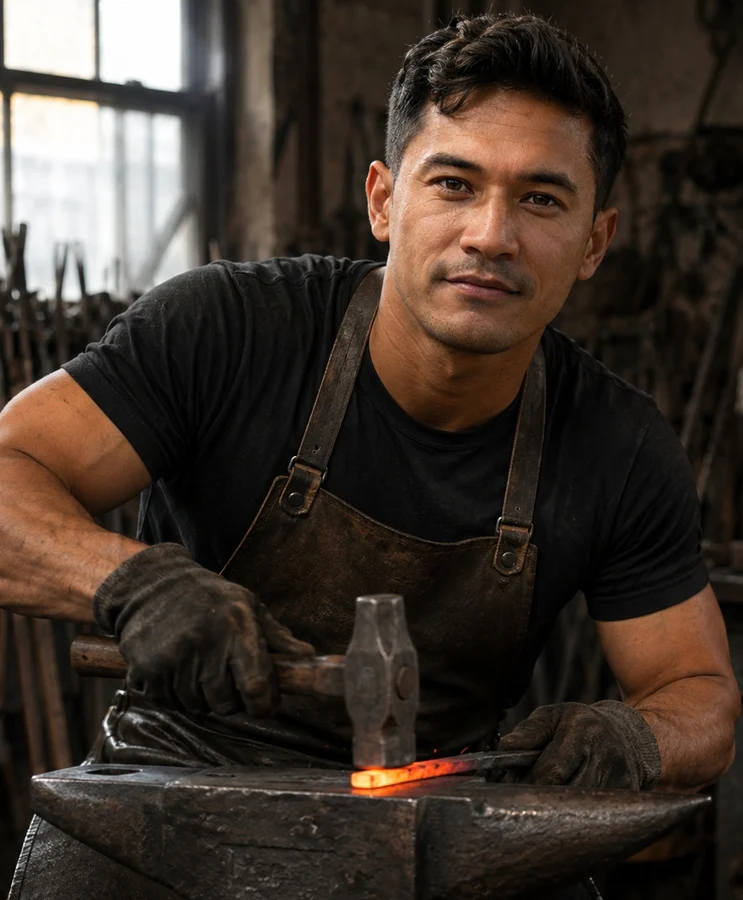
Bars of 1095 and 15N20 are cleaned and stacked. The billet is forge welded at heat, then drawn, cut, folded and rewelded until it holds the layer count wanted. It is forged toward a blade shape, normalised, hardened and tempered as an individual piece. Bevels are ground by hand against a belt, watching the steel. The handle is fitted to that blade. It is etched, sharpened and tested.
Where Judgement Enters
This is the substantive difference. In production, human judgement is exercised once, at setup, and then reproduced. In handmade work it is exercised at every stage, on every blade. That cuts both ways: a skilled maker catches problems a machine would repeat, and a distracted maker introduces problems a machine never would.
Time and Volume
A production line may finish hundreds of blades in the time a single Damascus billet takes to forge. Our own billets take six to eight hours before shaping begins, and the full sequence is set out in our guide to how Damascus steel is actually made.
Scale Changes What Is Possible
Volume is not a neutral fact about a workshop; it shapes what the workshop can do. A production line that makes forty thousand knives a year cannot inspect each one closely, so it designs out the need to: thicker stock that will not warp, conservative geometry that survives misuse, tolerances wide enough that assembly never stalls. Those are rational engineering choices, and they cost cutting performance at the margins.
A workshop making a few hundred blades a year can afford to leave each one thinner and closer to optimal, because a human looks at every blade before it ships. The same workshop cannot afford a fifty-thousand-dollar vacuum furnace. Each route optimises for what its volume permits, and the knives reflect that.
The Claim That Needs Correcting First
A correction: an earlier version of this page said Damascus gets its edge retention from “the hardness of the outer layers combined with the flexibility of the inner core.” That describes san-mai, a different construction where a hard core is clad in softer steel. Pattern-welded Damascus has no core and no cladding. Its layers run through the blade in alternating bands, and at any point the edge is simply one of the constituent steels.
Why This Matters for the Comparison
Because the myth implies handmade Damascus has a structural advantage that a production blade cannot match. It does not. The layers are visual and, at the margins, contribute a little crack resistance. They do not create a hard-edge-soft-spine composite.
The Second Myth: Damascus Resists Rust
Our Damascus is 1095 and 15N20, both carbon steels with no meaningful chromium. It rusts and needs oiling. If corrosion resistance is what you need, a production stainless knife beats handmade Damascus outright, and our comparison of stainless and carbon steel explains why. Full detail on what the layers do and do not change is in our Damascus versus high carbon steel comparison.
Does Either One Actually Cut Better?
The Short Answer
No, not by virtue of how it was made. A blade cuts according to its geometry, its steel, and its heat treatment. A machine can produce excellent geometry and a person can produce poor geometry, and vice versa.
Where Production Frequently Wins
Geometric precision. A CNC-ground bevel is consistent from heel to tip in a way that hand grinding achieves only with real skill. On a mid-priced knife, the production blade often has more even geometry than a mid-priced handmade one.
Where Handmade Frequently Wins
Distal taper and thickness behind the edge. A maker who is paying attention will thin the blade toward the tip and leave the edge thin where it matters, because they can feel it. Production designs frequently leave blades thicker than ideal because thicker blades survive shipping, abuse and warranty claims.
What Actually Separates Good From Bad
Thickness behind the edge, more than anything else. A blade that is 0.3mm behind the edge cuts dramatically better than one at 0.8mm, regardless of steel, price or how it was made. Ask about that number before you ask about anything else.
The Test That Settles Arguments
If you own both and want to know which cuts better, stop reading specifications and cut cardboard. Take a sheet of corrugated card and slice a long strip from each knife alternately, counting strokes until the blade starts tearing the paper rather than parting it. The difference will be obvious within a few minutes, and it will correlate with heat treatment and edge thickness rather than with price or provenance. Buyers are frequently surprised by the result in both directions.
Why Reviews Rarely Help Here
Most knife reviews assess fit, finish and feel, all of which are visible in the first five minutes. Edge retention takes weeks of real use to assess and varies with what is being cut, so it is the property least likely to be tested and most likely to be asserted. Treat unsupported edge-retention claims, from any maker including us, as marketing until someone cuts something.
Heat Treatment: Where the Real Difference Lives
Why It Matters More Than Steel Choice
The same 1095 can leave two workshops at HRC 54 or HRC 61. Those knives behave nothing alike, and no buyer can tell them apart by looking. Heat treatment is the single largest determinant of performance and the least visible.
The Production Advantage
Industrial heat treatment is genuinely excellent. Computer-controlled ovens, measured soak times, cryogenic treatment where appropriate, and documented results. A good production knife has more reliable heat treatment than most small workshops achieve.
The Handmade Advantage
A maker treating one blade at a time can tailor the cycle to that blade’s thickness and intended use, and can test it before it ships. The ceiling is higher; the floor is lower.
The Question to Ask
What hardness do you finish to, and how do you verify it? A published range such as HRC 58 to 60, with an explanation of how it is checked, tells you the maker measures. Silence or a vague “very hard” tells you they do not.
Consistency Against Character
What the Spread Means
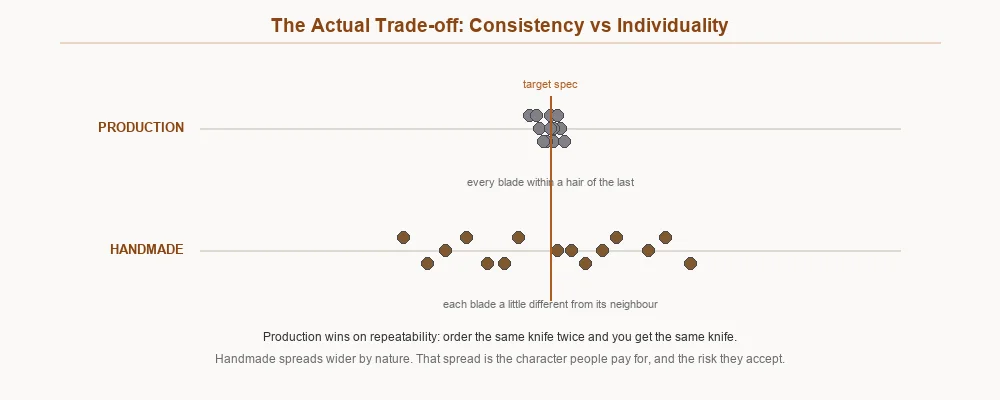
Order the same production knife twice and you receive two effectively identical knives. Order the same handmade model twice and you receive two related but distinct objects, differing in pattern, weight, balance and finish.
Which One You Want Depends Entirely on Why You Are Buying
If the knife is a tool that must match the one you already own, that spread is a defect. If the knife is a thing you will keep and look at, the spread is the point.
The Honest Risk
Spread is symmetrical. Some handmade blades land better than the maker’s average and some land worse, and you cannot tell which you are receiving from a stock photograph. Buying from a maker who photographs the actual knife you will receive removes most of this risk.
| Factor | Production | Handmade | Which matters to you? |
|---|---|---|---|
| Unit-to-unit consistency | Very high | Moderate | Critical for matched sets, irrelevant for a single knife |
| Geometric precision | High | Varies with maker skill | Affects how it cuts |
| Thickness behind edge | Often conservative | Often optimised | Affects how it cuts |
| Heat treatment reliability | Very high | Varies with maker | Affects everything |
| Individual character | None by design | Inherent | Matters if you value the object |
| Availability and lead time | In stock | Often weeks | Practical consideration |
| Repairability | Parts-dependent | Usually rebuildable | Matters over decades |
| Price | Lower | 2-4x | The whole question |
The Photograph Problem
Handmade knives are usually sold from a photograph of a representative knife rather than the one being shipped, and Damascus patterns vary enormously between blades from the same billet, let alone between billets. Buyers who expect the pattern in the listing photograph are frequently disappointed by a knife that is objectively fine. Either buy from a seller who photographs individual knives, or accept in advance that the pattern is a family resemblance rather than a specification.
What Goes Wrong in Each
Handmade Failure Modes
Cold shuts, where the forge weld did not take, showing as a fine dark line following the layers. Delamination at the plunge. Uneven grind lines. Handle fit gaps. Warped blades from an uneven quench. Most of these are visible if you know to look.
Production Failure Modes
Over-thick geometry that no amount of sharpening fixes. Batch heat treatment that missed. Handle materials chosen for moulding cost rather than grip. Assembly tolerances that let a folder develop play early.
The Asymmetry Worth Knowing
Production faults tend to be systematic: if one knife has them, the whole batch does, and reviews will tell you. Handmade faults tend to be individual: reviews of the maker will not warn you about the specific blade you are being sent. This is the strongest practical argument for buying handmade from someone who shows you the actual knife.
| Fault | Where it appears | How to spot it | Can it be fixed? |
|---|---|---|---|
| Cold shut | Handmade | Dark line crossing the pattern, often near the spine | No — reject the knife |
| Delamination | Handmade | Hairline gap at the plunge or edge | No |
| Uneven grind | Handmade | Bevel width changes heel to tip | Yes, by regrinding |
| Warp from quench | Handmade | Sight down the spine | Sometimes |
| Over-thick edge | Production | Blade wedges in a carrot | Yes, by thinning |
| Missed heat treat | Either | Edge rolls or chips unusually fast | No |
| Handle gaps | Either | Fingernail catches at the scale joint | Sometimes |
Where the Money Actually Goes
The Production Split
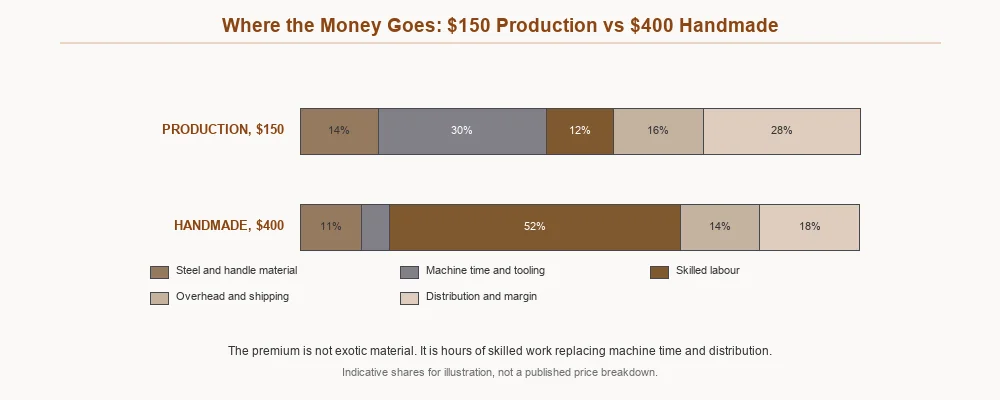
A significant share goes to machine time, tooling amortisation and distribution. Material is a small fraction. Labour is modest because the process is designed to minimise it.
The Handmade Split
Labour dominates, typically around half the price. Machine time nearly vanishes. Distribution shrinks because the maker often sells direct.
What You Are Not Paying For
Exotic material. 1095 and 15N20 are ordinary, inexpensive steels. Nobody is paying a premium for rare alloy content in a Damascus knife.
The Fair Way to Frame It
The premium buys hours of skilled attention. Whether that is worth it depends on whether attention produces something you value, which is a question about you rather than about knives. Our guide on where to spend your money on knives covers which features justify their cost across the board.
What the Premium Does Not Cover
It is worth being explicit about what the extra money is not buying, because buyers routinely assume otherwise. It does not buy corrosion resistance; carbon Damascus rusts more readily than production stainless. It does not buy hardness; both routes reach the same HRC range. It does not buy warranty support; large manufacturers frequently offer better formal guarantees than individual makers, simply because they have the infrastructure. And it does not buy resistance to neglect, which remains the leading cause of ruined knives at every price point.
Value at Each Price Tier
Under $100
Production wins clearly. At this price, handmade means corners cut somewhere you cannot see, usually heat treatment. A well made production knife at $60 will outperform a nominally handmade one at $90.
$100 to $250
The overlap zone. Good production knives are excellent here, and entry handmade work becomes genuine. Choose on whether you want consistency or character.
$250 to $500
Handmade starts to pull ahead on the things that matter: optimised geometry, individual heat treatment, fitted handles, and a maker who will talk to you. This is where the money is best spent if you want a handmade knife.
Above $500
You are buying finish, materials, and the maker’s name. All legitimate, all subject to diminishing returns on cutting performance.
| Price tier | Better buy | Why | What to avoid |
|---|---|---|---|
| Under $100 | Production | Handmade corners get cut invisibly | Damascus at suspiciously low prices |
| $100-$250 | Either | Both are genuinely good here | Paying for pattern over geometry |
| $250-$500 | Handmade | Geometry and heat treat get individual attention | Makers who will not state hardness |
| Above $500 | Preference | Finish and materials, not performance | Assuming price guarantees cutting ability |
How to Judge a Handmade Knife Before Buying
Look Along the Blade in Raking Light
Grind lines should be even and symmetrical, the plunge lines should match on both sides, and the pattern should be continuous. Any line crossing the pattern rather than following it is a question for the seller.
Sight Down the Spine
It should be straight. A visible warp means an uneven quench, and while it can sometimes be corrected, it tells you about the workshop.
Check the Handle Junction
Run a fingernail across where the scale meets the tang. It should not catch. Gaps trap moisture and are the first place a handmade knife shows its price.
Ask the Three Questions
Which steels, what hardness, and is it stainless. Straight answers indicate a maker who measures. This is the same filter we recommend in our guide to knife steel types.
Ask to See the Actual Knife
For handmade work this is the single most useful request you can make, because it converts an unknown into a known.
When Production Is the Better Buy
When Consistency Is the Requirement
Commercial kitchens, matched sets, or replacing a knife you already like. Handmade cannot promise you the same knife twice.
When the Knife Will Be Abused or Lost
Site work, boats, lending to others. Spend less and replace without regret.
When You Need Stainless
Wet environments favour a stainless production blade over carbon Damascus every time. See our use case guide for where each belongs.
When Budget Is Genuinely Tight
A good production knife plus a decent sharpening setup beats a handmade knife with nothing to maintain it. Our maintenance guide covers what that setup actually needs.
Weight and Balance Are Worth Handling For
Two knives with identical published dimensions can feel entirely different in the hand, because balance point and weight distribution are rarely specified and hugely affect how a knife works. A blade that balances at the guard feels lively and controllable for detail work; one balancing forward of it feels planted and chops better. Neither is superior, but you will strongly prefer one, and no specification sheet will tell you which. If you can handle a knife before buying, that is the property to attend to.
Ask What Happens If It Is Wrong
Return policies differ sharply between the two routes and are worth checking before purchase rather than after. Production knives sold through retailers usually carry straightforward returns. Individual makers, particularly on commissioned work, often cannot offer the same, because the knife was made for you. That is reasonable, but it means the questions about steel, hardness and geometry need asking before the order rather than after delivery.
Repair, Longevity and Resale
Handmade Knives Are Usually Rebuildable
Scales can be replaced, blades re-etched, edges reprofiled, sheaths remade. A maker who is still working will often service their own knives decades later.
Production Knives Depend on Parts
Excellent while the model is current, awkward once it is discontinued, particularly for folders where pivots and washers are model-specific.
What Holds Value
Handmade knives from identifiable makers hold value considerably better, because the supply is finite. Production knives depreciate like tools. Neither is a reason to buy, but it is worth knowing if the knife is expensive.
The Thirty-Year View
A well kept handmade fixed blade will very likely still be in service in thirty years, and the hunting knives and kitchen knives we forge are built on that assumption. A production folder from the same era will more likely have been replaced twice.
So Is Handmade Better?
Not at Cutting, Inherently
Geometry, steel and heat treatment decide cutting, and either route can get all three right or wrong.
Yes at Being an Object Worth Keeping
If you want a knife that was made rather than produced, that is a real thing to want, and only one route delivers it.
The Buyer Who Should Choose Handmade
Someone buying one knife they intend to keep, who will maintain it, and who values that a person made it.
The Buyer Who Should Choose Production
Someone who needs several knives, or a replaceable one, or absolute consistency, or stainless in a wet environment.
Format Matters More Than Provenance
One thing worth keeping in proportion: whether a knife folds or is fixed will affect your daily experience of it far more than whether a machine or a person ground the bevels. A handmade folder and a production folder both route their load through a pivot and a lock; a fixed blade of either origin does not. If you are weighing handmade against production while also undecided on format, settle the format first, because our comparison of folding and fixed blade knives covers a decision with larger consequences.
So Does Blade Shape
The same holds for profile. A hand-forged tanto will still be poor at skinning, and a production drop point will still be decent at it, because shape solves the problem and provenance does not. Our guide to blade profiles and when to use them is worth reading before you decide how much to spend, not after. The sequence that serves buyers best is format, then profile, then steel, then how it was made — and most people work through it in exactly the reverse order.
Frequently Asked Questions
Is handmade Damascus sharper than a production knife?
No. Sharpness comes from edge geometry and how well the blade was sharpened, not from how it was manufactured. A production knife with a thin, well-ground edge will outcut a handmade blade with a thick one.
Does handmade Damascus hold its edge longer?
Not because it is handmade or because it is Damascus. Edge retention comes from the steel and its heat treatment. Since Damascus is built from ordinary carbon steels, expect performance in the same band as a good single carbon steel blade.
Why is handmade so much more expensive?
Labour. A Damascus billet takes six to eight hours of skilled forge work before shaping even begins, and each blade is heat treated and ground individually. Roughly half the price of a handmade knife is that time.
How can I tell if a knife is genuinely handmade?
Ask who forged the billet, whether blades are heat treated individually or in batches, and whether the bevels were hand ground. Look for slight asymmetry between the two sides, which machines do not produce. Vague answers usually mean assembly rather than making.
Is cheap Damascus a warning sign?
Usually. Damascus below about $100 typically means imported billet, minimal heat treatment control, or an etched pattern on plain steel. The pattern is the cheapest part to fake and the hardest for a buyer to verify.
Should my first good knife be handmade?
Probably not. Buy a well made production knife and a sharpening setup first, learn what you actually like about how a knife cuts, then buy handmade with informed preferences. You will choose better and enjoy it more.
Buying With Your Eyes Open
Handmade is not a performance specification. It is a description of how a knife came to exist, and it correlates with performance only through the attention of the person who made it. A good maker produces knives that cut beautifully; a careless one produces expensive knives that do not.
Judge any knife on the things that actually decide how it works: thickness behind the edge, hardness and how it was verified, grind symmetry, and handle fit. Those four tell you more than the words handmade, forged or Damascus ever will.
If you want a knife that was watched at every stage by someone who cared how it turned out, that is what we make, and every blade in the HM Knives collection is forged that way. If a production knife is the better answer for your situation, we would rather say so. Contact us with what you actually need and we will tell you honestly, and our knife care tips will keep whichever you buy working for decades.
From Our Workshop
Pieces where the hand work is the whole product. Prices are on each listing.
- Damascus Steel Hand Made Hunter Knife with Stag Crown Handle & Fancy Hand Engraved Leather Sheath — stag crown Damascus with hand engraved sheath — hours of finishing you cannot automate.
- High Polish Trekker Dagger — Sheep Horn and Damascus Handle — High Polish Trekker — the finish is the labour.
- Damascus Chef Knife Set — 7 Pieces with Bone Handles — seven piece chef set — matched by hand across seven blades.
Browse the full range.