
Table of Contents
- What You Are Actually Buying
- What Makes a Knife a Bowie
- Where the Bowie Came From
- Choosing a Size
- Balance: Why Two Bowies of the Same Length Differ
- Steel for a Bowie
- Handle and Guard
- Construction and Tang
- The Sheath
- What a Bowie Is Genuinely Good For
- What It Is Not For
- Legal Considerations Before You Buy
- How to Judge One Before Buying
- Looking After It
- Frequently Asked Questions
- Buying One You Will Actually Use
What You Are Actually Buying
The bowie is the most romanticised knife in existence and the most frequently bought for the wrong reasons. People imagine clearing brush and splitting kindling, then buy a 300mm blade that lives in a drawer because it is too heavy to carry and too dramatic to take anywhere.
That is a shame, because a well chosen bowie in a sensible size is a genuinely capable tool. It chops, it slices, it handles camp work no folder can touch, and it does all of it with a presence that smaller knives lack.
This guide covers what actually defines a bowie, which size suits which use, why balance matters more than length, and how to judge one before you commit. It also says plainly what a bowie is not for, because that is where most disappointment comes from.
The Short Answer
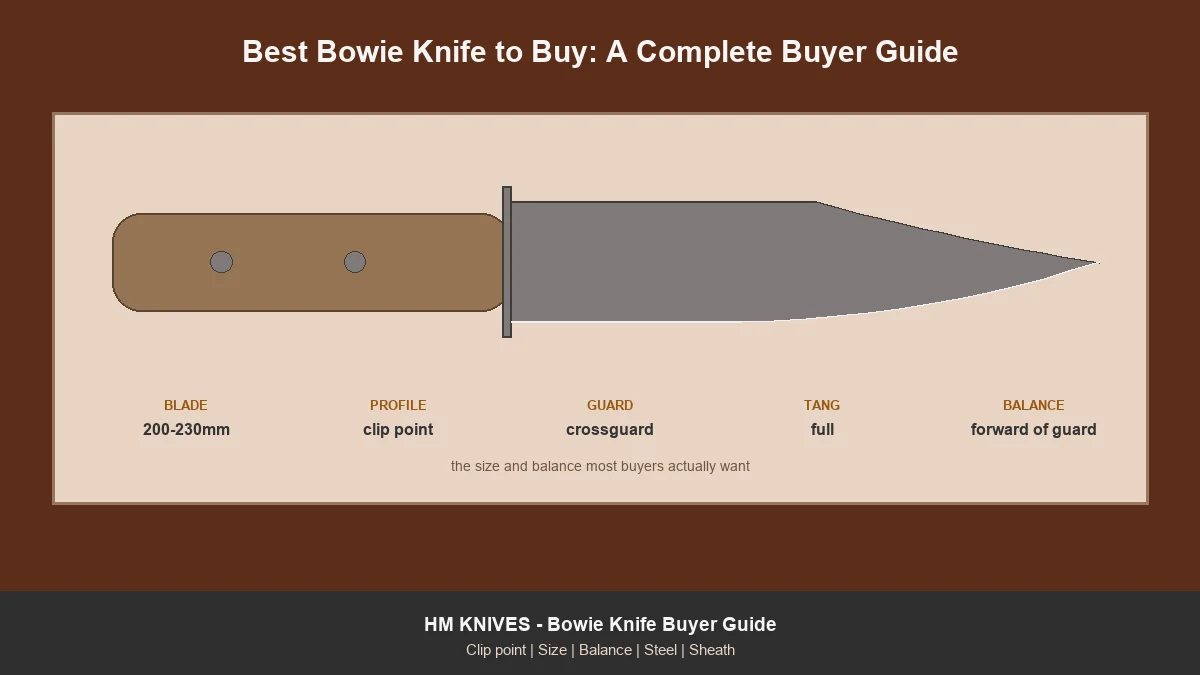
For most buyers: a 200 to 230mm clip point blade, full tang, with a crossguard and the balance point sitting forward of the guard. Big enough to chop, controllable enough to use, and carryable without planning your day around it.
What Makes a Knife a Bowie
The Clip
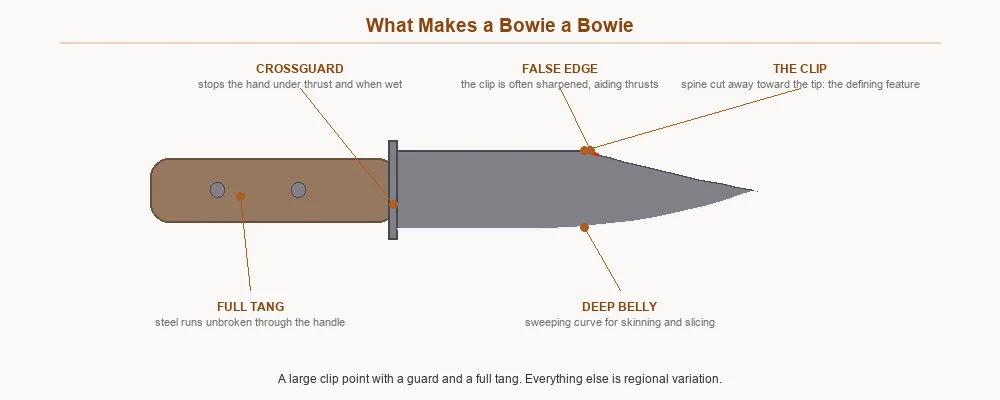
The defining feature. A section of the spine is cut away toward the tip, either straight or concave, which lowers the point and lightens the tip. Without a clip you have a large knife, not a bowie.
The False Edge
The clipped section is frequently sharpened, giving a second short edge along the top. It aids thrusting and back-cuts. Not universal, and it does reduce tip strength.
The Crossguard
A genuine functional feature rather than decoration. It stops the hand travelling onto the blade when a thrust meets sudden give, which matters more as blades get longer and heavier.
The Deep Belly
A pronounced curve running back from the tip, which is why a bowie skins and slices far better than its size suggests.
What Is Not Required
A brass guard, a stacked leather handle, a coffin handle or a particular length. These are stylistic conventions, not defining features.
Where the Bowie Came From
The Short Version
The knife takes its name from Jim Bowie, an American frontiersman of the early nineteenth century, and its reputation from the fights he was involved in. The original design is genuinely disputed, with several makers credited and no surviving example universally accepted as the first.
Why the Design Persisted
Because it solved a real problem. On the frontier a single large knife had to butcher, chop, prepare food and defend, and the clip point with a deep belly is a reasonable compromise across all four.
What Changed Since
Specialisation. Most of what a bowie was carried for is now done better by a dedicated tool: an axe chops better, a hunting knife dresses game better, a folder carries easier. The bowie survives because it does all of them adequately and because people like it.
Choosing a Size
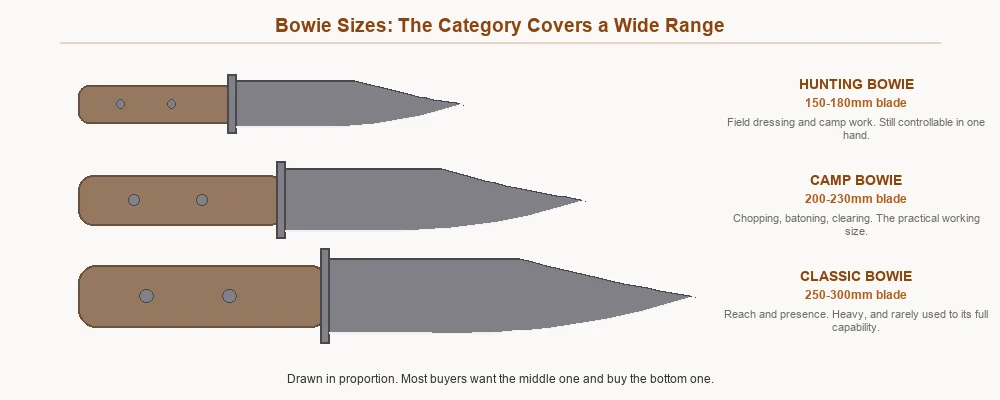
Hunting Bowie, 150 to 180mm
Controllable in one hand, light enough to carry all day, and capable of field dressing. It will chop only light material. The most practical choice if the knife will actually be worn.
Camp Bowie, 200 to 230mm
The working size. Enough mass to chop and baton, still short enough to control for food prep. If you want one bowie that earns its place, this is the band.
Classic Bowie, 250 to 300mm
Reach, presence and considerable weight. Magnificent objects. Genuinely useful for clearing and heavy chopping, and honestly, rarely used to their capability by most owners.
The Honest Guidance
Most buyers want the middle size and buy the largest. If in doubt, go one size down from what appeals in the photograph, because photographs do not convey weight.
| Size | Blade | Typical weight | Best at | Trade-off |
|---|---|---|---|---|
| Hunting bowie | 150-180mm | 200-280g | Field dressing, camp food prep | Limited chopping ability |
| Camp bowie | 200-230mm | 300-420g | Chopping, batoning, general camp work | Noticeable on a belt all day |
| Classic bowie | 250-300mm | 450-700g | Clearing, heavy chopping, display | Heavy, restricted in many places |
Balance: Why Two Bowies of the Same Length Differ
The Test
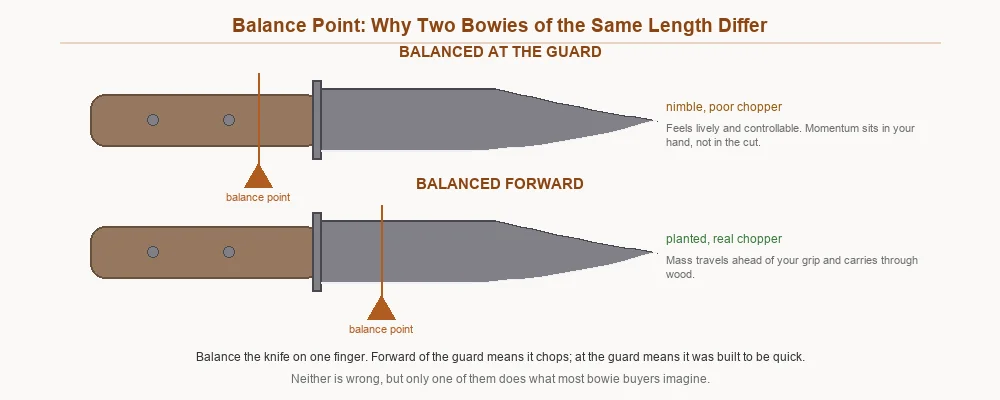
Balance the knife across one finger. Where it sits tells you what it was built to do, and it is not visible in any photograph.
Balanced at the Guard
Feels lively, quick and controllable. Excellent for detail work and slicing. A poor chopper, because momentum stays in your hand rather than travelling into the cut.
Balanced Forward
Feels planted and slightly nose-heavy. Mass travels ahead of your grip and carries through wood. This is what makes a big blade actually chop.
Which You Want
If the knife is for camp and clearing, forward balance. If it is for food prep and general use, closer to the guard. Buyers who want chopping and buy a guard-balanced blade are consistently disappointed and usually blame the steel.
Why Length Costs More Than You Expect
Weight rises faster than length, because a longer blade is also usually thicker and wider to stay rigid. Going from a 180mm to a 250mm blade does not add forty percent to the weight; it frequently doubles it. That is the arithmetic behind so many unused bowies.
Weight is also the property least conveyed by photographs and product listings. A knife that looks magnificent on screen can be genuinely tiring to hold out at arm’s length for thirty seconds, which is roughly what a minute of chopping demands. If you cannot handle one before buying, treat the stated weight as the most important number in the listing.
Steel for a Bowie
Toughness Over Edge Retention
A bowie meets wood, bone and the occasional buried nail. Toughness matters more here than in almost any other knife, because a chipped edge on a chopper is far worse than a dull one.
What We Forge
Our blades are 1095 and Damascus made from 1095 and 15N20, finished at HRC 58 to 60. Both are carbon steels, both take a keen edge, both sharpen easily in camp, and both will rust if left wet.
Damascus on a Bowie
Visually superb and functionally identical to good carbon steel. It is not stainless, whatever else you may read, so it needs the same drying and oiling. Our Damascus versus high carbon comparison covers exactly what the layers do and do not change.
If You Want Stainless
Reasonable for coastal or wet-country use, at some cost in ease of field sharpening. Our guide to knife steel types sets out the options.
Hardness
HRC 57 to 59 suits a chopper better than 60 plus. Slightly softer steel rolls rather than chips, and a rolled edge can be steeled back in the field where a chip cannot.
Blade Thickness and Distal Taper
A bowie spine typically runs 4.5 to 6mm at the ricasso, which is what gives it the rigidity to take impact. The detail that separates a well made one is distal taper: the spine thinning gradually toward the tip, so weight is removed from the end that does not need it while the base stays strong.
A blade of uniform thickness feels dead and tip-heavy in a way that tires the wrist, while a properly tapered one of the same length and weight feels alive. Sight along the spine from the handle: you should see it narrow. Many production bowies skip this because it costs grinding time, and it is one of the clearest indicators of care in the making.
Handle and Guard
Length and Shape
A bowie handle needs to be long enough to choke back for chopping and forward for detail work. Around 120 to 140mm suits most hands, with a defined swell so the grip does not shift under impact.
Material
Micarta and textured wood grip well wet. Stag and bone look superb and become slippery. On a chopping knife that slipperiness is a genuine safety issue, not just an inconvenience, which our knife materials guide explains.
The Guard Is Not Optional
On a heavy blade used with force, the crossguard is what stops your hand reaching the edge. Any bowie without one should be treated with real caution.
Shock and Comfort
Chopping transmits shock into the hand. A handle with some give, or at least without hard corners, makes an hour of work far more pleasant than a beautifully finished slab that raises blisters.
Construction and Tang
Full Tang Only
For a knife that chops, this is not negotiable. Every impact loads the joint between blade and handle, and a partial or rat-tail tang will eventually fail at the shoulder.
How to Check
Look at the handle edge-on. A continuous strip of steel should run between the scales all the way to the butt.
Pins and Fittings
Peened pins hold mechanically and survive impact; epoxy alone relies on adhesive. On a chopper, peened is meaningfully better.
Why Cheap Bowies Fail Where They Do
Bowies suffer a particular failure pattern at the budget end, and it is worth recognising. The tang narrows where it enters the handle, and on an inexpensive knife that shoulder is often left with a sharp internal corner rather than a radius. Sharp corners concentrate stress, and chopping loads the shoulder harder than any other use. That is where cheap bowies break, usually without warning, on a blade that looked substantial.
The other common failure is a guard that is merely slotted on and epoxied rather than fitted tightly and pinned. Under repeated impact it loosens, then rattles, then stops protecting the hand. Neither fault is visible in a photograph, which is why the tang and guard questions matter more on this category of knife than on any other.
The Sheath
It Has Real Work to Do
A 400g blade puts far more strain on a sheath than a pocket knife does. Stitching, rivets and retention all matter more.
Leather or Synthetic
Thick leather suits a bowie aesthetically and practically, provided it is properly welted so the edge cannot cut through the stitching. Synthetic is waterproof and noisier.
Carry Position
A long blade on a hip becomes unbearable when seated. A dangler loop or a cross-draw position makes a large bowie genuinely wearable.
Never Store It Sheathed
Leather holds moisture and its tannins are acidic, which is a reliable way to pit a carbon blade over a winter.
Grind Matters as Much as Steel
For a chopping blade the cross-section behind the edge does much of the work. A convex grind, curving outward toward the apex, puts the most steel behind the edge and is the traditional choice for choppers because it resists rolling and chipping on knots. A flat grind slices better and is more vulnerable to impact. A hollow grind, thinned by a concave cut, is the wrong choice on a bowie entirely.
This is why two bowies in identical steel at identical hardness can behave differently on wood, and why a chopper that keeps chipping is usually suffering from geometry rather than a bad heat treatment.
What a Bowie Is Genuinely Good For
Camp Chopping and Batoning
Its strongest case. A forward-balanced 200mm-plus blade processes firewood, clears branches and splits kindling with real efficiency.
Large Game Field Work
The deep belly skins well and the length reaches through heavy tissue. Less precise than a dedicated hunting knife for the delicate parts of field dressing.
Camp Food Preparation
Surprisingly capable. The belly and length work well on a flat surface, more so than most people expect from a knife this size.
Clearing Light Vegetation
Effective on brambles, saplings and undergrowth, though a machete does it better and cheaper.
Collecting and Display
An entirely legitimate reason to buy one. A Damascus bowie is a beautiful object, and there is nothing wrong with buying it as one, as our comparison of handmade and production knives discusses.
| Task | Bowie suitability | Better tool if you have one |
|---|---|---|
| Chopping firewood | Very good with forward balance | Hatchet or small axe |
| Batoning kindling | Very good | None; this is bowie territory |
| Skinning large game | Good | Dedicated skinner |
| Field dressing | Adequate | 90-115mm drop point |
| Camp food prep | Good | None needed |
| Clearing brush | Adequate | Machete |
| Everyday carry | Poor | Folder |
| Prying or levering | Do not | Pry bar |
What It Is Not For
Everyday Carry
Too large, too heavy and legally restricted almost everywhere. A folder does daily cutting better in every respect, as our comparison of folding and fixed blade knives sets out.
Prying
Length multiplies leverage, and leverage snaps tips. A long blade is more vulnerable to prying damage, not less.
Throwing
Throwing knives are purpose-built, unsharpened and cheap. Throwing a finished bowie damages the edge and the tip, and eventually the tang.
Self Defence Planning
The historical association is strong and the practical reality is not. Carrying a large fixed blade for defence is unlawful in most jurisdictions and unwise in nearly all.
A Note on the Self-Defence Framing
Bowies are still marketed on the fighting reputation, and it is worth separating the history from the purchase. The reputation is real and nineteenth century. The present-day reality is that carrying a large fixed blade for defence is unlawful in most jurisdictions, and that intent can affect how the same knife is treated in law regardless of what you actually do with it.
Buy a bowie because it chops well, skins well and is a pleasure to own. Those are sound reasons that hold up anywhere. Buying one on the strength of its fighting history is buying a story, and it tends to lead people toward blade sizes they will never carry.
Legal Considerations Before You Buy
Check Before, Not After
Large fixed blades attract more restriction than any other category. Many places permit ownership freely while restricting carry to specific activities such as hunting, fishing or camping.
Blade Length Limits
Some jurisdictions set hard limits, frequently between 100 and 150mm, which rules out most bowies for general carry regardless of purpose.
Transport
Even where carry is restricted, transporting a sheathed knife to and from a legitimate activity is usually permitted. Stow it rather than wear it.
Buying as a Gift
Check the recipient’s local rules, and check age restrictions, which apply to knife sales in most countries.
Price Tiers and What Changes
Below roughly $100, a bowie is almost always stamped from bar stock with minimal heat treatment control and a rat-tail or partial tang. At this size and weight, those shortcuts matter more than they would on a small knife, because the loads are higher. It is the one knife category where the cheap end is genuinely worth avoiding rather than merely compromised.
Between $150 and $400 you reach full tang construction, stated hardness, fitted guards and sheaths built to hold the weight. That is where the value sits. Above $500 you are paying for finish, handle materials, Damascus patterning and the maker’s reputation, all legitimate, none of which changes how the knife chops.
How to Judge One Before Buying
Find the Balance Point
The single most informative test, and it takes two seconds. Forward of the guard means it chops; at the guard means it was built to be quick.
Check the Tang
Look for continuous steel between the scales, running to the butt.
Ask for the Hardness
A published range such as HRC 58 to 60 means someone is measuring. Silence means they are not, whatever the price. Our guide on where to spend your money on knives explains why this matters more than any other specification.
Inspect the Grind in Raking Light
Bevels should be even and symmetrical, and plunge lines should match on both sides. On Damascus, the pattern should be continuous with no line crossing it.
Handle It If You Can
Weight and balance are the two properties no photograph conveys, and they decide whether you enjoy the knife.
The checklist: clip point, full tang, crossguard, 200-230mm for general use, balance forward of the guard if you intend to chop, HRC 57-60, and a welted sheath you can actually wear. Everything beyond that is preference.
| What to check | What good looks like | Why it matters |
|---|---|---|
| Balance point | Forward of the guard for chopping | Decides whether it chops at all |
| Tang | Continuous steel visible to the butt | Impact loads the blade-handle joint |
| Stated hardness | A published range, e.g. HRC 58-60 | Nobody can predict it otherwise |
| Guard | Present and positive | Stops the hand reaching the edge |
| Grind symmetry | Plunge lines match both sides | Signals care in the finishing |
| Handle texture | Grips when wet | Chopping with a slick handle is dangerous |
| Sheath welt | Stitching protected from the edge | Unwelted sheaths get cut through |
| Weight in hand | You can hold it out for 30 seconds | Photographs hide weight entirely |
Looking After It
After Every Use
Wipe down and dry, including the guard and the handle junction where moisture collects.
Carbon Steel and Damascus
Both rust. A light oil film before storage prevents it entirely. Our knife care tips cover the routine in a couple of minutes.
Sharpening a Long Blade
More edge to maintain, and a chopping bevel wants a slightly more obtuse angle, 25 to 30 degrees per side. Our step-by-step sharpening guide covers the technique, and the broader routine is in our maintenance guide.
Storage
Out of the sheath, lightly oiled, somewhere dry. A bowie stored in leather over a damp winter will come out pitted.
Where a Bowie Fits Alongside What You Already Own
A bowie is rarely a first knife and works best as a deliberate addition. If you already carry a folder for daily tasks and own something in the 90 to 115mm range for field work, a camp bowie fills the genuine gap: work that needs mass and reach. Our guide to the best knife type for every use case maps out where each sits.
If you own none of those yet, a bowie is an odd starting point, because it is the least versatile of the three and the hardest to carry. Buy the everyday knife first, discover what you actually cut, and add the bowie when you have identified a job it would do better. It will be a more satisfying purchase for having been chosen rather than imagined.
Frequently Asked Questions
What size bowie knife should I buy?
For general use, a 200 to 230mm blade. It has enough mass to chop and baton while staying controllable for food preparation and skinning. Larger blades of 250 to 300mm chop better but are heavy to carry and restricted in many places. Most buyers are better served going one size smaller than the one that appeals in photographs.
What makes a knife a bowie rather than just a big knife?
The clip: a section of spine cut away toward the tip, either straight or concave, which lowers and lightens the point. Most bowies also have a crossguard and a deep belly. Length, handle style and guard material are conventions rather than requirements.
Is a bowie knife good for chopping?
Only if the balance point sits forward of the guard. Two bowies of identical length can chop completely differently depending on where the mass sits. Balance the knife on one finger before buying: forward of the guard means it chops, at the guard means it was built to be quick and nimble instead.
Is Damascus a good choice for a bowie?
Visually, yes, and it performs the same as good carbon steel. It is not stainless. HM Knives Damascus is 1095 and 15N20, both carbon steels, so it rusts and needs drying and oiling like any carbon blade.
Can I carry a bowie knife legally?
It depends entirely on your jurisdiction. Ownership is usually unrestricted, but carry is frequently limited to specific activities such as hunting, fishing or camping, and many places set blade length limits between 100 and 150mm. Check your local law before buying, particularly if it is a gift.
What hardness should a bowie blade be?
HRC 57 to 59 suits a chopping blade better than harder figures. Slightly softer steel rolls rather than chips under impact, and a rolled edge can be steeled straight in the field whereas a chip cannot be repaired without a stone and real time.
Bringing an Edge Back After Hard Use
A chopping session leaves an edge in a different state to a day of slicing. Expect small rolls and flat spots along the section that did the work, usually the forward third. Feel along the edge with a fingertip drawn away from it and you will find them.
Rolls come out with a few passes on a ceramic rod or the fine side of a stone. Actual chips need a coarse stone and patience, working the whole section down until the damage is gone rather than trying to sharpen around it. This is exactly why a slightly softer chopping blade is preferable: rolls are a five-minute repair in camp, and chips are an evening at the bench.
Buying One You Will Actually Use
The bowie earns its reputation when it is bought as a tool and chosen on the things that matter: a clip point, a full tang, a guard, a size you will carry, and mass sitting forward of your hand if you want it to chop. Get those right and it will do camp work that nothing else in your kit can touch.
Get them wrong, usually by buying too much blade because it looked impressive, and it becomes an ornament. That is a fine thing to own deliberately and a disappointing thing to discover by accident.
Our bowie knives collection runs from hunting sizes up to full classic patterns, finished at HRC 58 to 60, in a mix of full tang and hidden tang construction that each listing states. If you tell us what you intend to do with it, we will tell you which size and balance suits, including when a smaller knife is the better buy. You can also browse the wider HM Knives collection if a camp or hunting blade would serve you better.

From Our Workshop
Bowies from the workshop, and what separates them. Prices are on each listing.
- 13 Inch Bowie Knife — Damascus Steel, Bone and Bull Horn Handle — 13 inch Damascus, bone and bull horn — full tang, and the classic proportions this guide describes.
- 14 Inch Bowie Knife — J2 Steel, Full Tang — 14 inch J2, full tang — the working choice if you want to use it rather than display it.
- Wenge Wood Bowie Knife — J2 Steel, Full Tang — wenge wood handle — the grip that holds up best wet, of the bowies here.
- Damascus Steel Hand Made Hunter Knife with Stag Crown Handle & Fancy Hand Engraved Leather Sheath — stag crown Damascus — the heirloom end of the range.
Browse all bowie knives.
Thanks for your blog, nice to read. Do not stop.